
Decision-making involves weighing alternatives, considering external factors, and evaluating potential outcomes. This process varies depending on the level of certainty, from clear-cut choices to situations with unknown probabilities.
Different criteria guide decisions under uncertainty, from optimistic to conservative approaches. Expected value calculations provide a numerical basis for comparison, though they have limitations in certain scenarios.
Decision-Making Components and Types
Components of decision problems
- Alternatives represent possible courses of action available to decision-maker mutually exclusive options (invest in stocks, bonds, real estate)
- States of nature encompass external factors or conditions affecting outcome beyond decision-maker's control (economic recession, natural disasters)
- Payoffs denote outcomes or consequences associated with each combination of alternative and state of nature often expressed monetarily or as utility values (profit, loss, customer satisfaction)
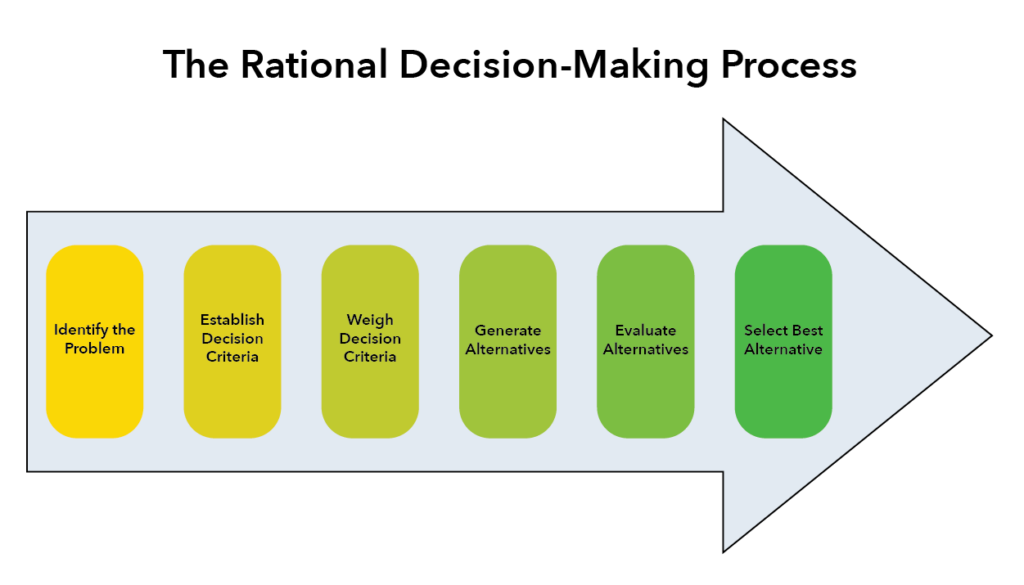
Decision-making under different conditions
- Certainty involves perfect information about outcomes in deterministic environment with only one state of nature (fixed-rate mortgage)
- Risk entails known probabilities of states of nature with multiple possible outcomes utilizing expected values and probabilistic analysis (insurance pricing)
- Uncertainty occurs when probabilities of states of nature are unknown with limited information about potential outcomes relying on decision criteria and subjective judgment (new product launch)

Criteria for decisions under uncertainty
- Maximax criterion adopts optimistic approach selecting alternative with best possible outcome ignoring potential losses (high-risk investment strategy)
- Maximin criterion employs conservative approach choosing alternative with best worst-case scenario focusing on minimizing potential losses (diversified portfolio)
- Minimax regret criterion uses regret-based approach calculating difference between best possible outcome and actual outcome selecting alternative that minimizes maximum regret (career choice)
Role of expected value
- Expected value calculated as weighted average of all possible outcomes provides single value to compare alternatives (investment returns)
- Useful for decision-making under risk forms basis for advanced decision analysis techniques (portfolio optimization)
- Limitations include not accounting for risk aversion may not suit one-time decisions or extreme outcomes (lottery ticket purchase)