1.4 Integrals and Integration Techniques

🧮Calculus and Statistics Methods Unit 1 Review
1.4 Integrals and Integration Techniques
🧮 Calculus and Statistics Methods
Integrals and integration techniques are essential tools in calculus for finding areas, volumes, and solving complex problems. They're the opposite of derivatives, allowing us to work backwards from rates of change to total quantities.
This section covers indefinite and definite integrals, the Fundamental Theorem of Calculus, and various integration methods. We'll learn how to evaluate integrals, use substitution and integration by parts, and handle improper integrals with infinite limits or discontinuities.
Indefinite vs Definite Integrals
Indefinite Integrals and Antiderivatives
- An indefinite integral is an antiderivative of a function, representing a family of functions that differ by a constant
- The indefinite integral of a function is denoted as
- Example: The indefinite integral of is , where is an arbitrary constant
- Antiderivatives are the opposite operation of differentiation, meaning that the derivative of an antiderivative of a function is the original function
Definite Integrals and Area
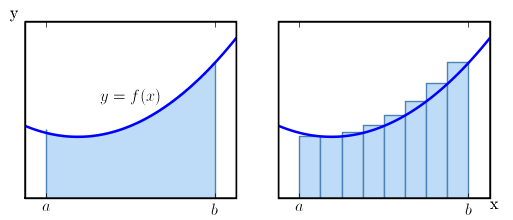
- A definite integral is a specific value that represents the signed area between a function and the x-axis over a given interval
- The definite integral of a function from to is denoted as
- The value of a definite integral is calculated by evaluating the antiderivative at the upper and lower limits and subtracting the lower limit value from the upper limit value
- Example: The definite integral of from 0 to 1 is
- Definite integrals can be used to find the area between a curve and the x-axis, the area between two curves, and the volume of solids of revolution
Fundamental Theorem of Calculus
Connecting Differentiation and Integration
- The fundamental theorem of calculus connects the concepts of differentiation and integration, stating that integration and differentiation are inverse operations
- If is an antiderivative of , then
- Conversely, if is a continuous function on an interval , then , where is any antiderivative of
Evaluating Definite Integrals
- The first part of the fundamental theorem of calculus states that if is an antiderivative of on an interval , then
- To evaluate a definite integral using the fundamental theorem of calculus:
- Find an antiderivative of the integrand
- Evaluate at the upper and lower limits
- Subtract the lower limit value from the upper limit value
- Example: To evaluate , find the antiderivative , then calculate

Relationship between Definite and Indefinite Integrals
- The second part of the fundamental theorem of calculus states that if is continuous on , then for all in
- This part of the theorem establishes the relationship between definite and indefinite integrals
- It allows for the calculation of definite integrals by first finding an indefinite integral (antiderivative) and then evaluating it at the given limits
- Example: To find , first find the antiderivative , then differentiate to get
Integration Techniques
Substitution Method (u-substitution)
- The substitution method (or u-substitution) is used to simplify the integrand by introducing a new variable, making the integration process more manageable
- The substitution is made, and is derived
- After substituting, the integral is evaluated with respect to , and then the result is converted back to the original variable
- Example: To integrate , let , then , and the integral becomes
Integration by Parts
- Integration by parts is a technique used when the integrand is a product of two functions, one of which is easier to integrate than the other
- The formula for integration by parts is
- The key is to choose and in a way that makes the resulting integral easier to evaluate than the original integral
- Example: To integrate , let and , then and . The integral becomes
Trigonometric Substitution
- Trigonometric substitution is a technique used when the integrand contains expressions such as , , or
- Substitutions involving trigonometric functions are made to simplify the integrand
- Common substitutions include:
- For , use and
- For , use and
- For , use and
- Example: To integrate , use the substitution and , then the integral becomes
Partial Fraction Decomposition
- Partial fraction decomposition is a technique used to integrate rational functions by decomposing the function into a sum of simpler rational functions with irreducible denominators
- The decomposition is performed by finding the coefficients of the partial fractions using a system of linear equations or by comparing coefficients
- The resulting simpler fractions can be integrated using basic integration rules or other techniques
- Example: To integrate , decompose the integrand into , where and are constants. By comparing coefficients or using a system of linear equations, find and . The integral becomes
Improper Integrals and Convergence
Improper Integrals with Infinite Limits
- An improper integral is an integral that involves an infinite limit of integration or an integrand that is undefined at one or more points within the interval of integration
- Improper integrals with infinite limits of integration can be of two types:
- (infinite upper limit)
- (infinite lower limit)
- These integrals are evaluated as limits of definite integrals
- Example: To evaluate , calculate the limit
Improper Integrals with Discontinuous Integrands
- Improper integrals with discontinuous integrands have an integrand that is undefined at one or more points within the interval of integration
- These integrals are evaluated by splitting the interval at the point(s) of discontinuity and evaluating the resulting integrals as limits
- Example: To evaluate , split the integral at the discontinuity and evaluate , which does not exist
Convergence and Divergence
- An improper integral is said to converge if the limit exists and is finite
- If the limit does not exist or is infinite, the improper integral is said to diverge
- The comparison test can be used to determine the convergence or divergence of improper integrals by comparing the integrand with a known convergent or divergent function
- Example: To determine the convergence of , compare it with the known convergent integral . If , then for large , and the integral converges by the comparison test. If , the integral diverges.
See Fiveable more often in Google
Mark Fiveable as a preferred source and Google is more likely to show you our guides in Top Stories, with a "preferred" badge in AI Mode and AI Overviews.