
X-ray diffraction techniques rely on specialized equipment to generate, manipulate, and detect X-rays. This section covers the key components: X-ray sources, optics, and detectors. Understanding these tools is crucial for conducting successful diffraction experiments.
From X-ray tubes to synchrotrons, we'll explore how X-rays are produced and shaped for crystallography. We'll also dive into detector technologies and goniometer setups, which are essential for capturing and analyzing diffraction patterns.
X-ray Sources
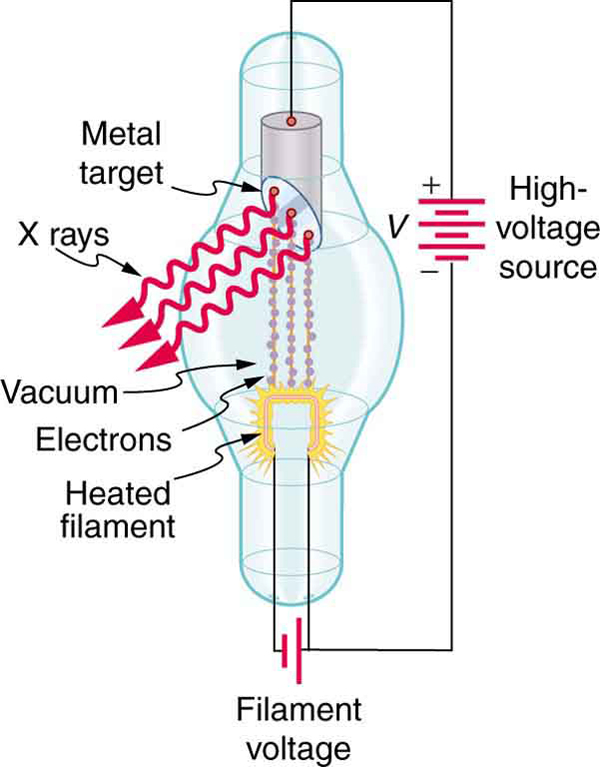
X-ray Tube Components and Function
- X-ray tube generates X-rays through electron bombardment of a metal target
- Cathode consists of a heated filament emitting electrons
- Anode serves as the metal target, typically made of copper or molybdenum
- High voltage (30-60 kV) accelerates electrons from cathode to anode
- Electron impact on anode produces two types of X-rays:
- Characteristic X-rays from electron transitions in target atoms
- Bremsstrahlung (continuous) X-rays from electron deceleration
- Cooling system prevents anode overheating, usually water or oil-based
- Beryllium window allows X-rays to exit the tube while maintaining vacuum
Synchrotron Radiation Properties and Generation
- Synchrotron radiation produces extremely intense and tunable X-rays
- Electrons accelerated to near-light speed in a circular path
- Magnetic fields bend electron trajectory, causing emission of X-rays
- Key advantages of synchrotron radiation:
- High brilliance, up to 10^10 times brighter than X-ray tubes
- Tunable wavelength across a wide spectrum (infrared to hard X-rays)
- Highly collimated beam with low divergence
- Pulsed time structure, enabling time-resolved experiments
- Synchrotron facilities consist of:
- Electron gun for initial electron generation
- Linear accelerator (linac) for initial acceleration
- Booster ring to further increase electron energy
- Storage ring where electrons circulate and produce X-rays
- Beamlines for directing X-rays to experimental stations

X-ray Optics
Monochromator Design and Function
- Monochromator selects a narrow range of X-ray wavelengths
- Crystal monochromators use Bragg diffraction to select specific wavelengths
- Common monochromator materials:
- Silicon (Si)
- Germanium (Ge)
- Graphite
- Double-crystal monochromators improve energy resolution and beam stability
- Multilayer monochromators offer higher flux but lower energy resolution
- Channel-cut monochromators maintain beam position during energy changes
- Monochromator performance factors:
- Energy resolution (ΔE/E)
- Flux throughput
- Harmonic rejection capability
Collimator Types and Applications
- Collimator narrows X-ray beam, reducing divergence and improving resolution
- Pinhole collimators create a small, circular beam:
- Used in small-angle X-ray scattering (SAXS)
- Diameter ranges from micrometers to millimeters
- Slit collimators produce a narrow, rectangular beam:
- Common in powder diffraction experiments
- Adjustable width and height for beam shaping
- Soller slits consist of parallel metal plates:
- Reduce axial divergence in diffractometers
- Improve peak shapes in powder diffraction patterns
- Polycapillary collimators use multiple hollow glass tubes:
- Focus divergent beams into quasi-parallel or convergent beams
- Increase X-ray flux on small samples (microfocus applications)
Detection and Measurement
Detector Technologies and Characteristics
- Detectors convert X-ray photons into measurable electrical signals
- Scintillation detectors:
- Use phosphor screen to convert X-rays to visible light
- Photomultiplier tube amplifies light signal
- Good energy resolution but limited count rate
- Gas-filled detectors (proportional counters):
- X-rays ionize gas molecules (xenon or argon)
- Applied voltage collects and amplifies charge
- High count rate capability but lower energy resolution
- Semiconductor detectors:
- Silicon or germanium crystals convert X-rays to electron-hole pairs
- Provide excellent energy resolution and moderate count rates
- Require cooling (liquid nitrogen) for optimal performance
- Hybrid Pixel Array Detectors (HPADs):
- Combine semiconductor sensor with CMOS readout electronics
- Offer high spatial resolution and fast readout speeds
- Examples include Pilatus and Eiger detectors
Goniometer and Diffractometer Components
- Goniometer precisely rotates sample and detector for angular measurements
- Key goniometer axes:
- ω (omega): sample rotation
- 2θ (two-theta): detector rotation
- χ (chi): sample tilt
- φ (phi): sample in-plane rotation
- Diffractometer integrates X-ray source, goniometer, and detector
- Bragg-Brentano geometry:
- Most common setup for powder diffraction
- Sample at center of goniometer circle
- X-ray source and detector move in coupled θ-2θ motion
- Focuses diffracted beam for high resolution
- Area detectors capture 2D diffraction patterns:
- Image plates: high sensitivity, slow readout
- CCD (Charge-Coupled Device): fast readout, limited dynamic range
- Flat panel detectors: large active area, moderate resolution
- Data collection strategies:
- Step scans: discrete angle measurements
- Continuous scans: smooth angular motion for faster acquisition
- Reciprocal space mapping: 2D or 3D scans for detailed structural analysis