2.4 Critical thinking skills in media consumption

📺Mass Media and Society Unit 2 Review
2.4 Critical thinking skills in media consumption
📺 Mass Media and Society
Critical Thinking for Media Engagement
Every day you encounter hundreds of media messages, from news articles to social media posts to ads. Critical thinking is the set of skills that lets you analyze, evaluate, and synthesize all that information instead of just absorbing it passively. Without these skills, you're far more vulnerable to misinformation, manipulation, and bias.

Top images from around the web for Analytical Approaches to Media Content
3.5 Everything’s Persuasion – Why Write? A Guide for Students in Canada View original
Is this image relevant?
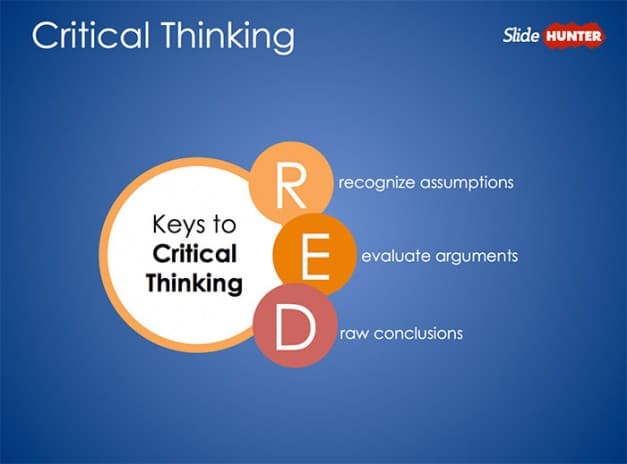
Free Pearson's Red Critical Thinking PowerPoint Diagram - Free PowerPoint Templates ... View original
Is this image relevant?
Information Sources: Bias – Introduction to College Research View original
Is this image relevant?
3.5 Everything’s Persuasion – Why Write? A Guide for Students in Canada View original
Is this image relevant?
Free Pearson's Red Critical Thinking PowerPoint Diagram - Free PowerPoint Templates ... View original
Is this image relevant?
Analytical Approaches to Media Content
One of the most practical tools for evaluating sources is the CRAAP test. Each letter stands for a question you should ask about any source:
- Currency — How recent is the information? A 2015 article about social media trends is probably outdated, but a 2015 article about the history of the printing press might still be fine.
- Relevance — Does this source actually address your specific question or topic?
- Authority — Who wrote or published this? Are they qualified? A medical claim from a peer-reviewed journal carries more weight than one from an anonymous blog.
- Accuracy — Is the content supported by evidence? Can you verify the claims elsewhere? Are there obvious errors?
- Purpose — Why does this source exist? Is it trying to inform, persuade, sell, or entertain? The purpose shapes how the information is presented.
Beyond evaluating sources, you need to spot logical fallacies in media arguments. These are errors in reasoning that make an argument seem stronger than it actually is:
- Ad hominem — Attacking the person making the argument rather than the argument itself. ("You can't trust her opinion on education policy; she didn't even finish college.")
- Straw man — Misrepresenting someone's position to make it easier to attack. A politician says "we should regulate social media for minors," and a critic responds with "they want to ban the internet."
- False dichotomy — Presenting only two options when more exist. ("You're either with us or against us.")
You also need to recognize bias in how information is selected and presented:
- Selection bias — Cherry-picking data or examples that support a particular conclusion while ignoring contradictory evidence
- Confirmation bias — Favoring information that already aligns with what you believe (this one affects you as a consumer, not just the media)
- Framing bias — Presenting the same facts in a way that steers your interpretation. Describing a glass as "half full" versus "half empty" is framing at its simplest; in media, framing can be far more subtle and consequential.
Media Literacy and Verification Techniques
When you encounter a claim that seems surprising or important, verify it before sharing or acting on it. Here's a straightforward process:
- Cross-reference the claim with multiple reputable sources. If only one outlet is reporting it, be cautious.
- Consult dedicated fact-checking sites like Snopes, FactCheck.org, or PolitiFact. These organizations specialize in tracing claims to their origins.
- Trace the claim back to its original source. Many stories are repackaged versions of a single report. Find that original report and check whether the claim is being represented accurately.
Deeper media literacy goes beyond fact-checking individual claims. It means asking structural questions about any piece of media:
- What visual and textual choices were made, and how do they shape your reaction?
- Who is the target audience, and what response is the creator hoping for?
- Who owns or funds this outlet, and could that influence the content?
Finally, practice intellectual humility. This means staying open to new information, being willing to change your views when credible evidence warrants it, and honestly acknowledging the limits of what you know. Intellectual humility isn't weakness; it's what separates critical thinkers from stubborn ones.
Facts, Opinions, and Propaganda

Distinguishing Information Types
Not all statements carry the same weight, and recognizing the difference between facts, opinions, and propaganda is fundamental to media literacy.
- Facts are verifiable. They can be proven true or false through evidence or documentation. "Earth orbits the Sun" is a fact. "The U.S. population was approximately 331 million in the 2020 Census" is a fact.
- Opinions are subjective. They express personal beliefs, judgments, or preferences that can't be definitively proven. "Chocolate ice cream is the best flavor" is an opinion. Opinions can be well-supported or poorly supported, but they remain interpretive.
- Propaganda is information deliberately shaped to promote a particular political cause or viewpoint, often using biased or misleading techniques. Wartime posters demonizing enemy nations are a classic example, but propaganda also shows up in modern political ads, state-run media, and viral social media campaigns.
To tell these apart in practice, watch for specific language cues:
- Emotional appeals — Words like "heartbreaking," "outrageous," or "shocking" are designed to trigger feelings rather than present evidence
- Loaded words — Terms like "radical," "extremist," or "freedom fighter" carry built-in judgments
- Absolute statements — Words like "always," "never," or "everyone" should raise a red flag, since very few things in the real world are truly absolute
Propaganda relies on specific manipulative techniques that are worth memorizing:
- Bandwagon effect — Implying that "everyone is doing it," pressuring you to conform
- Glittering generalities — Using vague, positive-sounding phrases ("fighting for freedom," "a brighter tomorrow") that sound appealing but say almost nothing specific
- Transfer — Associating an idea or product with a respected symbol, person, or institution to borrow their credibility (a political ad featuring the American flag and a military veteran, for instance)
Evaluating Source Credibility
Understanding the difference between primary and secondary sources helps you judge how close you are to the actual evidence:
- Primary sources provide firsthand accounts or original data. These include eyewitness testimonies, original scientific studies, court documents, and raw datasets.
- Secondary sources interpret, analyze, or summarize primary sources. Textbooks, news articles, and documentary films are secondary sources.
Neither type is automatically better, but knowing which you're looking at matters. A news article (secondary) summarizing a scientific study (primary) might oversimplify or misrepresent the findings. When possible, go to the primary source.
When analyzing any media message, consider three things about its context:
- The author's background — What expertise do they have? What biases might they bring?
- The publication's reputation — Does it have editorial standards? A track record of corrections? Or a history of sensationalism?
- The intended audience and purpose — A press release from a company has a very different purpose than an investigative report about that same company.
Questioning Media Assumptions

Developing a Critical Mindset
A critical mindset doesn't mean being cynical about everything. It means habitually asking good questions rather than passively accepting what you're told. Three habits help build this mindset:
- Ask probing questions about the information you encounter. Who benefits from this narrative? What evidence supports it? What's missing?
- Seek out diverse perspectives. If you only consume media from sources that share your worldview, you'll develop blind spots. Deliberately read or watch coverage from outlets with different editorial leanings.
- Challenge your own preconceptions. This is the hardest part. Your existing beliefs act as a filter, and it takes conscious effort to notice when you're dismissing information just because it's uncomfortable.
The Socratic method offers a useful framework for questioning media content. It involves three types of questions:
- Clarifying questions — "What exactly is being claimed here? What do these terms mean?"
- Assumption questions — "What unstated premises does this argument rely on? Are those premises actually true?"
- Implication questions — "If this claim is true, what follows? What are the consequences?"
Applying these questions to a news article or opinion piece will often reveal gaps, assumptions, or leaps in logic that aren't obvious on a first read.
Analyzing Media Framing and Agenda-Setting
Framing refers to the choices media makers use to shape how you perceive a story. The facts might be accurate, but the presentation steers your interpretation:
- Selective emphasis — Highlighting certain aspects while downplaying others. A story about a protest might focus on a few violent incidents rather than the thousands of peaceful participants, or vice versa.
- Omission — Leaving out relevant facts or perspectives entirely. What a story doesn't mention can be just as revealing as what it does.
- Language and imagery choices — Describing the same group of people as "freedom fighters" versus "insurgents" creates completely different impressions using the same underlying facts.
Agenda-setting is a related concept from media theory. It describes how media doesn't just tell you what to think but tells you what to think about. The stories that get front-page coverage or top billing in a news broadcast shape which issues the public considers important.
When you notice a story dominating the news cycle, ask yourself:
- Why is this story being prioritized over others?
- Are different outlets covering the same events differently, or covering entirely different stories?
- Could ownership, advertisers, or political affiliations be influencing editorial decisions?
Finally, pay attention to rhetorical devices that embed assumptions into media messages:
- Metaphors — Describing immigration as a "flood" or "wave" implies something uncontrollable and threatening, which is a choice, not a neutral description
- Analogies — Drawing parallels between different situations can illuminate, but they can also mislead if the situations aren't truly comparable
- Euphemisms — Softening language to reduce the impact of uncomfortable realities. "Collateral damage" instead of "civilian deaths," or "downsizing" instead of "layoffs"
Evidence-Based Media Arguments
Building Strong Arguments
Critical thinking isn't just about consuming media. It's also about constructing your own well-supported arguments. Strong arguments have three components (drawn from the Toulmin model of argumentation):
- Claims — The main point you're arguing
- Warrants — The reasoning and evidence that support your claim
- Rebuttals — Your acknowledgment of and response to potential counterarguments
When building an argument from media sources, evaluate those sources carefully:
- Does the author have relevant expertise and credentials?
- For research studies, is the methodology sound? Is the sample size adequate?
- Has the work been peer-reviewed or gone through an editorial process?
Synthesizing information from multiple, diverse sources strengthens your argument significantly. Compare viewpoints from different outlets, integrate both qualitative evidence (interviews, case studies) and quantitative data (statistics, surveys), and don't ignore alternative or independent media that might offer perspectives missing from mainstream coverage.
Critical Analysis and Ethical Considerations
When evaluating evidence presented in media, dig into the details:
- Sample sizes and methodology — A study of 15 people doesn't carry the same weight as one with 15,000. Was the study randomized? Was there a control group?
- Conflicts of interest — Who funded the research? A study on the health effects of sugar funded by a beverage company deserves extra scrutiny.
- Context and limitations — Data can be technically accurate but misleading without context. A statistic about crime rates means little without knowing the time period, geographic scope, and how "crime" was defined.
When you use media evidence in your own work, proper citation and attribution matter both ethically and practically:
- Use the citation style required for your course (APA, MLA, Chicago)
- Link to online sources when possible so others can verify your claims
- Clearly distinguish between direct quotes and paraphrasing
Most importantly, apply the same critical lens to your own arguments that you apply to others'. Reflect on how your personal experiences shape your perspective, acknowledge the limits of your knowledge, and actively seek feedback from people who might see your blind spots. The goal of critical thinking isn't to win arguments; it's to get closer to the truth.
See Fiveable more often in Google
Mark Fiveable as a preferred source and Google is more likely to show you our guides in Top Stories, with a "preferred" badge in AI Mode and AI Overviews.