
Principles of Quantum Computing
Leveraging Quantum Mechanics for Computation
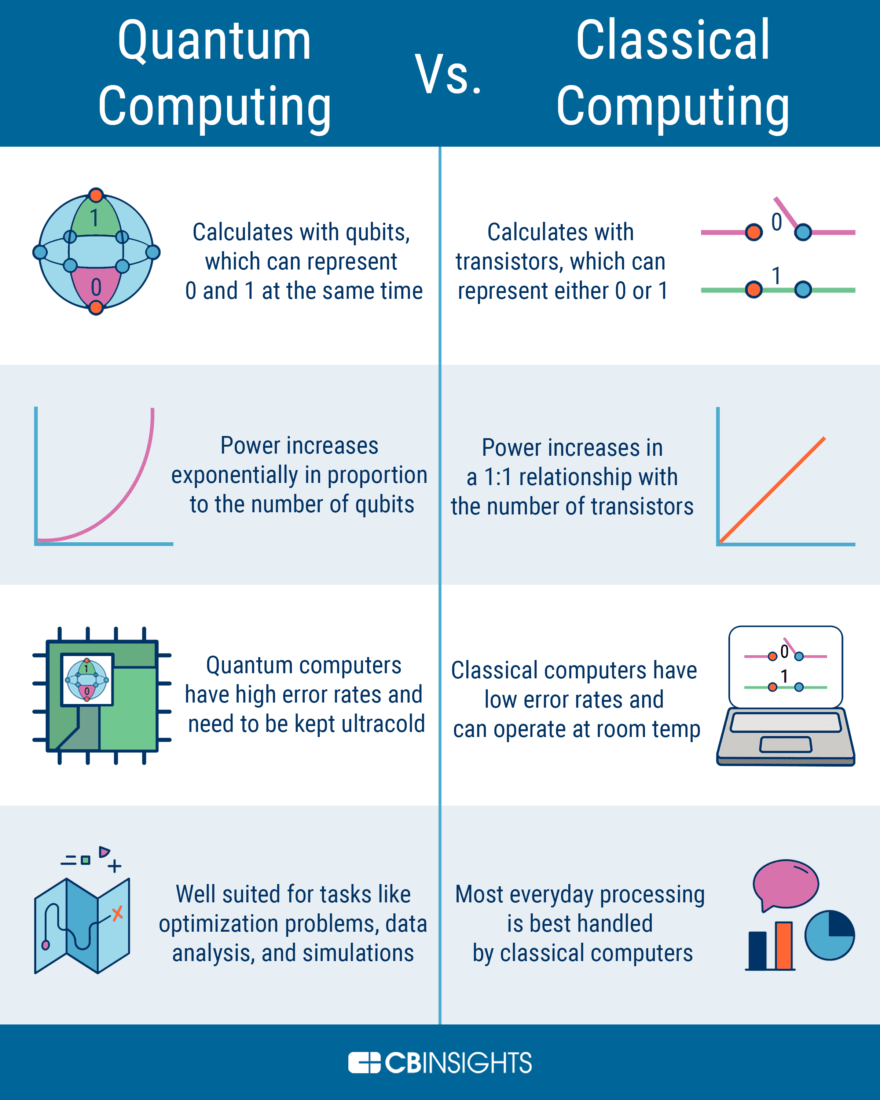
Classical computers store information as bits, where each bit is either a 0 or a 1. Quantum computers replace bits with qubits (quantum bits), which follow the rules of quantum mechanics rather than classical physics. This difference gives quantum computers a fundamentally different way of processing information.
The two key quantum properties that make this possible are superposition and entanglement:
- Superposition allows a qubit to exist in a combination of the 0 and 1 states at the same time, rather than being locked into one or the other. A system of qubits can represent states simultaneously, which is what enables quantum parallelism.
- Quantum entanglement is a phenomenon where two or more qubits become correlated so that the state of one qubit depends on the state of the other(s), even when they're physically separated. This correlation is a resource that quantum algorithms rely on to coordinate computations across qubits.
Together, these properties allow quantum computers to explore many possible solutions at once, making them dramatically faster than classical computers for certain types of problems.
Quantum Gates and Algorithms
Just as classical computers use logic gates (AND, OR, NOT) to manipulate bits, quantum computers use quantum gates to manipulate qubits. Quantum gates are the building blocks of quantum circuits, and each gate performs a specific operation on one or more qubits.
Common quantum gates include:
- Hadamard gate (H): Places a qubit into an equal superposition of and . This is often the first step in a quantum algorithm.
- CNOT gate (Controlled-NOT): A two-qubit gate that flips the second qubit only if the first qubit is . It's essential for creating entanglement.
- Phase gates: Modify the phase of a qubit's state without changing its measurement probabilities. Phase manipulation is central to how quantum algorithms extract useful answers.
Two landmark quantum algorithms show why quantum computing matters:
- Shor's algorithm can factor large numbers exponentially faster than any known classical algorithm. This is significant because RSA encryption, widely used for secure internet communication, relies on the difficulty of factoring large numbers. A sufficiently powerful quantum computer running Shor's algorithm could break RSA.
- Grover's algorithm searches an unstructured database of items in roughly steps, compared to steps classically. That's a quadratic speedup, which matters a lot as databases grow large.
Qubits, Superposition, and Entanglement
Qubits and Superposition
A qubit is the fundamental unit of quantum information. Physically, it's a two-state quantum system, and its two basis states are written as and (using Dirac notation).
Unlike a classical bit, a qubit can exist in a superposition of both states at once. Mathematically, a qubit's state is described as:
Here, and are complex numbers called probability amplitudes. They must satisfy the constraint , because gives the probability of measuring and gives the probability of measuring .
There's a catch: measurement collapses the superposition. When you measure a qubit, it snaps to either or , and the superposition is destroyed. This means quantum algorithms have to be carefully designed so that the correct answer has a high probability of being measured at the end.
Quantum Entanglement
Entanglement occurs when two or more qubits become correlated in a way that has no classical equivalent. Once entangled, you can't fully describe the state of one qubit without referencing the other.
The Bell states are the simplest and most important examples of entanglement. They are four maximally entangled two-qubit states:
- : If you measure the first qubit and get , the second qubit is guaranteed to also be , and vice versa.
- : Here the qubits are always measured in opposite states.
These correlations hold regardless of the distance between the qubits. Bell states form the basis for quantum communication protocols, quantum teleportation, and quantum error correction schemes.
Entanglement is not just a curiosity; it's a critical resource. Without entanglement, quantum computers would lose much of their advantage over classical machines, since many quantum algorithms depend on entangled qubits to coordinate and amplify correct answers.
Quantum Computing Architectures
Gate-Based Quantum Computers
Gate-based (circuit model) quantum computers are the most widely studied architecture. They work by applying a sequence of quantum gates to qubits, building up a quantum circuit step by step.
- The circuit model uses a universal set of gates (typically Hadamard, CNOT, and phase gates) to construct any quantum computation. This is analogous to how any classical computation can be built from NAND gates.
- Topological quantum computers are a more exotic variant. They encode information in braiding patterns of quasi-particles called anyons, which have fractional statistics. The advantage is that topological encoding is inherently resistant to local errors, making fault-tolerant computation easier in principle. Microsoft's research efforts have focused on this approach, though building a working topological qubit remains an open challenge.
Most current quantum computers from IBM, Google, and others use the gate-based circuit model.
Adiabatic Quantum Computers
Adiabatic quantum computing takes a different approach. Instead of applying a sequence of gates, it encodes a problem into a mathematical object called a Hamiltonian (which describes the energy of the system) and then slowly evolves the system from an easy-to-prepare initial state toward the ground state (lowest energy state) of the problem Hamiltonian.
The key idea: if the evolution is slow enough, quantum mechanics guarantees the system stays in the ground state throughout the process. When it arrives at the problem Hamiltonian, the ground state encodes the solution.
- D-Wave Systems builds commercial adiabatic quantum computers (more precisely, quantum annealers, which are a related but not identical approach). These have been applied to optimization problems in finance, logistics, and machine learning.
- Adiabatic quantum computing is theoretically equivalent in power to gate-based quantum computing, but in practice the two architectures have different strengths.
Quantum Processor and Memory
Quantum processors contain the physical qubits along with the control and readout electronics needed to run quantum circuits. Several competing qubit technologies exist:
- Superconducting qubits: Tiny circuits cooled to near absolute zero (around 15 millikelvin). Used by IBM and Google. Currently the most mature technology.
- Trapped ions: Individual ions held in place by electromagnetic fields and manipulated with lasers. Used by IonQ and Quantinuum. Known for high gate fidelity.
- Photonic qubits: Use individual photons as qubits. Naturally resistant to decoherence but harder to make interact with each other. Pursued by companies like Xanadu and PsiQuantum.
Quantum memory stores and retrieves quantum states, which is essential for error correction and for algorithms that need to hold intermediate results. Quantum memories can be built from atomic ensembles, nitrogen-vacancy centers in diamond, or superconducting resonators. Reliable, long-lived quantum memory remains an active area of research.
Applications and Challenges of Quantum Computing
Potential Applications
Quantum computing won't replace classical computers for everyday tasks. Its advantage shows up in specific problem types where quantum algorithms offer a clear speedup:
- Cryptography: Shor's algorithm threatens RSA and other public-key cryptography schemes. This has already spurred the development of post-quantum cryptography, which refers to classical encryption methods designed to be secure even against quantum attacks. NIST finalized its first post-quantum cryptography standards in 2024.
- Drug discovery and materials science: Simulating molecular behavior is exponentially hard for classical computers as molecules get larger. Quantum computers could model complex molecular interactions directly, potentially accelerating the design of new drugs and materials.
- Optimization: Many real-world problems (supply chain routing, portfolio optimization, scheduling) involve searching through enormous solution spaces. Quantum algorithms may find good solutions faster than classical methods for certain classes of these problems.
- Machine learning: Quantum machine learning algorithms could offer speedups for tasks like classification, clustering, and dimensionality reduction, though this area is still largely theoretical.
Challenges in Quantum Computing
Building practical, large-scale quantum computers faces several major obstacles:
- Decoherence: Qubits are extremely fragile. Unwanted interactions with the environment cause qubits to lose their quantum properties, a process called decoherence. Current qubit coherence times are measured in microseconds to milliseconds, which limits how many operations you can perform before errors accumulate.
- Scalability: Today's largest quantum processors have on the order of 1,000+ qubits (IBM's Condor processor reached 1,121 superconducting qubits in 2023), but many practical applications would require millions of high-quality qubits. Scaling up while maintaining low error rates is a massive engineering challenge.
- Quantum error correction: Because qubits are error-prone, quantum error correction is necessary for reliable computation. The problem is overhead: current error correction schemes require roughly 1,000 physical qubits to create a single reliable "logical" qubit. This multiplies the hardware requirements dramatically.
- Algorithm development: Relatively few quantum algorithms with proven speedups are known. Mapping real-world problems onto quantum hardware in a way that actually delivers an advantage over classical computers is an ongoing research challenge that requires collaboration across physics, computer science, and engineering.