
Red-Black trees are self-balancing binary search trees that use node coloring to maintain balance. They offer efficient searching, insertion, and deletion operations with a time complexity of O(log n), making them a crucial topic in the study of balanced trees.
These trees strike a balance between the strict AVL tree structure and the more relaxed B-tree balance. By using color-based rules and rotations, Red-Black trees maintain their efficiency while allowing for more flexibility in tree structure compared to other balanced tree types.
Red-Black Tree Properties
Structural Characteristics
- Self-balancing binary search trees with nodes colored red or black
- Root node always black, leaf nodes (NIL nodes) considered black
- Red nodes have two black child nodes
- Path from node to descendant leaves contains same number of black nodes (black-height property)
- Height with n nodes always , ensuring efficient operations
- Longest root-to-leaf path no more than twice as long as shortest path, maintaining rough balance
- Efficient searching, insertion, and deletion operations, all with time complexity
- Type of 2-3-4 tree, red nodes represent "glued" nodes in corresponding 2-3-4 tree structure
Balancing Mechanism
- Node coloring enforces structural constraints without requiring perfect balance
- Alternating red and black nodes distributes tree weight evenly, preventing long paths
- Black nodes contribute to black-height property, promoting balance
- Red nodes allow local imbalances while maintaining overall tree balance
- Coloring rules prevent consecutive red nodes, limiting maximum path length
- Interplay between red and black nodes achieves balance between strict AVL tree balance and relaxed B-tree balance
Node Coloring for Balance

Color Distribution
- Alternating pattern of red and black nodes helps distribute tree weight evenly
- Prevents formation of long paths, ensuring logarithmic height
- Black nodes contribute to black-height property
- All paths from root to leaves have same number of black nodes
- Promotes overall balance in tree structure
- Red nodes allow for local imbalances
- Provides flexibility in tree structure
- Maintains overall tree balance
Coloring Rules and Balance
- Prevent consecutive red nodes
- Indirectly limits maximum path length
- Helps maintain tree's logarithmic height property
- During insertion and deletion operations, node coloring identifies and resolves property violations
- Uses color changes and rotations to restore balance
- Balances between strict AVL tree balance and more relaxed B-tree balance
- Achieves good performance for various operations (searching, insertion, deletion)
Red-Black Tree Operations
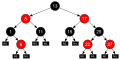
Insertion Process
- Begins with standard binary search tree insertion
- Colors new node red
- Applies fix-up procedures to maintain Red-Black properties
- Fix-up procedure involves cases based on color and position of newly inserted node's uncle
- May require color changes and rotations
- Rotations include left rotations and right rotations
- Rebalance tree structure
- Preserve binary search tree property
- Maintains worst-case time complexity of
Deletion Procedure
- More complex than insertion
- Involves cases based on color and position of node to be deleted and its replacement
- May require fix-up procedure to restore Red-Black properties
- Can involve color changes and rotations similar to insertion fix-up
- Special attention given to maintaining black-height property
- Ensures tree remains balanced after deletion
- Also maintains worst-case time complexity of
Red-Black Trees vs Other Structures
Performance Comparison
- Offer good balance between performance and implementation complexity
- AVL trees maintain stricter balance than Red-Black trees
- Potentially faster lookups
- Slower insertions and deletions due to more frequent rotations
- Red-Black trees perform better with frequent insertions and deletions
- Require fewer rotations to maintain balance
- B-trees and variants (2-3 trees, 2-3-4 trees) suited for disk-based storage systems
- Minimize disk accesses
- Red-Black trees typically used for in-memory data structures
Practical Applications
- Widely used in implementing associative arrays
- Underlying data structure for TreeSet and TreeMap in Java's Collections framework
- Often outperform theoretically superior data structures
- Simpler implementation
- Good average-case performance
- Preferred for general-purpose applications requiring balance of search, insertion, and deletion performance
- Choice depends on specific use case
- Consider factors like frequency of operations, memory constraints, and implementation complexity