8.3 Skene and scenic elements

🎭Greek Tragedy Unit 8 Review
8.3 Skene and scenic elements
🎭 Greek Tragedy
Origins of the Skene
The skene (literally "tent" or "hut") began as a simple temporary structure and grew into the most important architectural element of the Greek theater. Its development tracks directly with the increasing ambition of Greek playwrights and the growing complexity of tragic performance.

Top images from around the web for Early Greek theater architecture
Theater der griechischen Antike – Wikipedia View original
Is this image relevant?
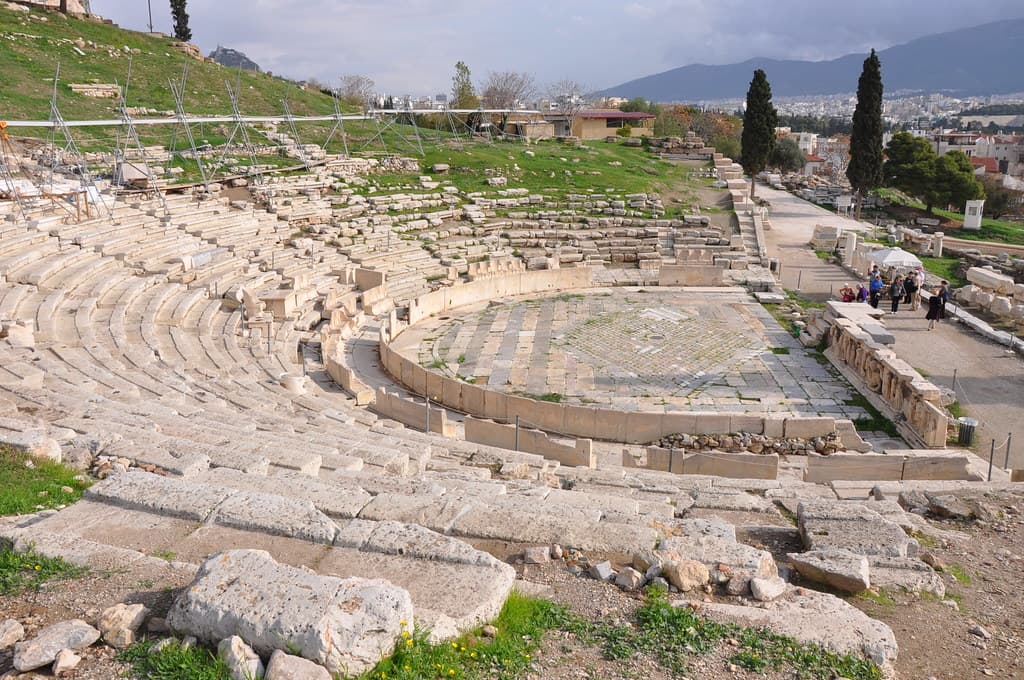
Theatre of Dionysus | The Theatre of Dionysus was a major op… | Flickr View original
Is this image relevant?
File:Ancient greek theater (en).svg - Wikimedia Commons View original
Is this image relevant?
Theater der griechischen Antike – Wikipedia View original
Is this image relevant?
Theatre of Dionysus | The Theatre of Dionysus was a major op… | Flickr View original
Is this image relevant?
Early Greek Theater Architecture
Greek theater architecture took shape during the 5th century BCE, centered on the City Dionysia festival in Athens. The earliest performance spaces were minimal: a circular dancing area called the orchestra with a hillside carved out for audience seating (the theatron). There were no permanent structures behind the performance area. Actors and the chorus shared the orchestra, and there was no dedicated backstage space for costume changes or storage.
Evolution from Temporary Structures
The skene likely started as a literal tent or wooden hut set up behind the orchestra, where actors could change masks and costumes out of the audience's sight. Over time, these makeshift structures became more standardized:
- Temporary wooden huts gave way to semi-permanent wooden buildings
- The structure gradually became part of the theater's design rather than an afterthought
- As playwrights demanded more visual storytelling, the skene gained painted scenery and multiple levels
- By the late 5th century BCE, it functioned as both a practical backstage area and a scenic backdrop
Structure of the Skene
Basic Layout and Design
The skene was a rectangular building positioned behind the orchestra, facing the audience. Its key architectural features included:
- Height: Typically one or two stories, with a flat roof that doubled as an acting area
- Doors: One to three doors in the front wall, used for entrances and exits
- Proskenion: A raised platform or colonnade extending in front of the main structure, which became increasingly important as a performance space
- Paraskenia: Projecting wings on either side of the main building, framing the performance area
Together, these elements created a versatile architectural frame that playwrights could adapt to represent different dramatic settings.
Materials and Construction Techniques
Early skene buildings were built entirely of wood, using post-and-lintel construction. Later theaters, particularly from the Hellenistic period onward, incorporated stone for greater permanence. Construction details included:
- Wooden beams and planks for flooring and roofing
- Decorative columns and friezes to suggest grand architecture
- Plaster and paint applied to surfaces to create scenic effects
- Stone foundations that survive at sites like the Theater of Dionysus in Athens
Functions of the Skene
The skene served three overlapping purposes: it was a visual backdrop, a practical backstage area, and a system for managing entrances and exits.
Backdrop for Performances
The skene's front wall provided the visual context for nearly every scene in a tragedy. Through painted panels and architectural detailing, it could represent a palace, a temple, a cave, or a city gate. The building's height and width created a sense of depth and scale, and its multiple levels allowed action to take place at different heights, reinforcing visual storytelling.
Storage and Dressing Area
Behind the facade, the skene housed costumes, masks, props, and stage machinery. Actors used this hidden space to change between roles (since Greek tragedy limited the number of speaking actors to two or three, each actor typically played multiple characters). Quick costume and mask changes were essential, and the skene made them possible without breaking the flow of performance.
Entrances and Exits
The skene's doors were not just practical openings; they carried dramatic meaning. A character emerging from the central door was typically exiting a palace or important building. Side doors could represent different locations or lesser entrances. Playwrights used these doors strategically for surprise reveals, dramatic confrontations, and the separation of interior and exterior worlds.
Scenic Elements
Beyond the skene itself, Greek theater employed several scenic devices that worked with the building to create visual variety and spectacle.
Pinakes and Painted Scenery
Pinakes were painted wooden panels attached to the skene's facade. They depicted landscapes, architectural features, or other settings and could be swapped between plays or even between scenes. Ancient sources credit Sophocles with introducing scene painting (skenographia), and later artists reportedly used perspective techniques to create an illusion of depth. These panels were the closest thing Greek theater had to modern set design.
.svg.png)
Periaktoi for Scene Changes
Periaktoi were triangular prisms, each face painted with a different scene. Mounted on a central axis at the sides of the skene, they could be rotated to show a new face, signaling a change in location. This was one of the few mechanisms available for quick, visible scene transitions and gave playwrights more flexibility in shifting settings within a single play.
Mechane for Aerial Effects
The mechane was a crane-like device mounted on or behind the skene's roof. It used a wooden beam, pulleys, and counterweights to lift actors into the air, creating the illusion of flight or divine descent. This is the origin of the phrase deus ex machina ("god from the machine"), since the device was most famously used to lower a god onto the stage to resolve a plot. Euripides used the mechane frequently, and Aristophanes mocked him for it.
Symbolism in Skene Design
Representation of Palaces
In tragedy, the skene almost always represented a palace, temple, or other seat of authority. This was not just a practical default; it carried symbolic weight. The grand facade with its columns and pediments visually reinforced the themes of power, fate, and the relationship between mortals and gods. The contrast between the public space of the orchestra (where the chorus gathered) and the hidden interior behind the skene doors mirrored the tension between public and private life that drives so many tragic plots.
Doors and Their Significance
The central door, called the thyromata, represented the main entrance to the palace or building depicted by the skene. Side doors typically led to secondary locations. The act of opening or closing these doors often marked turning points in the plot. Think of Clytemnestra emerging through the central door in Aeschylus's Agamemnon, or the doors opening to reveal a tableau of bodies on the ekkyklema (a wheeled platform rolled out through the doorway). The door was a threshold between the seen and unseen, the known and unknown.
Skene in Different Play Types
Tragedy vs. Comedy Usage
Tragedy and comedy made different demands on the skene:
- Tragedy typically used the skene to represent grand, imposing structures like palaces and temples. The building's symbolic weight reinforced themes of power and fate. Dramatic reveals through the doors and divine appearances from the roof were common.
- Comedy (especially Aristophanes) used the skene more flexibly, depicting ordinary houses, streets, or even fantastical locations. The doors served farcical chase scenes and physical gags rather than solemn entrances.
Variations Across Playwrights
Each major playwright used the skene differently, reflecting both the building's physical evolution and their own dramatic priorities:
- Aeschylus (earliest of the three great tragedians) made relatively limited use of the skene, keeping the focus on the chorus in the orchestra. His Oresteia (458 BCE) is among the earliest plays to use the skene as a palace facade.
- Sophocles integrated the skene more fully into the dramatic action. He's credited with introducing scene painting and used the building's doors and levels as active elements of staging.
- Euripides pushed the skene's possibilities furthest, relying on the mechane for divine appearances and using the building for complex staging effects.
- Aristophanes (a comic playwright) exploited the skene for rapid scene changes and visual comedy, sometimes representing multiple locations in a single play.
Acoustic Properties
Sound Projection Techniques
The skene contributed to the remarkable acoustics of Greek theaters, though the theater's overall shape did most of the work. The concave seating arrangement naturally focused sound toward the audience, and the skene's hard, flat surface behind the performers acted as a sound reflector, bouncing actors' voices outward. Actors positioned close to the skene benefited from this reflective effect. Some ancient sources mention echeia (acoustic vessels) placed in theaters to enhance resonance, though archaeological evidence for these remains debated.
Mask Amplification
Actors' masks featured open mouths that may have helped project the voice, though the degree of actual amplification is disputed among scholars. What's more certain is that the combination of the mask's resonant cavity, the skene's reflective wall, and the theater's curved seating design allowed performances to reach audiences of 14,000 or more (as at Epidaurus) without any modern amplification technology.

Skene and Actor Interaction
Blocking and Stage Positioning
The skene shaped how actors moved and where they stood. Most acting took place on the proskenion in front of the skene, while the chorus occupied the orchestra below. This physical separation created a visual and dramatic dynamic between individual characters and the collective voice of the chorus. Entrances and exits through the skene doors dictated the rhythm of scenes, and actors used the full width of the facade for confrontations and dialogues.
Levels and Elevated Platforms
The skene's vertical dimension added a powerful visual tool:
- The theologeion (the roof) was reserved for appearances by gods or characters who needed to be visually elevated above mortals
- The episkenion (an upper level or balcony) provided additional acting space above the main doors
- Steps or ramps connected levels, allowing dynamic vertical movement
- Characters appearing at different heights created an immediate visual hierarchy, reinforcing power dynamics and the distinction between human and divine
Evolution of the Skene
Hellenistic Period Developments
After the great age of Athenian tragedy (5th century BCE), theater architecture continued to develop during the Hellenistic period (roughly 323–31 BCE):
- Stone construction replaced wood, creating more permanent and elaborate structures
- The proskenion expanded into a true raised stage, shifting the primary acting area upward
- Architectural ornamentation increased, with more columns, decorative friezes, and sculptural elements
- Stage machinery became more sophisticated
- Multiple stories and levels became standard
Roman Adaptations
Roman theaters transformed the Greek skene into the scaenae frons, a monumental, permanent architectural backdrop:
- The facade became highly decorated with columns, niches, and statuary, sometimes rising three or more stories
- The orchestra shrank as the raised stage expanded
- The entire theater became a unified architectural structure (unlike Greek theaters, which used natural hillsides for seating)
- The emphasis shifted from the symbolic flexibility of the Greek skene to the sheer visual grandeur of the Roman facade
Archaeological Evidence
Surviving Skene Structures
Several ancient theaters preserve evidence of skene construction:
- Theater of Dionysus, Athens: Stone foundations and remnants of the skene that was rebuilt multiple times
- Theater of Epidaurus: A well-preserved proskenion and orchestra layout, widely considered the best-surviving example of classical Greek theater design
- Theater of Delphi: Evidence of a two-story skene structure
- Theater of Pergamon: Remains of a Hellenistic-era skene with multiple levels
- Roman theaters at Aspendos and Orange: Nearly intact examples of the fully developed scaenae frons
Reconstruction Challenges
Reconstructing the original appearance and function of the skene is difficult for several reasons:
- Wooden structures from the 5th century BCE have not survived
- Painted scenery and decorations left almost no physical trace
- The exact mechanisms of stage machinery (mechane, ekkyklema) are known mainly from literary references, not physical remains
- Theater designs varied across regions and periods, so no single reconstruction applies universally
- Many sites have been rebuilt, modified, or damaged over centuries, making it hard to isolate any one historical phase
Impact on Dramaturgy
Influence on Playwriting
The skene didn't just house performances; it shaped how plays were written. Because the interior of the skene was hidden from view, violence and death almost always occurred offstage, reported to the audience by messengers who entered through the doors. This convention became a defining feature of Greek tragedy. The skene also enabled playwrights to create scenes that moved between interior and exterior spaces, to stage dramatic reveals (using the ekkyklema to display the aftermath of offstage events), and to build plots around multiple locations.
The three-actor rule (a convention limiting speaking roles to three actors at a time) was both a practical constraint and a creative catalyst, encouraging playwrights to write scenes that could be staged with the skene's doors and levels.
Staging Limitations and Innovations
Every limitation of the skene inspired a workaround:
- The inability to show violence onstage led to the powerful convention of messenger speeches
- The limited number of actors drove the use of masks and quick costume changes behind the skene
- The need to show interior scenes led to the invention of the ekkyklema (a wheeled platform rolled out through the central door)
- The desire for divine appearances from above led to the mechane
- The chorus, positioned in the orchestra below the skene, served as a bridge between the audience and the actors, commenting on and reacting to the action
These innovations weren't just technical solutions. They became defining features of Greek tragic form, shaping the art in ways that persisted long after the original architectural constraints disappeared.
See Fiveable more often in Google
Mark Fiveable as a preferred source and Google is more likely to show you our guides in Top Stories, with a "preferred" badge in AI Mode and AI Overviews.