7.2 Fate and free will

🎭Greek Tragedy Unit 7 Review
7.2 Fate and free will
🎭 Greek Tragedy
Concept of fate
In Greek tragedy, fate isn't just a plot device. It's the foundational worldview that shapes every character's struggle. The Greeks believed certain outcomes were fixed before a person was born, and no amount of cleverness or virtue could change them. This belief creates the central dramatic engine of tragedy: watching characters fight against something they cannot escape.

Top images from around the web for Moirai in Greek mythology
Moirai - Wikipedia View original
Is this image relevant?
Mojre - Wikipedija, prosta enciklopedija View original
Is this image relevant?
Moirai - Wikipedia View original
Is this image relevant?
Moirai - Wikipedia View original
Is this image relevant?
Mojre - Wikipedija, prosta enciklopedija View original
Is this image relevant?
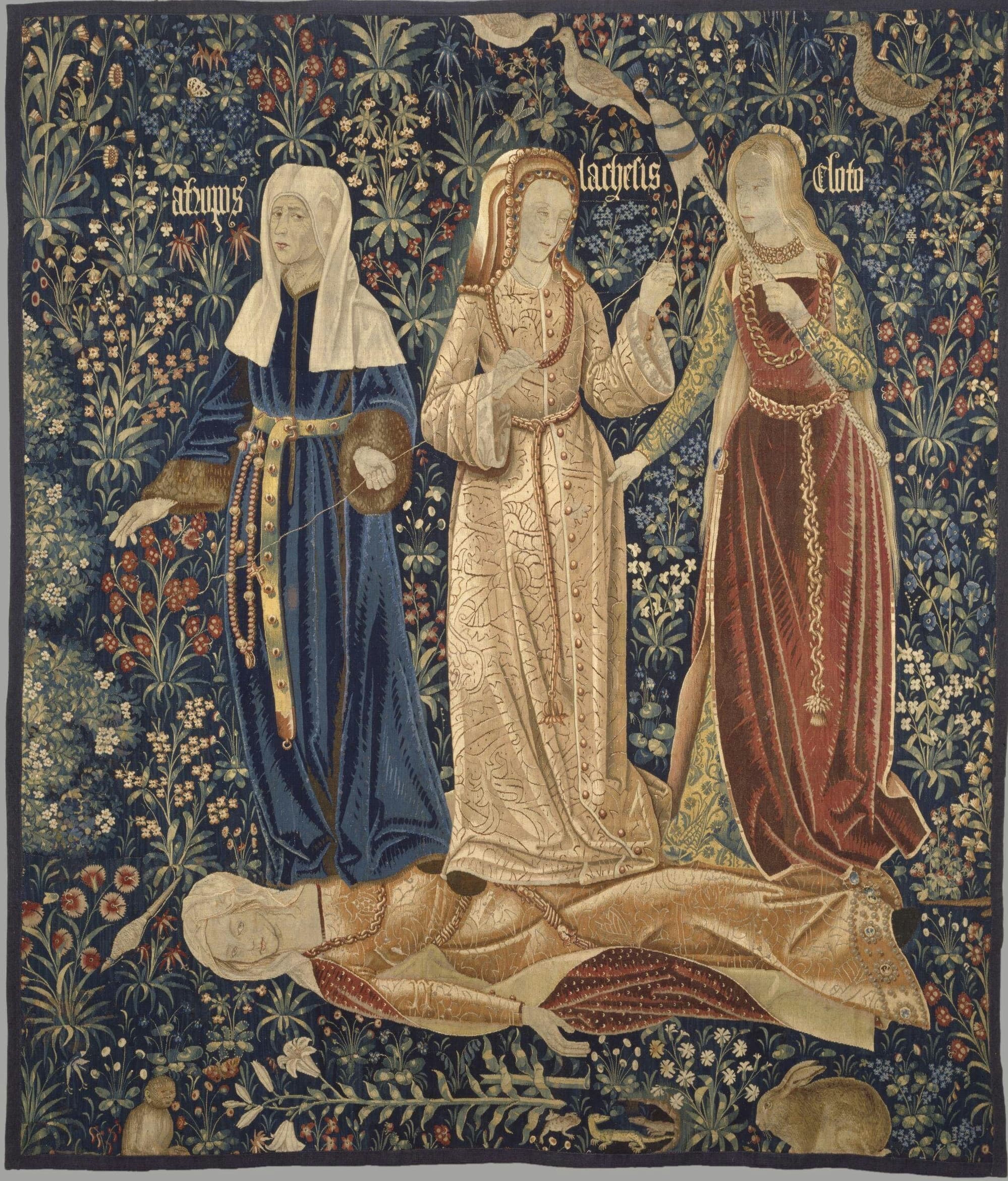
Moirai in Greek mythology
The Moirai (the Fates) are three sister goddesses who control human destiny:
- Clotho spins the thread of life
- Lachesis measures its length
- Atropos cuts it, determining the moment of death
What makes the Moirai significant is that they operate independently of the Olympian gods. Even Zeus cannot override their decisions. This means fate in Greek thought isn't the whim of a powerful deity; it's an impersonal cosmic order that binds mortals and immortals alike.
Predestination vs. personal choice
Greek tragedy sits right at the fault line between two ideas: your life is already determined, and your choices matter. Playwrights never fully resolve this contradiction. Instead, they use it to generate dramatic tension.
- Characters struggle against their fated paths, but their struggles often accelerate the very outcomes they're trying to prevent
- The concept of hamartia (tragic flaw or error) introduces personal responsibility into the equation. A character's fate may be sealed, but how they arrive there involves their own decisions and flaws
- This tension means tragedy isn't simply about watching someone get crushed by destiny. It's about watching them participate in their own downfall
Oracles and prophecies
Oracles and prophecies serve as the mechanism through which fate enters the plot. They give characters (and the audience) advance knowledge of what's coming.
- The Delphic Oracle, Apollo's priestess at Delphi, is the most prominent source of prophecy in Greek drama
- Tiresias, the blind prophet, appears in multiple tragedies (including Oedipus Rex and Antigone) as a figure who sees truth that sighted characters cannot
- Prophecies are typically delivered in cryptic or ambiguous language, which leads characters to misinterpret them
- A recurring pattern: characters hear a prophecy, try to avoid it, and their avoidance is exactly what brings it about. This is the self-fulfilling prophecy, one of the most important structural devices in Greek tragedy
Free will in Greek thought
If fate were the whole story, Greek tragedy would be pretty flat. What gives these plays their depth is that characters also exercise genuine choice. They deliberate, they argue, they act on principle. The playwrights take free will seriously even while showing its limits.
Philosophical perspectives
Several Greek philosophical traditions inform how we understand free will in tragedy:
- Stoicism teaches acceptance of fate while insisting you can still choose to act with virtue and reason. Your circumstances are fixed; your character is not.
- Epicureanism argues more strongly for free will and holds individuals responsible for their actions.
- Plato's tripartite soul (reason, spirit, appetite) suggests that decision-making involves an internal struggle between competing drives. A person who lets appetite override reason is making a choice, even if a flawed one.
- Aristotle distinguishes between voluntary and involuntary actions, which becomes directly relevant to how we judge tragic heroes. Did Oedipus act voluntarily when he killed a stranger at a crossroads? Aristotle's framework helps us think through that question.
Note: Stoicism and Epicureanism postdate the major tragedians (Aeschylus, Sophocles, Euripides), but they reflect and formalize ideas about fate and agency that were already circulating in 5th-century Athens.
Individual agency vs. divine intervention
Characters in Greek tragedy frequently assert their autonomy through decisive action and moral reasoning. But the gods can redirect events at any moment.
- Deus ex machina (literally "god from the machine") occurs when a deity arrives to resolve the plot, sometimes overriding everything the characters have done. Euripides uses this device frequently.
- Tragic heroes often struggle against both their own nature and external divine forces, which makes their situation doubly constrained.
- The key question playwrights keep raising: where does human will end and divine authority begin? The plays don't give a clean answer.
Responsibility for actions
Despite the power of fate, Greek tragedy consistently holds characters accountable for their choices.
- Hubris (excessive pride or defiance of the gods) is treated as a moral failing that the character chose, not something fate imposed on them
- Characters experience guilt, remorse, and self-punishment, which only makes sense if they bear some responsibility
- The chorus often functions as a moral voice, commenting on whether a character's choices were wise or reckless. The chorus doesn't excuse bad decisions by pointing to fate.
Fate vs. free will tension
This tension is the engine of Greek tragedy. It's what creates dramatic irony, drives character development, and gives the audience something genuinely difficult to think about. The plays don't argue that fate wins or that free will wins. They show both forces operating simultaneously.
Dramatic irony in tragedies
Dramatic irony occurs when the audience knows something the characters don't. In Greek tragedy, the audience often knows the prophecy or the fated outcome from the start.
- You watch characters make decisions that you know will lead to disaster, which creates unbearable tension
- Characters' attempts to avoid destiny lead directly to its fulfillment. Their actions contradict their intentions.
- This irony highlights both the inevitability of fate and the limits of human knowledge. Characters act rationally based on what they know, but they never know enough.
Character decisions and consequences
Tragic protagonists face genuine moral dilemmas where no option is good.
- Choices made under pressure produce unforeseen consequences that ripple outward
- Characters who try to assert free will often set in motion the exact chain of events that fulfills their fate
- This pattern doesn't mean free will is an illusion. It means the relationship between choice and outcome is more complex than characters realize.

Inevitability of fate
In nearly every Greek tragedy, the predetermined outcome prevails. But how it prevails matters.
- Anagnorisis (recognition) is the moment when a character finally sees the truth of their situation. This is often the emotional climax of the play.
- Tragic heroes frequently accept their fate with dignity once they understand it. Paradoxically, this acceptance can feel like the most free choice they make in the entire play.
- The inevitability of fate serves as a commentary on human limitations: you can be intelligent, brave, and well-intentioned, and still not escape what's been determined for you.
Oedipus as case study
Sophocles' Oedipus Rex is the definitive example of the fate-versus-free-will dynamic. Every major concept discussed above plays out in Oedipus's story.
Prophecy and attempts to avoid fate
The tragedy begins long before the play's action starts:
- An oracle predicts that Oedipus will kill his father (Laius) and marry his mother (Jocasta)
- Laius and Jocasta try to prevent this by abandoning the infant Oedipus on a mountainside
- Oedipus survives, is raised in Corinth, and later hears the same prophecy himself
- He flees Corinth to avoid harming the people he believes are his parents
Every attempt to escape the prophecy moves Oedipus closer to fulfilling it. This is the self-fulfilling prophecy pattern at its most devastating.
Choices leading to fulfillment
Oedipus's free will is on full display throughout the play, and that's precisely the problem:
- At a crossroads, he kills a stranger in a dispute over right-of-way. That stranger is Laius, his biological father.
- He solves the Sphinx's riddle, saves Thebes, and is rewarded with the throne and marriage to the queen, Jocasta, his biological mother.
- Once a plague strikes Thebes, he chooses to investigate the murder of the former king, ignoring repeated warnings to stop.
His intelligence, determination, and sense of duty are admirable qualities. They're also what destroy him.
Knowledge and acceptance of fate
The play's climax is a moment of pure anagnorisis:
- Oedipus pieces together the evidence and realizes he is the source of Thebes' pollution
- He discovers that every action he took to avoid the prophecy contributed to its fulfillment
- He blinds himself, an act that functions as both self-punishment and a grim acknowledgment that his "sight" (his famous intelligence) never let him see the truth
- His acceptance of his fate in the play's final scenes carries a strange dignity. He stops fighting and faces what he is.
Other tragic heroes
Oedipus is the most famous case, but other tragic heroes explore the fate-versus-free-will dynamic in distinct ways.
Antigone's moral choice
In Sophocles' Antigone, the protagonist's conflict isn't with a prophecy but with a human law. King Creon forbids burial of Antigone's brother Polynices, who fought against Thebes.
- Antigone consciously chooses to bury her brother, prioritizing divine law and family obligation over the king's decree
- Her fate isn't driven by an oracle. It flows directly from her own moral conviction.
- This makes Antigone a play that emphasizes free will more strongly than Oedipus Rex. Antigone knows the consequences and accepts them in advance.
Medea's revenge and agency
Euripides' Medea pushes the question of agency to an extreme. After Jason abandons her for a new wife, Medea takes revenge by killing their children.
- Medea is arguably the most active protagonist in Greek tragedy. She plans and executes her revenge with full awareness of what she's doing.
- Her actions challenge the idea that fate controls everything. Medea shapes her own destiny through sheer force of will.
- She escapes at the play's end in a chariot sent by the sun god Helios, defying the conventional tragic ending where the hero is destroyed.
Agamemnon's fateful decisions
Aeschylus's Agamemnon shows how personal choices intersect with larger cycles of inherited guilt and divine retribution.
- Agamemnon sacrifices his daughter Iphigenia to gain favorable winds for the Greek fleet sailing to Troy. This choice haunts the rest of the trilogy.
- Upon returning home, he walks on costly purple tapestries at Clytemnestra's urging, an act of hubris that symbolically seals his fate.
- The play layers personal decisions on top of a family curse (the curse of the House of Atreus), making it hard to separate individual responsibility from inherited doom.
Role of gods
The gods in Greek tragedy aren't distant or abstract. They intervene directly, take sides, and sometimes act out of spite. Their presence complicates any simple reading of fate or free will.

Divine manipulation of events
Gods frequently set tragic events in motion or steer them toward particular outcomes.
- Apollo's oracle drives the plot of Oedipus Rex, and his curse on the House of Laius extends across generations
- Athena intervenes in The Eumenides (the final play of Aeschylus's Oresteia) to establish a jury trial and break the cycle of blood vengeance
- Aphrodite and Artemis manipulate events in Euripides' Hippolytus, with the mortal characters caught between two competing divine agendas
These interventions raise the question: if a god manipulates you into a decision, is it still your decision?
Human prayers and sacrifices
Characters regularly appeal to the gods through ritual, prayer, and sacrifice, trying to influence their fate.
- The effectiveness of these appeals varies wildly, which underscores the unpredictable nature of divine favor
- Prayers and sacrifices also function as dramatic devices, revealing how desperate or pious a character is
- Agamemnon's sacrifice of Iphigenia is the most extreme example: a father killing his daughter to secure divine cooperation
Limits of godly influence
The gods in Greek tragedy aren't omnipotent in the way a monotheistic God might be.
- Gods have their own conflicts, rivalries, and limitations. They can be petty, jealous, and contradictory.
- The Moirai (Fates) stand above even the gods, suggesting that the cosmic order transcends divine will
- Human characters sometimes challenge the gods or find ways to act within the gaps of divine authority. Prometheus, though from a different genre, is the iconic example of defying divine power.
Fate in dramatic structure
Greek playwrights didn't just write about fate. They built it into the structure of their plays. The audience's experience of inevitability is a deliberate artistic effect.
Foreshadowing and prophecies
- Prophecies announced early in a play create a framework of expectation. Everything that follows is colored by the audience's knowledge of what's coming.
- Subtler foreshadowing (ominous imagery, loaded dialogue) reinforces the sense that destiny is unfolding beneath the surface
- Cassandra's prophetic visions in Agamemnon are a powerful example: she sees the truth clearly, but no one believes her, which compounds the tragic irony
Tragic recognition and reversal
Aristotle identified two structural elements as central to tragedy:
- Anagnorisis (recognition): the moment a character discovers the truth about their identity or situation
- Peripeteia (reversal): a sudden shift in the character's fortune, usually from good to bad
These two elements often occur together. In Oedipus Rex, the moment Oedipus recognizes who he is is the moment his fortune reverses. The interplay between fate and free will is built right into the play's architecture.
Catharsis and audience response
Aristotle argued that tragedy produces catharsis, an emotional purging through pity and fear.
- You pity the characters because their suffering exceeds what they deserve
- You fear because their situation could, in some sense, be yours: anyone can be blind to the forces shaping their life
- This emotional experience isn't just entertainment. For the Athenian audience, it was a form of communal reflection on justice, responsibility, and the human condition.
Modern interpretations
The fate-versus-free-will tension in Greek tragedy continues to resonate because the underlying questions haven't been resolved.
Psychological vs. supernatural fate
Modern interpreters often replace divine fate with psychological determinism.
- Freud's reading of Oedipus Rex reframes the prophecy as a symbol of unconscious desire (the Oedipus complex)
- Jungian analysis sees tragic heroes as enacting universal archetypes from the collective unconscious
- In these readings, characters' fates result from internal conflicts and unresolved traumas rather than from gods or cosmic order
- The question shifts from "Can you escape the gods?" to "Can you escape your own psychology?"
Existentialism and Greek tragedy
Existentialist thinkers, particularly Sartre and Camus, found deep parallels between Greek tragedy and their own concerns.
- Camus explicitly connected the myth of Sisyphus to the absurd condition of human existence
- Existentialism reinterprets fate as the sum of one's choices and their consequences, not as an external force
- The tragic hero's struggle against an indifferent universe mirrors the existentialist emphasis on creating meaning where none is given
- Sartre's idea that "existence precedes essence" inverts the Greek notion of a predetermined destiny, yet both traditions insist on the weight of individual responsibility
Fate in contemporary adaptations
Modern adaptations translate Greek tragic themes into current contexts.
- Eugene O'Neill's Mourning Becomes Electra (1931) transposes the Oresteia to post-Civil War New England, replacing divine fate with psychological compulsion and family dysfunction
- Lars von Trier's Medea (1988) and other film adaptations explore how social structures and gender dynamics function as modern forms of "fate"
- Contemporary playwrights often reimagine fate as systemic oppression, economic determinism, or the weight of historical trauma
- These adaptations show that the core question of Greek tragedy still applies: how much of your life do you actually control?
See Fiveable more often in Google
Mark Fiveable as a preferred source and Google is more likely to show you our guides in Top Stories, with a "preferred" badge in AI Mode and AI Overviews.