3.1 Population growth models

🪺Environmental Biology Unit 3 Review
3.1 Population growth models
🪺 Environmental Biology
Population growth models are the mathematical tools ecologists use to describe how populations change in size over time. They form the foundation of population ecology because they let scientists predict future population trends, evaluate threats to species, and design management strategies for wildlife, fisheries, and conservation.
This section covers two core models (exponential and logistic growth), the factors that regulate populations, and how these models get applied in real-world scenarios.
Exponential population growth
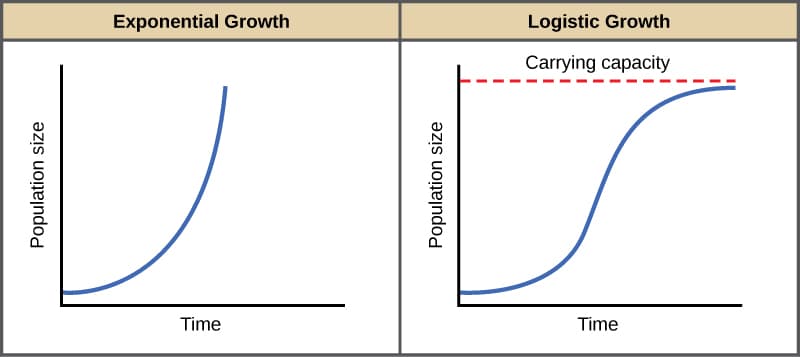
Exponential growth describes what happens when a population grows without any environmental constraints. Every individual reproduces at the same rate, and nothing slows the population down. On a graph, this produces a J-shaped curve: growth starts slow when the population is small, then accelerates dramatically as more individuals reproduce.
This pattern shows up in nature when resources are abundant and there's little competition, predation, or disease to hold the population back. It's common in the early stages of colonization or when a species enters a new environment.

Top images from around the web for Characteristics of exponential growth
4.2 Population Growth and Regulation | Environmental Biology View original
Is this image relevant?
Environmental Limits to Population Growth | Biology for Majors II View original
Is this image relevant?
Ecology - Simple English Wikipedia, the free encyclopedia View original
Is this image relevant?
4.2 Population Growth and Regulation | Environmental Biology View original
Is this image relevant?
Environmental Limits to Population Growth | Biology for Majors II View original
Is this image relevant?
Characteristics of exponential growth
- The per capita growth rate stays constant, meaning each individual contributes equally to population growth regardless of how many individuals exist.
- The population increases by a fixed percentage each time interval, so the doubling time stays the same throughout.
- Exponential growth is always temporary. No environment has truly unlimited resources, so density-dependent factors eventually kick in.
- You'll most often see this pattern in newly established populations before they run into resource limits.
Calculating exponential growth rate
The exponential growth model is described by:
where:
- = population size at time
- = initial population size
- = per capita growth rate (also called the intrinsic rate of increase)
- = time elapsed
- = the mathematical constant (~2.718)
If you need to solve for the growth rate itself, rearrange to:
A positive means the population is growing. A negative means it's declining. An of zero means the population size is stable.
Quick example: A bacterial colony starts with 100 cells () and has a growth rate of per hour. After 6 hours:
Examples in nature
- Bacteria in a nutrient-rich medium at optimal temperature can double every 20 minutes, a textbook case of exponential growth.
- Invasive species often grow exponentially after introduction. Zebra mussels in the Great Lakes had few natural predators and exploded in number during the late 1980s and 1990s.
- Locust outbreaks can show exponential growth when rainfall produces abundant vegetation, triggering rapid reproduction before density-dependent effects catch up.
Logistic population growth
The logistic model is more realistic because it accounts for the fact that environments have limits. As a population grows and resources become scarcer, the per capita growth rate decreases. This produces an S-shaped (sigmoidal) curve: the population grows rapidly at first, then slows, and eventually levels off near the environment's carrying capacity.
Carrying capacity
Carrying capacity () is the maximum population size an environment can sustain indefinitely given its available resources. Think of it as the ceiling the environment imposes on a population.
- As a population approaches , competition for food, water, space, and other resources intensifies.
- is determined by factors like food availability, habitat size, water supply, and the intensity of competition.
- Carrying capacity is not fixed forever. It can shift due to environmental changes, seasonal variation, or human actions like habitat restoration or degradation.
Density-dependent factors
These are factors whose effects get stronger as population density increases. They act like a brake on population growth as numbers climb toward .
- Competition for resources: More individuals means less food, water, or shelter per individual.
- Predation: Higher prey density can attract more predators or increase predation efficiency.
- Disease: Pathogens spread more easily in crowded populations.
- Reduced reproduction: Crowding can increase stress, lower fertility, or reduce parental care.
Together, these factors create a negative feedback loop that keeps the population from overshooting its carrying capacity indefinitely.
S-shaped growth curve
The logistic S-curve has three recognizable phases:
- Lag phase: The population is small, so even though per capita growth rate is high, the total number of new individuals added is low.
- Exponential phase: The population is large enough to add many new individuals per time period but still far enough from that resources aren't limiting.
- Stationary phase: The population nears , density-dependent factors intensify, and growth slows to near zero. The population stabilizes.
The inflection point occurs at roughly . This is where the population is growing fastest in absolute terms. After this point, growth rate declines as density-dependent effects strengthen.
Calculating logistic growth rate
The logistic growth equation is:
where:
- = current population size
- = intrinsic growth rate (maximum per capita rate with no density effects)
- = carrying capacity
- = time
The key term is . This fraction acts as a multiplier that reduces growth as gets closer to :
- When is very small relative to , the term is close to 1, and growth is nearly exponential.
- When , the term equals 0.5, and growth rate is at its maximum absolute value.
- When , the term equals 0, and population growth stops entirely.
- If exceeds , the term becomes negative, meaning the population shrinks back toward .
Real-world examples
- Large mammals like elephants and whales typically follow logistic growth. Their populations are constrained by limited habitat, slow reproduction, and social competition.
- Island populations such as Galápagos tortoises are bounded by the finite resources and space of their islands, producing clear S-shaped growth patterns.
- Crop populations like wheat or corn in a field show logistic growth as plants compete for soil nutrients, water, and sunlight until the field reaches its maximum sustainable density.
Comparing exponential vs logistic models
| Feature | Exponential Model | Logistic Model |
|---|---|---|
| Curve shape | J-shaped | S-shaped |
| Resources assumed | Unlimited | Limited |
| Growth rate | Constant per capita rate | Decreases as approaches |
| Carrying capacity | Not included | Central to the model |
| Best applies to | Early-stage or colonizing populations | Established populations near capacity |

Assumptions and limitations
- Exponential model assumes unlimited resources and no density-dependent effects. This is almost never true for long in nature.
- Logistic model assumes a constant carrying capacity and a smooth, predictable relationship between density and growth rate. In reality, fluctuates and populations can overshoot it.
- Both models treat all individuals as identical. They ignore differences in age, size, sex, and genetic variation that affect survival and reproduction.
- Neither model accounts for environmental randomness (droughts, storms, disease outbreaks) that can cause sudden population changes.
Applicability to different populations
- Exponential growth best describes populations in the early stages of colonization, invasive species entering new habitats, or organisms recovering after a major population crash.
- Logistic growth better fits established populations in relatively stable environments where density-dependent regulation is clearly operating.
- Many real populations show elements of both: exponential growth early on, followed by logistic slowing, sometimes with boom-and-bust oscillations around .
- Choosing the right model depends on the species, the time scale you're looking at, and the specific question you're trying to answer.
Density-independent factors
Not all factors that affect populations are tied to density. Density-independent factors impact populations regardless of how many individuals are present. A hurricane kills the same proportion of a bird population whether there are 50 birds or 5,000.
Types of density-independent factors
- Climate and weather events: Droughts, floods, hurricanes, heat waves, and hard freezes can cause mass mortality or reproductive failure.
- Natural disasters: Wildfires, volcanic eruptions, and tsunamis can destroy habitat and kill large portions of a population instantly.
- Human activities: Habitat destruction, pollution, pesticide application, and overharvesting affect populations independent of their density.
- Catastrophic events: Oil spills or sudden disease introductions can cause rapid, severe population declines.
Impact on population growth
- Density-independent factors cause unpredictable fluctuations in population size that simple growth models struggle to capture.
- They can create population bottlenecks, where a large fraction of the population is wiped out. This reduces genetic diversity and makes the population more vulnerable to future threats.
- These factors often interact with density-dependent factors. For example, a drought (density-independent) intensifies competition for the remaining water (density-dependent).
- For small or already-declining populations, density-independent events can push a species toward extinction.
Population growth and resource availability
Resource availability is one of the most direct drivers of population growth. The amount of food, water, shelter, and other necessities in an environment determines how many individuals can survive and reproduce.
Effect of limited resources
- When resources are scarce, individuals compete for access to food, water, shelter, and mates.
- Resource limitation reduces individual growth rates, reproductive output, and survival, all of which slow population growth.
- As populations approach , resource limitation intensifies, creating the density-dependent regulation described by the logistic model.
- Different age or size classes within a population may have different resource needs and competitive abilities, so resource limitation can also alter population structure.
Intraspecific competition
Intraspecific competition is competition between individuals of the same species for limited resources. It comes in two forms:
- Contest competition (interference): Direct, aggressive interactions where dominant individuals secure resources and subordinates go without. Think of territorial birds defending nesting sites or male elk fighting for mates. This often leads to dominance hierarchies.
- Scramble competition (exploitative): Indirect competition where all individuals have equal access to the resource, but everyone gets less as the population grows. Imagine tadpoles in a pond all consuming the same algae. If the resource runs out, everyone suffers.
Intraspecific competition is a major density-dependent factor. It also drives natural selection by favoring individuals with traits that make them better competitors or more efficient at using resources.
Metapopulations and source-sink dynamics
Most species don't exist as a single, continuous population. Instead, they're often divided into metapopulations: networks of smaller subpopulations living in separate habitat patches but connected by occasional dispersal (movement of individuals between patches).
Characteristics of metapopulations
- Subpopulations occupy distinct habitat patches separated by unsuitable habitat.
- Individuals occasionally disperse between patches, exchanging genes and recolonizing empty areas.
- Individual subpopulations can go locally extinct due to random events or habitat degradation.
- Empty patches can be recolonized by dispersers from surviving subpopulations.
- The metapopulation persists as long as the rate of recolonization across all patches keeps pace with the rate of local extinctions.

Source and sink populations
Within a metapopulation, not all subpopulations are equal:
- Source populations occupy high-quality habitat. They have high birth rates and produce surplus individuals that emigrate to other patches. Sources are the "engine" of the metapopulation.
- Sink populations occupy lower-quality habitat. Their birth rates are too low to sustain themselves without immigration from sources. Without that influx, sink populations would decline to extinction.
Source-sink dynamics arise from differences in habitat quality, resource availability, or predation pressure between patches. The overall metapopulation can persist even if some patches are sinks, as long as source populations remain healthy.
Implications for conservation
- Protect source populations first. Losing a source population can trigger a cascade of local extinctions across sink populations.
- Maintain habitat connectivity. Corridors or stepping-stone habitats between patches allow dispersal, gene flow, and recolonization. Fragmented landscapes with no connectivity can doom a metapopulation.
- Preserve a network of patches. A single large reserve may not be enough. Multiple connected patches of good habitat provide insurance against local extinctions.
- Metapopulation models help conservationists predict the effects of habitat loss, fragmentation, and restoration, and prioritize where to focus limited resources.
Applications of population growth models
Population growth models aren't just theoretical. They're used daily in ecology, resource management, and public health to make practical decisions.
Fisheries and wildlife management
- Models estimate maximum sustainable yield (MSY), the largest harvest that can be taken without causing long-term population decline. This is often calculated at the population size where growth rate is highest (around in the logistic model).
- Managers use growth models to set harvest quotas, size limits, and seasonal closures.
- In adaptive management, models are updated with new monitoring data each season to refine predictions and adjust harvest levels.
Invasive species control
- Growth models help predict how fast an invasive species will spread and how large its population could become.
- By estimating and for the invasive population, managers can assess potential ecological and economic damage.
- Models compare the effectiveness of control strategies (physical removal, chemical treatment, biological control) and help prioritize where to intervene.
- Spatially explicit models identify key dispersal routes so managers can target efforts to prevent further spread.
Conservation planning
- Population viability analysis (PVA) uses growth models combined with data on environmental variability to estimate a species' probability of extinction over a given time frame.
- Models evaluate the potential benefits of interventions like habitat protection, captive breeding, or translocation.
- Metapopulation models identify which habitat patches and corridors are most critical for long-term species persistence.
- These tools help conservation planners allocate limited funding to the actions most likely to prevent extinction.
Limitations and criticisms
Population growth models are powerful, but they're simplifications of reality. Understanding their limitations helps you interpret their predictions appropriately.
Simplifying assumptions
- Both the exponential and logistic models treat all individuals as identical. Real populations have variation in age, size, sex, health, and genetics that all affect demographic rates.
- The logistic model assumes is constant, but carrying capacity shifts with seasons, climate change, and human land use.
- Models assume the environment changes predictably or not at all. Real ecosystems are full of random, unpredictable events.
- These simplifications mean model predictions are approximations, not exact forecasts. They're most useful for understanding general trends rather than precise numbers.
Challenges in parameter estimation
- Estimating , , and density-dependent effects from field data is difficult. These parameters can vary across space and time.
- Small sample sizes, measurement errors, and biased sampling methods introduce uncertainty into estimates.
- Some parameters (like carrying capacity for a wide-ranging species) may be nearly impossible to measure directly, requiring indirect estimates or expert judgment.
- Uncertainty in parameter estimates propagates through the model, producing wide confidence intervals that can limit the model's usefulness for decision-making.
Alternative population growth models
The exponential and logistic models are starting points. Ecologists have developed more complex models to capture biological details these classic models miss:
- Age-structured models account for the fact that individuals of different ages have different birth and death rates (e.g., juveniles don't reproduce).
- Stochastic models incorporate random variation in birth rates, death rates, or environmental conditions, giving a range of possible outcomes rather than a single prediction.
- Individual-based models (IBMs) simulate each organism's behavior and interactions, building population-level patterns from the bottom up.
- Matrix population models use transition matrices to track how individuals move between life stages (seed → seedling → adult, for example) and identify which life stage transitions matter most for population growth.
Each of these alternatives adds realism but also requires more data and makes more assumptions. The right model depends on the species, the available data, and the question being asked.
See Fiveable more often in Google
Mark Fiveable as a preferred source and Google is more likely to show you our guides in Top Stories, with a "preferred" badge in AI Mode and AI Overviews.