2.1 Levels of biodiversity

🪺Environmental Biology Unit 2 Review
2.1 Levels of biodiversity
🪺 Environmental Biology
Biodiversity describes the variety of life on Earth, from the genes inside a single organism to the ecosystems spanning entire continents. Understanding its different levels helps you see why losing any one piece can ripple through the whole system. This guide covers the three core levels of biodiversity, why they matter, how we measure them, what threatens them, and how we work to conserve them.
Genetic diversity
Genetic diversity is the variety of gene versions (alleles) that exist within a population or species. It's the raw material for evolution: without genetic variation, populations can't adapt when conditions change.
A genetically diverse population is more likely to include individuals that can survive a new disease, a shift in climate, or a sudden environmental disturbance. When genetic diversity drops too low, populations become vulnerable to inbreeding depression, where harmful recessive traits become more common and overall fitness declines.

Top images from around the web for Importance of genetic variation
Frontiers | Linking Terrestrial and Aquatic Biodiversity to Ecosystem Function Across Scales ... View original
Is this image relevant?
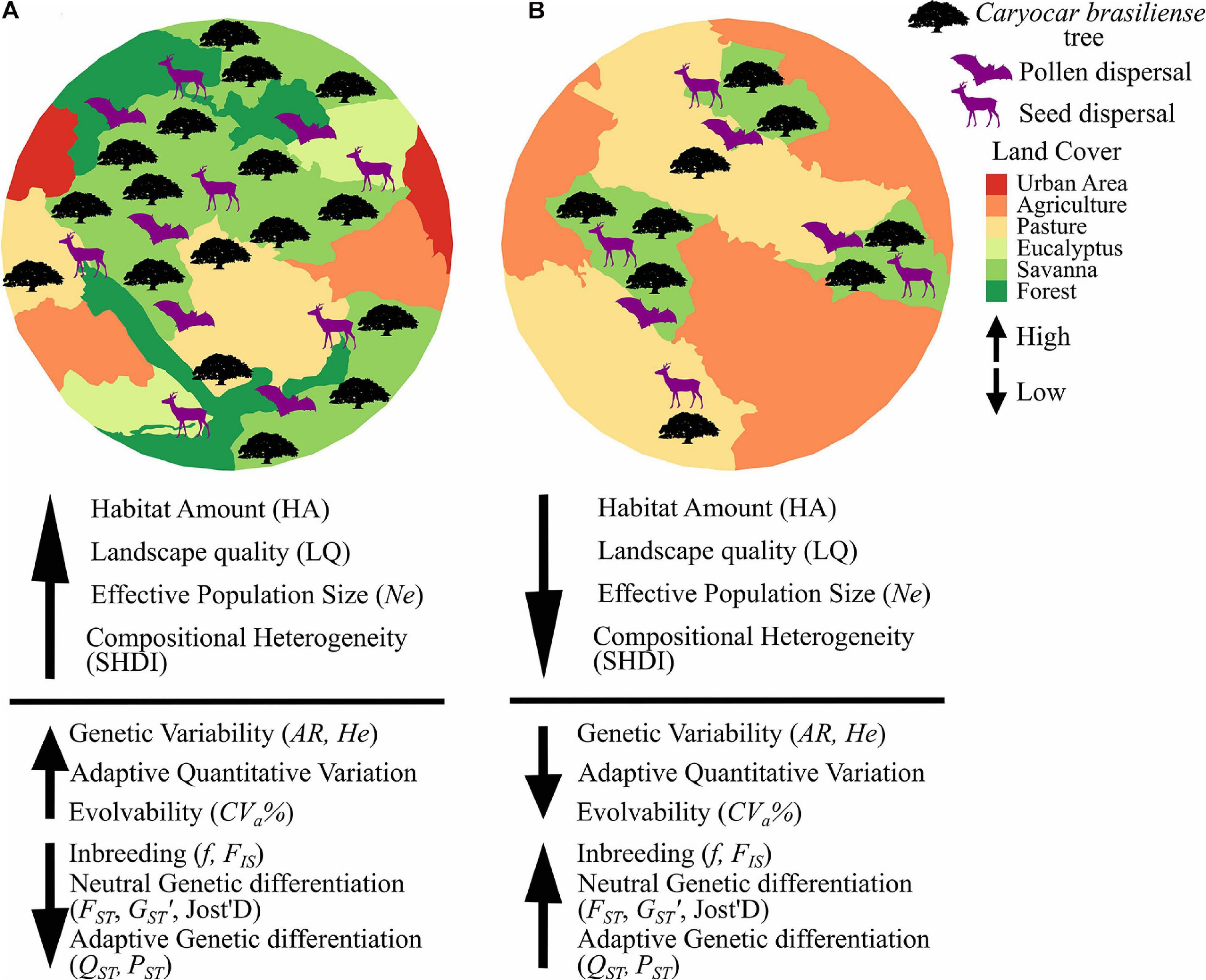
Frontiers | Agricultural Landscape Heterogeneity Matter: Responses of Neutral Genetic Diversity ... View original
Is this image relevant?
Frontiers | Linking Ecology to Genetics to Better Understand Adaptation and Evolution: A Review ... View original
Is this image relevant?
Frontiers | Linking Terrestrial and Aquatic Biodiversity to Ecosystem Function Across Scales ... View original
Is this image relevant?
Frontiers | Agricultural Landscape Heterogeneity Matter: Responses of Neutral Genetic Diversity ... View original
Is this image relevant?
Importance of genetic variation
- Enables adaptation to environmental changes like shifting temperatures or new pathogens
- Increases resilience against diseases and parasites, because some individuals will carry resistant alleles
- Provides the variation that natural selection acts on, driving evolution over time
- Helps maintain healthy populations by reducing the chance of inbreeding depression
Measuring genetic diversity
- Allelic diversity: the number and frequency of different alleles at a given gene locus
- Heterozygosity: the proportion of individuals carrying two different alleles at a locus (higher heterozygosity generally signals greater genetic health)
- Nucleotide diversity: the average number of nucleotide differences per site when comparing two DNA sequences from the same population
- Genotypic diversity: the number and frequency of distinct genotypes present in a population
Factors influencing genetic diversity
- Population size: Larger populations maintain more genetic variation simply because there are more individuals carrying different alleles.
- Gene flow: Migration or dispersal between populations introduces new alleles, boosting diversity.
- Mutation rates: Mutations are the ultimate source of new alleles. Higher mutation rates add variation faster.
- Selection pressures: Natural selection can reduce diversity by favoring certain alleles while eliminating others.
- Genetic drift: Random fluctuations in allele frequencies, especially powerful in small populations where a single chance event can wipe out an allele entirely.
Species diversity
Species diversity captures the variety of species within a community or ecosystem. It has two components: how many species are present and how evenly individuals are spread among those species. Ecologists frequently use species diversity as a quick indicator of ecosystem health.
Species richness vs. evenness
Species richness is simply the count of different species in an area. Species evenness describes how equally individuals are distributed across those species.
Consider two forest plots, each with 5 tree species and 100 total trees. In Plot A, each species has about 20 trees. In Plot B, one species has 92 trees and the other four share the remaining 8. Both have the same richness, but Plot A has much higher evenness and is considered more diverse.
Alpha, beta, and gamma diversity
These three terms describe diversity at different spatial scales:
- Alpha diversity: species diversity within a single habitat or community (local scale). Think of it as the diversity you'd find in one meadow.
- Beta diversity: the change in species composition between habitats. If two nearby meadows share very few species, beta diversity is high.
- Gamma diversity: total species diversity across all habitats in a region (landscape scale). It reflects the combined effect of alpha and beta diversity.
Keystone and indicator species
A keystone species has an outsized effect on its ecosystem relative to its abundance. Sea otters are a classic example: they prey on sea urchins, which prevents urchins from overgrazing kelp forests. Remove the otters, and the entire kelp ecosystem can collapse.
An indicator species signals the health of its environment. Lichens, for instance, are sensitive to air pollution. Their presence suggests good air quality; their absence can be a warning sign. Monitoring both keystone and indicator species gives ecologists a practical window into ecosystem condition.
Rare and endemic species
- Rare species have small population sizes or restricted geographic ranges. The snow leopard, with an estimated 4,000–6,500 individuals spread across Central Asian mountain ranges, is a well-known example.
- Endemic species are found in only one geographic location and nowhere else on Earth. Lemurs are endemic to Madagascar, meaning if their habitat there is destroyed, they have no backup population elsewhere.
Both rare and endemic species face elevated extinction risk because of their limited distributions and often specialized habitat needs.
Ecosystem diversity
Ecosystem diversity refers to the variety of distinct ecosystems within a region or across the planet. More ecosystem types in a landscape means a wider range of habitats, ecological processes, and niches for species to occupy.
Types of ecosystems
- Terrestrial ecosystems: forests, grasslands, deserts, tundra, and others, each shaped by climate, soil, and dominant vegetation
- Aquatic ecosystems: marine environments (oceans, coral reefs, estuaries) and freshwater systems (lakes, rivers, wetlands)
These categories overlap in transition zones. Wetlands, for example, bridge terrestrial and aquatic systems and support uniquely high biodiversity.
Structural vs. functional diversity
Structural diversity refers to the physical complexity of an ecosystem. A tropical rainforest with a canopy layer, understory, shrub layer, and forest floor has high structural diversity, providing many different microhabitats.
Functional diversity captures the range of ecological roles and processes carried out by species in the ecosystem, such as pollination, decomposition, nitrogen fixation, and seed dispersal. Both structural and functional diversity contribute to an ecosystem's overall complexity and resilience.
Ecosystem services and functions
Ecosystem functions are the ecological processes that keep ecosystems running: nutrient cycling, primary production, water filtration, and decomposition.
Ecosystem services are the benefits humans derive from those functions:
- Clean drinking water (filtered by wetlands and forests)
- Crop pollination (performed by bees, bats, and other animals)
- Carbon sequestration (forests and oceans absorb atmospheric )
- Flood regulation (wetlands and floodplains absorb excess water)
Biodiversity underpins both functions and services. When species are lost, the processes they support can weaken or fail.

Threats to ecosystem diversity
- Land-use change: Conversion of natural habitats to agriculture, urban areas, or infrastructure is the single largest driver of ecosystem loss globally.
- Pollution: Chemical runoff, plastic waste, and nutrient loading (e.g., excess nitrogen and phosphorus) degrade ecosystem quality.
- Climate change: Shifting temperatures and precipitation patterns alter the conditions that define ecosystems, pushing some past tipping points.
- Invasive species: Non-native organisms can restructure ecosystems by outcompeting native species or disrupting food webs.
Importance of biodiversity
Biodiversity matters for ecological, economic, and ethical reasons. Ecosystems with more species tend to be more productive, more stable, and better at delivering the services humans depend on.
Ecological roles and interactions
Species don't exist in isolation. They interact through predation, competition, mutualism (both species benefit), and parasitism (one benefits at the other's expense). These interactions form complex food webs and nutrient cycles.
Ecological roles like primary producers (plants, algae), herbivores, carnivores, and decomposers each keep energy and nutrients flowing through the system. Greater biodiversity means more connections in these networks, which generally translates to greater stability.
Economic and social benefits
- Food security: Wild crop relatives carry genetic traits (drought tolerance, pest resistance) that breeders use to improve agricultural varieties.
- Medicinal resources: Roughly 50% of modern pharmaceuticals trace their origins to natural compounds. Aspirin came from willow bark; the cancer drug paclitaxel comes from Pacific yew trees.
- Tourism and recreation: Nature-based tourism generates significant revenue. Costa Rica, for example, earns over $3 billion annually from ecotourism.
- Cultural and spiritual values: Many communities have deep cultural ties to local species and landscapes.
Intrinsic vs. instrumental value
- Intrinsic value: The idea that species and ecosystems have worth simply because they exist, regardless of their usefulness to humans.
- Instrumental value: The practical benefits biodiversity provides to people (food, medicine, clean water, etc.).
Conservation arguments are strongest when they draw on both perspectives. Instrumental value resonates in policy discussions; intrinsic value speaks to ethical responsibility.
Biodiversity and resilience
Resilience is an ecosystem's ability to absorb disturbance and still maintain its structure and function. Higher biodiversity enhances resilience in two key ways:
- Redundancy: Multiple species may perform similar ecological roles, so if one is lost, others can compensate.
- Functional diversity: A wider range of traits means the ecosystem can respond to a broader range of challenges.
Think of biodiversity as an insurance policy: the more variety you have, the more likely the system can handle whatever comes next.
Patterns of biodiversity
Biodiversity isn't spread evenly across the planet. It follows predictable geographic patterns that help ecologists understand why certain areas are species-rich and guide where conservation efforts should focus.
Latitudinal biodiversity gradient
Species richness generally increases from the poles toward the equator. This pattern holds across most groups of organisms, from trees to insects to marine fish.
Several hypotheses explain this gradient:
- Higher solar energy near the equator supports greater productivity and more niches
- Tropical regions have had longer periods of relatively stable climate, allowing more time for speciation
- Greater habitat complexity in the tropics provides more microhabitats for species to occupy
Biodiversity hotspots
A biodiversity hotspot is a region that contains at least 1,500 endemic plant species and has lost at least 70% of its original habitat. There are currently 36 recognized hotspots worldwide.
Examples include the tropical Andes (the most species-rich hotspot on Earth), Madagascar (with roughly 90% of its wildlife found nowhere else), and the Caribbean islands. These areas are conservation priorities because they hold disproportionate amounts of the world's biodiversity in relatively small, threatened areas.
Island biogeography
The theory of island biogeography, developed by MacArthur and Wilson, explains species richness on islands through a balance of two rates:
- Colonization rate: how quickly new species arrive (higher for islands closer to the mainland)
- Extinction rate: how quickly species disappear (higher on smaller islands with fewer resources)
An equilibrium number of species is reached when these two rates balance. This theory also applies to habitat "islands" like forest fragments surrounded by farmland.
Species-area relationship
The number of species in an area increases with the size of that area, following a well-documented pattern described by:
where is species number, is area, is a constant that varies by taxon and region, and typically falls between 0.15 and 0.35.
This relationship has direct conservation implications: when habitat area is reduced by fragmentation or destruction, species loss follows predictably. A common rough estimate is that a 90% reduction in habitat area leads to a 50% loss of species.
Measuring biodiversity
Quantifying biodiversity is essential for tracking changes over time and evaluating whether conservation strategies are working. Different metrics capture different aspects of diversity, and no single measure tells the whole story.

Diversity indices
- Shannon diversity index (): Accounts for both richness and evenness. Higher values indicate greater diversity. Calculated as , where is the proportion of individuals belonging to species .
- Simpson diversity index (): Measures the probability that two randomly selected individuals belong to the same species. Often reported as so that higher values mean more diversity.
- Phylogenetic diversity: Incorporates evolutionary relationships, giving more weight to communities that span a broader range of the tree of life.
- Functional diversity: Considers the variety of ecological traits and roles within a community, not just species identity.
Sampling techniques
- Quadrat sampling: Small, defined plots used mainly for sessile (non-moving) organisms like plants. You count everything within the quadrat.
- Transect sampling: A line or belt laid across a habitat, useful for studying how species composition changes along an environmental gradient.
- Mark-recapture: Animals are captured, marked, released, and recaptured later. The ratio of marked to unmarked individuals in the second sample allows population size estimation.
- Environmental DNA (eDNA): DNA shed by organisms into water, soil, or air is collected and sequenced to detect species presence without ever seeing the organism.
Limitations and challenges
- Sampling bias: Conspicuous or easily trapped species are overrepresented; cryptic or rare species are often missed.
- Taxonomic uncertainty: An estimated 80% of Earth's species remain undescribed, and many groups are difficult to identify even for specialists.
- Spatial and temporal variability: Biodiversity can shift dramatically across short distances or between seasons, making single surveys unreliable.
- Resource constraints: Comprehensive biodiversity surveys require significant time, funding, and expertise.
Monitoring biodiversity change
- Long-term monitoring programs like the North American Breeding Bird Survey track population trends over decades, revealing gradual shifts that short-term studies would miss.
- Remote sensing uses satellite imagery to detect habitat loss, deforestation, and changes in vegetation health at large scales.
- Citizen science platforms like iNaturalist and eBird engage millions of volunteers in collecting occurrence data, vastly expanding geographic coverage.
- Biodiversity indicators such as the Living Planet Index (which tracks vertebrate population trends) summarize complex data into metrics that policymakers can act on.
Threats to biodiversity
Human activities are driving biodiversity loss at rates estimated to be 100 to 1,000 times higher than natural background extinction rates. The main threats often interact, compounding their effects.
Habitat loss and fragmentation
Habitat loss is the outright destruction of natural environments, most commonly through deforestation, agricultural expansion, and urban development. Tropical deforestation alone eliminates an estimated 10 million hectares per year.
Habitat fragmentation divides continuous habitat into smaller, isolated patches. Fragments support smaller populations that are more vulnerable to inbreeding, edge effects, and local extinction. Species that need large home ranges (like jaguars or wolves) are especially affected.
Overexploitation and poaching
Overexploitation occurs when species are harvested faster than they can reproduce. Global fisheries provide a stark example: roughly one-third of assessed fish stocks are currently overfished.
Poaching targets protected species for illegal trade. Elephant ivory, rhino horn, and pangolin scales drive poaching that has pushed some populations to critically low numbers. Between 2010 and 2012, poachers killed an estimated 100,000 African elephants for their ivory.
Invasive species impacts
Invasive species are non-native organisms that establish, spread, and cause ecological or economic harm in their new environment. The brown tree snake, accidentally introduced to Guam after World War II, drove 10 of the island's 12 native forest bird species to extinction. Zebra mussels in North American lakes clog water infrastructure and outcompete native filter feeders.
Invasive species succeed because they often arrive without the predators, parasites, or competitors that kept them in check in their native range.
Climate change effects
Climate change alters temperature and precipitation patterns, shifts species' geographic ranges, and disrupts the timing of ecological events like migration and flowering (phenology). Coral bleaching, driven by warming ocean temperatures, has damaged over 50% of the Great Barrier Reef's coral cover in recent bleaching events.
Climate change also amplifies other threats. Warmer temperatures can expand the range of invasive species and accelerate habitat degradation in already-stressed ecosystems.
Conserving biodiversity
Conservation biology applies ecological principles to protect and restore biodiversity. Effective strategies typically combine habitat protection, species-level interventions, and engagement with local communities.
In-situ vs. ex-situ conservation
- In-situ conservation protects species in their natural habitats. This is generally preferred because it preserves not just species but also the ecological interactions and evolutionary processes they depend on.
- Ex-situ conservation maintains species outside their natural habitats in facilities like zoos, botanical gardens, and seed banks. The Svalbard Global Seed Vault, for example, stores over 1.1 million seed samples as a backup against crop diversity loss.
Both approaches work best in combination. Captive breeding programs (ex-situ) have successfully reintroduced species like the California condor and Arabian oryx back into the wild (in-situ).
Protected areas and reserves
Protected areas are legally designated regions managed primarily for conservation. They range from strictly protected wilderness areas (no human use) to multiple-use reserves that allow sustainable activities like selective harvesting or ecotourism.
As of 2023, roughly 17% of Earth's land surface and about 8% of its ocean area fall within protected areas. Conservation targets under the Kunming-Montreal Global Biodiversity Framework call for protecting 30% of land and sea by 2030 (the "30 by 30" goal).
Well-connected networks of protected areas are more effective than isolated reserves because they allow species to move between habitats, maintaining gene flow and enabling range shifts in response to climate change.
Biodiversity action plans
- National Biodiversity Strategies and Action Plans (NBSAPs): Country-specific frameworks required under the Convention on Biological Diversity. They set priorities, identify key threats, and outline concrete conservation actions.
- Species action plans: Targeted strategies for individual threatened species, often including habitat restoration, anti-poaching measures, and captive breeding.
These plans translate broad conservation goals into specific, measurable steps at national and local levels.
Engaging local communities
Conservation is most effective and most durable when local communities are involved. Community-based conservation gives residents a role in planning and managing natural resources, creating direct incentives to protect biodiversity.
Indigenous and local knowledge often contains detailed ecological understanding built over generations. Incorporating this knowledge into conservation planning can improve outcomes and ensure that strategies are culturally appropriate.
When local people benefit from conservation through sustainable livelihoods, ecotourism revenue, or improved ecosystem services, they become active partners rather than obstacles.
See Fiveable more often in Google
Mark Fiveable as a preferred source and Google is more likely to show you our guides in Top Stories, with a "preferred" badge in AI Mode and AI Overviews.