
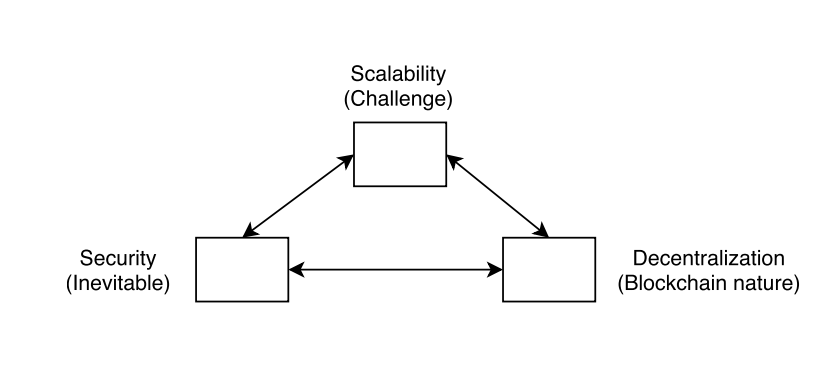
Blockchain networks face a fundamental challenge known as the blockchain trilemma: balancing decentralization, security, and scalability. These three properties often involve trade-offs, making it difficult to optimize all simultaneously. Understanding these trade-offs is crucial for designing effective blockchain systems.
Scalability, a key aspect of the trilemma, is influenced by factors like block size, consensus mechanisms, and network propagation. Transaction metrics such as throughput and latency play a vital role in determining a blockchain's performance. Overcoming limitations in blockchain architectures is essential for improving scalability and user experience.
Blockchain Trilemma and Scalability
Blockchain trilemma trade-offs
- Blockchain trilemma represents the challenge of simultaneously achieving decentralization, security, and scalability in a blockchain network
- Decentralization ensures no single entity controls the network, promoting trust and resilience (Bitcoin, Ethereum)
- Security maintains the integrity and immutability of the blockchain, preventing unauthorized modifications or attacks (51% attacks, double-spending)
- Scalability enables the network to handle a high volume of transactions, supporting widespread adoption and usability (Visa, Mastercard)
- Trade-offs exist between these properties, making it difficult to optimize all three simultaneously
- Increasing decentralization may reduce scalability due to the need for consensus among a large number of nodes (Bitcoin's limited TPS)
- Prioritizing security can limit scalability by requiring more computational resources and time for transaction validation (Proof of Work's energy consumption)
- Improving scalability often involves compromising decentralization or security to some extent (delegated Proof of Stake, sharding)
- Balancing the trilemma requires careful design choices and innovative solutions to address the inherent limitations of blockchain technology (Layer 2 solutions, sidechains)
Factors in blockchain scalability
- Block size limitations restrict the number of transactions that can be included in each block, affecting throughput
- Smaller block sizes (Bitcoin's 1 MB) result in fewer transactions per block and longer confirmation times
- Larger block sizes (Bitcoin Cash's 32 MB) increase storage and bandwidth requirements for nodes
- Consensus mechanisms play a crucial role in determining the scalability of a blockchain network
- Proof of Work (PoW) requires significant computational power, limiting transaction throughput (Bitcoin's ~7 TPS)
- Proof of Stake (PoS) and other alternative consensus mechanisms aim to improve scalability by reducing computational requirements (Ethereum 2.0's Casper)
- Network propagation delays impact the time taken for blocks to spread across the network, affecting transaction confirmation times
- Latency and network congestion can slow down block propagation (Bitcoin's 10-minute block time)
- Faster block propagation enables quicker transaction confirmations and improves overall scalability (Ethereum's 15-second block time)
- Transaction validation and execution costs, especially for complex smart contracts, can slow down transaction processing
- Gas costs in Ethereum limit the computational complexity of smart contracts to prevent network congestion
- Optimizing smart contract code and using off-chain computation can help reduce execution costs (Ethereum's Optimism rollups)

Impact of transaction metrics
- Transaction throughput, measured in transactions per second (TPS), indicates a blockchain's ability to handle a high volume of transactions
- Higher TPS enables better scalability and supports more users and applications (Visa's ~1,700 TPS)
- Limited TPS can lead to network congestion, high transaction fees, and poor user experience (Ethereum's CryptoKitties incident)
- Latency, the time taken for a transaction to be confirmed and added to the blockchain, affects user experience and transaction settlement speed
- Lower latency enables faster transaction confirmations and improves usability (Solana's 400ms block time)
- Higher latency can result in longer waiting times for users and hinder real-time applications (Bitcoin's 60-minute confirmation time for 6 blocks)
- Throughput and latency often involve trade-offs, as increasing throughput may lead to higher latency due to larger block sizes and propagation delays
- Sharding in Ethereum 2.0 aims to improve both throughput and latency by parallelizing transaction processing
- Layer 2 solutions like Lightning Network (Bitcoin) and Plasma (Ethereum) offload transactions from the main chain to improve scalability
Limitations of blockchain architectures
- Sequential processing of transactions limits parallelization and throughput, as transactions are processed one at a time
- Block ordering and transaction dependencies prevent efficient parallel processing (Bitcoin's UTXO model)
- Introducing parallel transaction execution can improve scalability but requires careful handling of conflicts and dependencies (Ethereum's proposed parallel EVM)
- Global state management requires each node to maintain a full copy of the blockchain state, leading to storage and synchronization overhead
- Full nodes store the entire blockchain history, which can grow significantly over time (Ethereum's >1 TB state size)
- State synchronization and data propagation can be time-consuming and resource-intensive (Ethereum's fast sync)
- Consensus overhead arises from the need to reach agreement among all nodes, which can be time-consuming and resource-intensive
- Proof of Work (PoW) requires significant computational power and energy consumption (Bitcoin's annual energy consumption comparable to Argentina)
- Alternative consensus mechanisms like Proof of Stake (PoS) aim to reduce consensus overhead but may introduce other trade-offs (Ethereum 2.0's Casper)
- Limited on-chain storage makes it expensive to store large amounts of data directly on the blockchain, impacting performance and cost
- Storing data on-chain increases the size of the blockchain and requires replication across all nodes (Ethereum's high gas costs for storage)
- Off-chain storage solutions and data compression techniques can help alleviate storage limitations (InterPlanetary File System (IPFS), Ethereum's Swarm)
- Lack of interoperability between different blockchain networks hinders cross-chain communication and limits overall scalability
- Siloed blockchain ecosystems prevent seamless transfer of assets and data across chains (Bitcoin and Ethereum's separate networks)
- Interoperability protocols and cross-chain communication solutions aim to enable better collaboration and scalability (Polkadot, Cosmos)