
Blockchain transactions follow a complex lifecycle, from initiation to confirmation. This process ensures security and validity through digital signatures, multi-step verification, and consensus mechanisms. Understanding this lifecycle is crucial for grasping how blockchains maintain trust and integrity.
Transaction finality is a key concept in blockchain, referring to the irreversibility of confirmed transactions. This feature provides immutability and trust in the transaction history, preventing double-spending and ensuring the integrity of the ledger. Finality is achieved through consensus and multiple confirmations.
Transaction Lifecycle and Validation
Blockchain transaction lifecycle
- Transaction initiation
- User creates a transaction using their wallet software specifying recipient address, amount, and any additional data
- Transaction signing
- User's wallet signs the transaction with their private key proving the transaction originated from the user's wallet
- Broadcasting the transaction
- Signed transaction is broadcast and propagated to nodes across the blockchain network
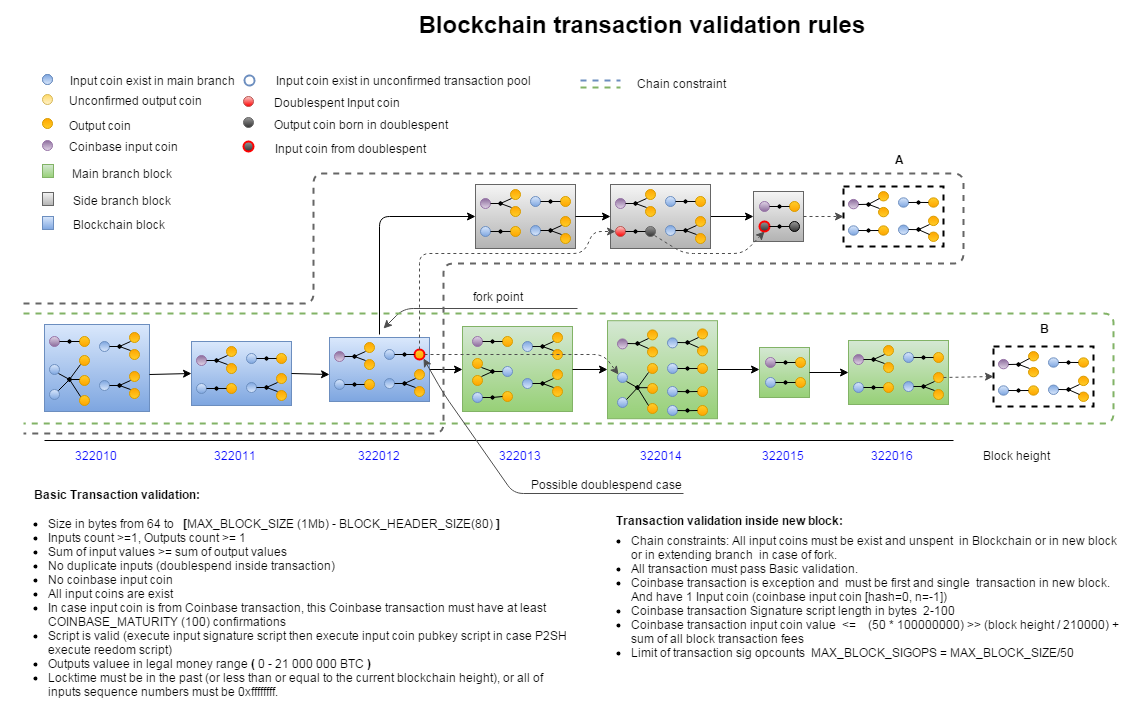
- Transaction validation
- Nodes verify the transaction's validity based on predefined criteria including signature verification, sufficient balance, and adherence to network rules
- Transaction pooling
- Valid transactions are added to the memory pool (mempool) where they await inclusion in a block
- Block creation
- Miners or validators select transactions from the mempool and bundle them into a new block
- Block validation and consensus
- Miners or validators compete to add the new block to the blockchain using a consensus mechanism (Proof-of-Work, Proof-of-Stake) to reach agreement
- Block confirmation
- Once a block is added to the blockchain, the transactions within it are considered confirmed with multiple confirmations increasing the security and finality of the transactions
Digital signatures in transactions
- Digital signatures are created using the user's private key and prove that the transaction originated from the owner of the private key
- Signatures ensure the authenticity of the transaction
- Confirms the transaction was created by the claimed sender preventing impersonation and unauthorized access to funds
- Signatures maintain the integrity of the transaction
- Any modification to the transaction data invalidates the signature making tampering with the transaction content detectable
- Signatures are verified using the corresponding public key allowing nodes to confirm the signature's validity without revealing the private key
- Digital signatures are a crucial component of blockchain security
- Provide non-repudiation, ensuring users cannot deny their actions enabling trustless and secure transactions without intermediaries
![Blockchain transaction lifecycle, Blockchain and smart contract for IoT enabled smart agriculture [PeerJ]](https://storage.googleapis.com/static.prod.fiveable.me/search-images%2F%22Blockchain_transaction_lifecycle_diagram%3A_initiation_signing_broadcasting_validation_pooling_block_creation_consensus%22-fig-2-full.png)
Transaction validation process
-
Signature verification
- Nodes check if the transaction has a valid digital signature confirming the transaction originated from the claimed sender
-
Balance verification
- Nodes ensure the sender has sufficient funds to cover the transaction amount preventing double-spending and spending more than one's balance
-
Adherence to network rules
- Transactions must follow the specific rules and format of the blockchain network including data structure, size limits, and any network-specific requirements
-
Smart contract execution (if applicable)
- For blockchains with smart contract functionality (Ethereum), nodes execute the associated smart contract code ensuring the transaction complies with the contract's conditions and logic
-
Consensus rules
- Transactions must adhere to the consensus rules of the blockchain such as transaction fees, block size limits, and other network parameters
- Valid transactions are added to the memory pool (mempool) awaiting inclusion in a block by miners or validators while invalid transactions are rejected and not propagated further
Transaction finality concept
- Transaction finality refers to the irreversibility of a transaction once confirmed with confirmed transactions permanently recorded on the blockchain and cannot be altered, reversed, or deleted providing immutability and trust in the transaction history
- Finality is achieved through consensus and multiple confirmations
- Transactions are considered final after a certain number of block confirmations with more confirmations resulting in a higher level of finality and security
- Finality is important for preventing double-spending and ensuring the integrity of the ledger
- Once a transaction is final, the funds cannot be spent again eliminating the risk of transaction reversal or manipulation
- The level of finality depends on the blockchain's consensus mechanism and network characteristics
- Proof-of-Work (PoW) blockchains (Bitcoin) have probabilistic finality with finality increasing with each subsequent block confirmation
- Proof-of-Stake (PoS) and Byzantine Fault Tolerant (BFT) blockchains can achieve faster finality through validator voting and consensus
- Transaction finality is crucial for real-world applications and use cases enabling secure and reliable transfer of value and assets and providing confidence in the settlement of transactions