8.1 Molecular clouds and star-forming regions

🌠Astrophysics I Unit 8 Review
8.1 Molecular clouds and star-forming regions
🌠 Astrophysics I
Molecular Cloud Properties and Star Formation
Molecular clouds are the regions in the interstellar medium where stars form. These vast, cold structures of gas and dust span light-years across space and contain the raw ingredients for stellar creation. Understanding their properties is essential because the physical conditions inside these clouds directly determine whether, where, and how quickly stars can form.
The physics of molecular clouds comes down to a competition: gravity pulls material inward toward collapse, while turbulence, thermal pressure, and magnetic fields push back. This balance governs everything from the formation of individual protostars to the star formation rate of entire galaxies.
Properties of molecular clouds
Molecular clouds are far colder and denser than the diffuse interstellar medium surrounding them, and those extreme conditions are what allow molecules to survive and gravity to gain a foothold.
Physical characteristics:
- Temperature: Typically 10–20 K. At these temperatures, thermal pressure is low, which makes gravitational collapse much easier.
- Density: Ranges from to molecules per cubic centimeter. Even the low end is orders of magnitude denser than the general interstellar medium ().
- Size: Spans roughly 1 to 100 parsecs. Giant molecular clouds like the Orion Molecular Cloud can contain to solar masses of material.
Composition:
- Molecular hydrogen () dominates, making up ~75% of the cloud mass. However, is nearly invisible at these temperatures because it lacks a permanent dipole moment and doesn't emit efficiently in cold conditions.
- Helium accounts for ~25% of the mass but is chemically inert and doesn't radiate.
- Trace molecules are rare by mass but critical for observations and cloud physics:
- Carbon monoxide () is the primary tracer molecule. Its rotational transitions are easily excited at 10–20 K, so observers use CO emission lines to map cloud structure and velocity fields.
- Ammonia () serves as a reliable temperature probe because the ratio of its inversion transition lines is sensitive to kinetic temperature.
- Water () contributes to cooling processes within the cloud.
Structure and dynamics:
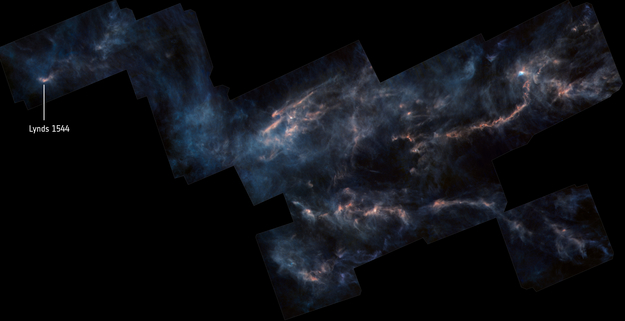
Molecular clouds are not smooth, uniform blobs. They have a filamentary, clumpy internal structure, often described as hierarchical. Large clouds contain smaller clumps ( pc, – ), which in turn contain dense cores ( pc, ). The Taurus Molecular Cloud is a well-studied example of this filamentary morphology.
Internally, molecular clouds are highly dynamic. Supersonic turbulent motions create complex velocity fields throughout the cloud. Clouds also exhibit bulk rotation, and magnetic fields thread through the gas, coupling to the ionized component and influencing the cloud's evolution at every scale.
Gravity and turbulence in star formation
The central question in star formation theory is: what causes a stable (or quasi-stable) molecular cloud to collapse and form stars? The answer lies in the competition between gravity and the forces that resist it.
Gravitational collapse and the Jeans criterion:
A cloud (or a region within a cloud) will collapse when its self-gravity overcomes internal thermal pressure. The Jeans mass sets the critical threshold:
where is the temperature, is the density, is the mean molecular weight, and is the hydrogen mass. Regions exceeding the Jeans mass are gravitationally unstable. Notice that lower temperatures and higher densities both reduce the Jeans mass, making collapse easier. This is why the cold, dense interiors of molecular clouds are where collapse actually happens.
As a cloud collapses, it doesn't form one single star. Instead, it undergoes fragmentation: the collapsing region breaks into smaller, denser cores, each of which may form an individual star or small multiple system.
The role of turbulence:
Turbulence in molecular clouds is supersonic (Mach numbers of 5–50) and plays a dual role:
- On large scales, turbulent motions provide pressure support against global gravitational collapse. This is why entire giant molecular clouds don't collapse all at once.
- On small scales, turbulence creates shock compressions that locally enhance the density. These compressed regions can exceed the local Jeans mass and become seeds for collapse.
- Turbulent energy cascades from large scales to small scales, where it eventually dissipates. Once turbulent support fades in a given region, gravity wins and localized collapse proceeds.
The interplay:
Turbulence simultaneously inhibits star formation globally and triggers it locally. This is a key reason why star formation is an inefficient process: typically only a few percent of a cloud's mass converts into stars per free-fall time. The balance between turbulent support and gravitational collapse sets the star formation efficiency of a cloud.

Observational signatures of star-forming regions
Because molecular clouds are cold and dusty, they are largely opaque at visible wavelengths. Observing star formation requires looking across the electromagnetic spectrum.
Infrared observations:
- Thermal dust emission at mid- and far-infrared wavelengths (e.g., 24 μm with the Spitzer Space Telescope) reveals the distribution of warm dust heated by embedded protostars.
- Embedded protostars are invisible in optical light but appear as point sources in the infrared, where dust reprocesses their radiation to longer wavelengths.
- PAH (polycyclic aromatic hydrocarbon) emission features in the mid-infrared trace regions where UV radiation from nearby hot stars illuminates the cloud edges.
Radio and submillimeter observations:
- Molecular line emission from species like , , and maps the cloud's structure, density, temperature, and velocity (kinematics). Different molecules trace different density regimes.
- Maser emission from water () and methanol () pinpoints regions of high-mass star formation, where conditions produce the population inversions needed for masing.
- Free-free continuum emission from HII regions traces ionized gas around newly formed massive stars.
- Submillimeter continuum observations (e.g., with ALMA) map the cold dust and gas distribution at high angular resolution, revealing the detailed structure of cores and disks.
X-ray observations:
Young stellar objects, particularly T Tauri stars, produce X-ray emission from magnetically active coronae. X-rays also trace hot, shocked gas in outflow regions.
Specific signposts of star formation:
- Bok globules are small, dense, dark clouds seen in silhouette against bright backgrounds. Barnard 68 is a classic example of an isolated globule that may be on the verge of collapse.
- Herbig-Haro (HH) objects are shock-excited nebulae produced where bipolar jets from young protostars slam into the surrounding medium at hundreds of km/s.
- T Tauri stars are low-mass pre-main-sequence stars characterized by strong emission lines (especially H-alpha), infrared excess from circumstellar disks, and photometric variability.
Magnetic fields and cosmic rays in cloud evolution
Gravity and turbulence aren't the only players. Magnetic fields and cosmic rays both influence how molecular clouds evolve and how quickly they form stars.
Magnetic fields:
Molecular clouds inherit magnetic fields from the large-scale galactic field, with typical strengths of a few to tens of microgauss. Through flux freezing, the magnetic field is coupled to the ionized gas component. Since even a small ionization fraction links the field to the bulk neutral gas (via ion-neutral collisions), the field can exert forces on the entire cloud.
Magnetic fields affect cloud evolution in several ways:
- Magnetic pressure provides additional support against gravitational collapse, supplementing thermal and turbulent pressure. A cloud must exceed the magnetic critical mass (related to the mass-to-flux ratio) for collapse to proceed.
- Magnetic braking transfers angular momentum outward, regulating how fast collapsing cores rotate. This has direct consequences for disk formation around protostars.
Cosmic rays:
Cosmic rays, originating primarily from supernova remnants, penetrate deep into molecular clouds where UV photons cannot reach. They serve three important functions:
- Ionization: Cosmic rays maintain a low but nonzero ionization fraction () inside clouds. This residual ionization is what allows the magnetic field to couple to the gas via ion-neutral friction.
- Heating: Cosmic ray ionization deposits energy into the gas, contributing to the thermal balance of cloud interiors alongside line cooling from molecules like .
- Chemistry: Cosmic ray ionization of initiates ion-molecule reaction chains that produce the complex molecules observed in clouds.
Combined effects and ambipolar diffusion:
Because the ionization fraction is so low, the coupling between the magnetic field (tied to ions) and the bulk neutral gas is imperfect. Ambipolar diffusion is the process by which neutral gas slowly drifts through the ions and the magnetic field, allowing a magnetically subcritical core to gradually lose magnetic support and eventually collapse. This process operates on timescales of – years, much longer than the free-fall time, and was historically considered the rate-limiting step for star formation.
MHD (magnetohydrodynamic) waves also transport energy through the cloud and can provide additional support on intermediate scales. Together, magnetic fields and cosmic rays regulate the overall timescale and efficiency of star formation, helping explain why molecular clouds convert only a small fraction of their mass into stars.
See Fiveable more often in Google
Mark Fiveable as a preferred source and Google is more likely to show you our guides in Top Stories, with a "preferred" badge in AI Mode and AI Overviews.