7.1 Composition and phases of the interstellar medium

🌠Astrophysics I Unit 7 Review
7.1 Composition and phases of the interstellar medium
🌠 Astrophysics I
Composition of the Interstellar Medium
The interstellar medium (ISM) is the gas and dust that fills the space between stars. It's mostly hydrogen and helium, with trace amounts of heavier elements and tiny solid particles called dust grains. The ISM matters because it's the raw material for new stars: stars form from it, live their lives, and then return processed material back into it when they die. Understanding the ISM means understanding the full life cycle of stars and galaxies.
Gas and Dust Components
Gas dominates the ISM by mass and volume. Hydrogen is the most abundant element, making up about 90% of all ISM atoms. It shows up in two important forms:
- Atomic hydrogen (H I) exists in diffuse clouds and is detected through its characteristic 21 cm radio emission line, produced when the electron in a hydrogen atom flips its spin relative to the proton.
- Molecular hydrogen () is concentrated in cold, dense clouds. itself is very hard to observe directly because it lacks a permanent dipole moment, so astronomers trace it using CO emission as a proxy.
Helium is the second most abundant element at roughly 10% of ISM atoms. Trace heavier elements like carbon, oxygen, and nitrogen are present in small quantities but play outsized roles in cooling the gas and building complex molecules.
Dust grains account for only about 1% of the ISM by mass, but they have a big impact:
- Silicate grains (silicon + oxygen compounds) efficiently absorb ultraviolet light and re-emit it in the infrared.
- Carbonaceous particles, including graphite and polycyclic aromatic hydrocarbons (PAHs), also emit strongly in the infrared.
- Ice mantles can coat dust grains in cold regions, hosting complex organic molecules like methanol () and formaldehyde ().
Beyond gas and dust, the ISM contains cosmic rays (high-energy particles, mostly protons, accelerated by supernova remnants), magnetic fields that influence gas dynamics and regulate collapse during star formation, and radiation fields (UV from hot stars, X-rays from compact objects) that heat and ionize the gas.
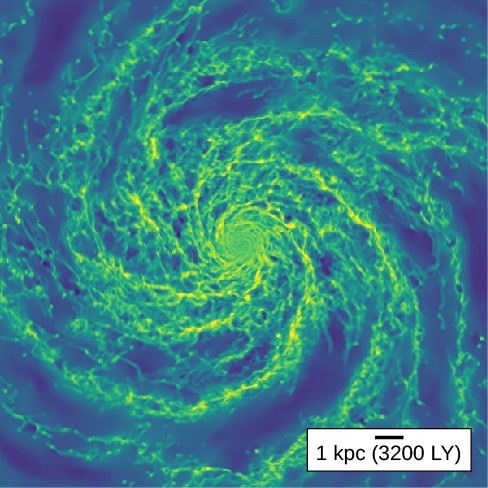
Element Distribution in Space
Hydrogen and helium together make up about 98% of the ISM by mass. Their abundances were set during Big Bang nucleosynthesis: roughly 70% hydrogen and 28% helium by mass. These primordial ratios still dominate today.
Everything heavier than helium is lumped together as metals in astrophysics terminology (even elements like carbon and oxygen). Metals make up only about 2% of the ISM by mass, but that fraction has grown over cosmic time as successive generations of stars have fused lighter elements into heavier ones and expelled them through stellar winds and supernova explosions. This process is called chemical enrichment.
Metal abundances aren't uniform across a galaxy:
- Galactic disks tend to have higher metallicity because active star formation continuously produces and recycles heavy elements.
- Galactic halos have lower metallicity, reflecting their older stellar populations and less active enrichment history.
Some elements are depleted from the gas phase, meaning they're less abundant in the gas than you'd expect from overall cosmic abundances. Iron and silicon, for example, get locked up in dust grains. The degree of depletion depends on the local ISM density and environment: denser regions tend to show stronger depletion because dust grains survive longer there.

Phases and Role of the Interstellar Medium
Phases of the ISM
The ISM isn't a single uniform medium. It exists in several distinct phases that coexist in rough pressure equilibrium, spanning a huge range of temperatures and densities. From coldest and densest to hottest and most diffuse:
| Phase | Temperature | Density () | Key Tracer |
|---|---|---|---|
| Molecular clouds | 10–20 K | CO emission | |
| Cold neutral medium (CNM) | ~100 K | 10–100 | H I 21 cm absorption |
| Warm neutral medium (WNM) | ~6,000–10,000 K | 0.1–1 | H I 21 cm emission |
| Warm ionized medium (WIM) | ~8,000 K | 0.1–1 | H emission |
| Hot ionized medium (HIM) | K | X-ray emission |
Molecular clouds are the coldest, densest regions. Their high density shields the interior from UV radiation, allowing to survive. These are the sites where stars form.
The cold neutral medium (CNM) consists of atomic hydrogen clouds at around 100 K. These regions show up in 21 cm absorption against background radio sources.
The warm neutral medium (WNM) is diffuse atomic hydrogen heated by cosmic rays and the interstellar radiation field. It fills a large fraction of the ISM's volume.
The warm ionized medium (WIM) includes H II regions around hot O and B stars, where UV photons have enough energy to ionize hydrogen. These regions glow in H (the red Balmer line at 656.3 nm).
The hot ionized medium (HIM), sometimes called coronal gas, is extremely hot, low-density plasma created by supernova blast waves. It fills large cavities called superbubbles and emits primarily in X-rays.
Role in Star Formation and Galaxy Evolution
Star formation begins in molecular clouds when dense clumps become gravitationally unstable and collapse. These clumps fragment into protostellar cores, each of which can accrete surrounding material through a rotating accretion disk that may eventually form a planetary system.
The ISM serves as the gas reservoir for a galaxy's ongoing star formation. Without it, a galaxy would simply run out of fuel. The cycle works like this:
- Gas in the ISM cools and condenses into molecular clouds.
- Molecular clouds fragment and collapse to form new stars.
- Stars process gas through nuclear fusion, creating heavier elements.
- Stars return enriched material to the ISM through stellar winds and supernova explosions.
- The enriched ISM feeds the next generation of star formation.
This recycling means each new generation of stars starts with slightly higher metallicity than the last.
Dust grains play a surprisingly active role in this cycle. They provide surfaces where hydrogen atoms can meet and combine into , a reaction that's very inefficient in the gas phase alone. Dust also shields cloud interiors from UV radiation, keeping molecules intact, and serves as a substrate for building complex organic molecules.
Feedback processes regulate the whole system. Stellar winds and supernova explosions inject energy into the ISM, heating and dispersing gas, which temporarily suppresses star formation. Supernova shock waves can also compress nearby gas, triggering new collapse and star formation. Galactic fountains carry hot gas from supernova activity up out of the disk and into the halo, where it cools and eventually falls back down, redistributing material. The balance between heating and cooling across these processes determines which ISM phases are present and in what proportions.
See Fiveable more often in Google
Mark Fiveable as a preferred source and Google is more likely to show you our guides in Top Stories, with a "preferred" badge in AI Mode and AI Overviews.