AP US History SAQ Practice
1477 Short Answer Questions written in the AP format. Pick one, read the source and all three parts, and write a short answer to each. Fiveable scores each SAQ response part by part on the AP rubric.
Your first scored response is included. A plan unlocks unlimited scoring.
1477 questions
sorted by unit
Inca city organization in sixteenth-century Spanish chronicle
Unit 1: Interactions North America, 1491–1607
Source: Cieza de Leon, The Chronicle of Peru, 1554.
In the name of Ticiviracocha, and of the Sun, and of the other Gods, he laid the foundation of the new city. The original and beginning of it was a small stone house with a roof of straw that Manco Capac' and his women built, to which they gave the name of Curicancha,^ meaning the place of gold. This is the place where afterwards stood that celebrated and most rich temple of the Sun, and now a monastery of monks of the order of St. Domingo. It is held for certain that, at the time when Manco luca Capac built this house, there were Indians in large numbers in the district ; but as he did them no harm and did not in any Vise molest them, they did not object to his remaining in their land, but rather rejoiced at his coming.
Answer all parts of the question that follows.
Describe ONE claim Cieza de Leon makes about the founding of the Inca city described in the excerpt.
Explain ONE way the social organization described in the excerpt reflects the development of complex native societies in the Americas before European contact.
Explain ONE way Spanish accounts like Cieza de Leon's chronicle shaped European understandings of native societies in the Americas during the period 1491 to 1607.
What the SAQ asks
Short-answer questions make up Section I, Part B of the AP US History exam, with three required questions in 40 minutes. Each one starts from a source, such as one or two historians’ arguments, a primary text, or an image, and asks three short parts about it and the history around it.
- 13 min
- suggested time per SAQ
- 3 points
- one for each part, A to C
- 20%
- of your exam score, for all three SAQs
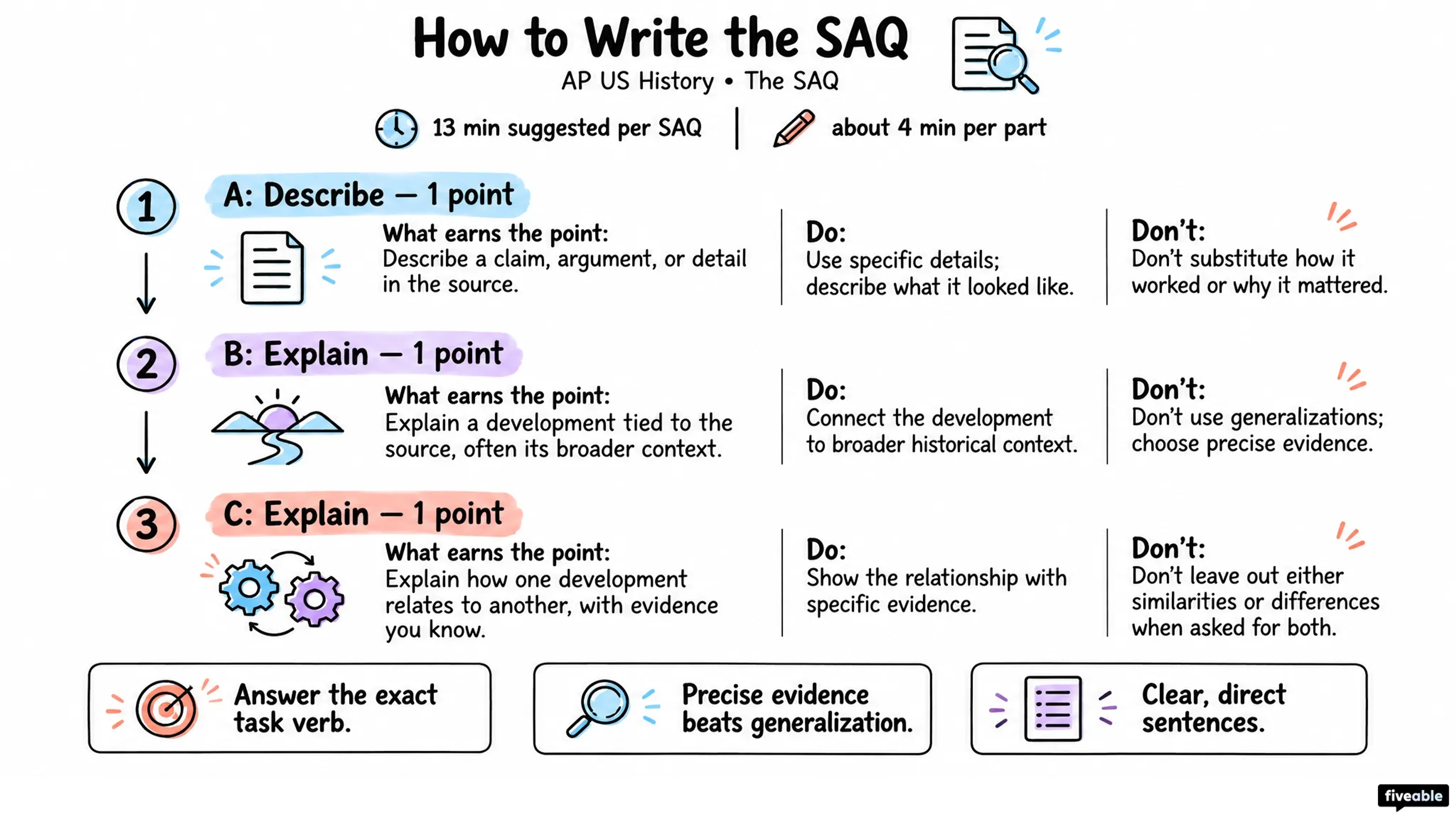
Part A: Describe
A claim, argument, or detail in the source
1 pt
Part B: Explain
A development tied to the source, often its broader context
1 pt
Part C: Explain
How one development relates to another, with evidence you know
1 pt
SAQ skill sheet
Every rubric point on one page: what earns it, what to do and what to avoid. Tap the sheet to see it full size.
How SAQ practice works
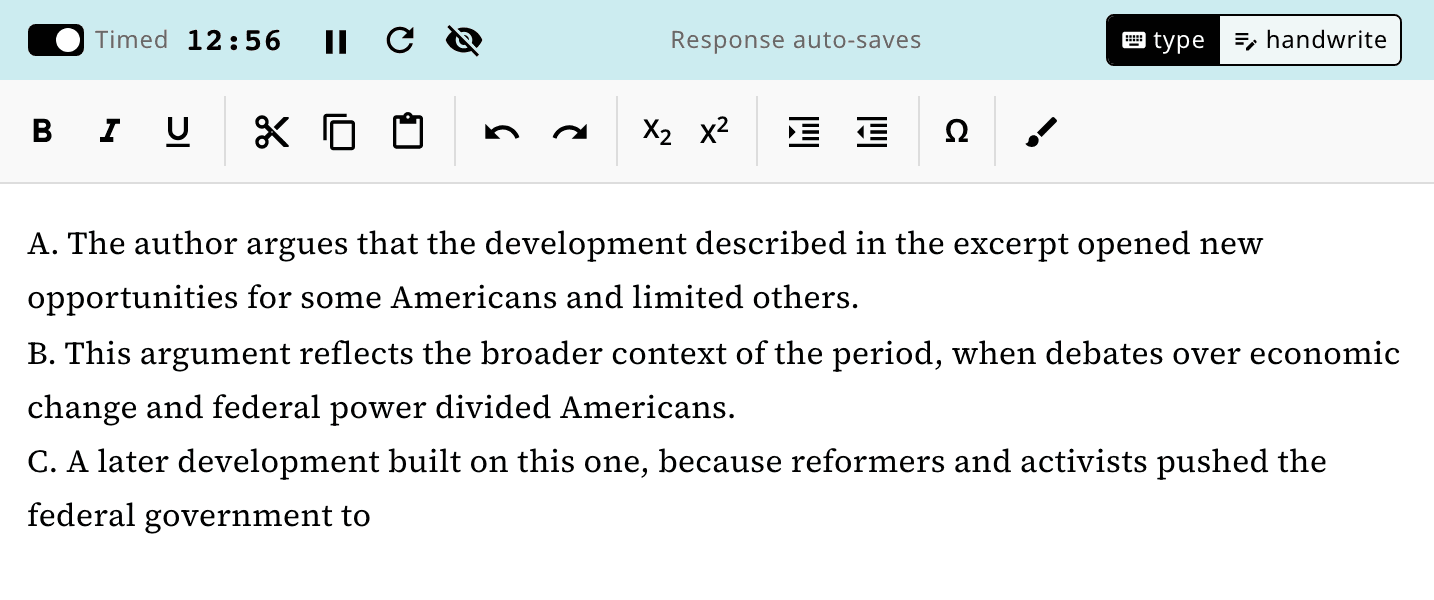
Each question follows the exam’s format, from the full prompt to a score on every part.
Read the source and question
The source and all three parts, A through C, laid out the way the exam shows them.
Write on a 13-minute timer
About the time each SAQ gets on exam day. Pause it or turn it off, and your response saves as you go.
Submit for a score out of 3
Your response is scored against the scoring guidelines written for that question. Your first score is included.
Feedback on every part
A summary at the top tells you what to work on next. Below it, each part shows whether you earned the point and what the scoring guidelines were looking for.
Detailed Feedback
Part A: 1/1 point
You describe soldiers holding a Native American man while his family watches and explain how this depicts forced removal.
Part B: 1/1 point
You explain that a painting made in 1995 reflects a later interpretation rather than direct observation, limiting its usefulness as evidence of the Cherokee experience.
Part C: 0/1 point
You say the government treated Native Americans badly, but you do not identify and explain a specific policy or practice that continued from the colonial period through removal.
Questions about the SAQ
How many responses can I get scored?
You can read every question without a plan. Your first scored response is included. A plan unlocks unlimited scoring.
Do I still choose between Questions 3 and 4?
No. Beginning with the May 2027 exam, all three SAQs are required and each one has a source. Question 1 uses one or two secondary texts, Question 2 a primary text, and Question 3 a non-text source. Every question here comes with a source.
How is the SAQ different from the DBQ?
The SAQ asks three short parts about a source, with about 13 minutes per question. The DBQ asks for a full essay built on seven documents, and the exam gives it 60 minutes.
How long should each answer be?
A few sentences per part. You don’t need a thesis, an introduction, or a conclusion.
Is each part scored on its own?
Yes. Each part is worth 1 point and is scored separately, so a strong answer to part A still counts if part C misses.
More AP US History practice
See the SAQ rubric points students miss most, from responses scored on Fiveable.
Write your first SAQ
Pick one from the list, or let us choose for you.
Teaching AP US History? Assign these SAQs to your class