AP US History LEQ Practice
351 Long Essay Questions written in the AP format. Pick one, read the full prompt, and write your essay from what you know. Fiveable scores each LEQ response part by part on the AP rubric.
Your first scored response is included. A plan unlocks unlimited scoring.

351 questions
sorted by unit
Spanish versus English colonial approaches and outcomes
Respond to the prompt with a historically defensible thesis or claim that establishes a line of reasoning.
Describe a broader historical context relevant to the prompt.
Support an argument in response to the prompt using at least two pieces of specific and relevant evidence.
Use historical reasoning (e.g., comparison, causation, continuity or change over time) to frame or structure an argument that addresses the prompt.
Demonstrate a complex understanding of a historical development related to the prompt through sophisticated argumentation and/or effective use of evidence.
1. From the late fifteenth through the mid-eighteenth century, Spain and England established colonies in the Americas. Their colonial ventures developed amid competition for land and resources, encounters with Indigenous peoples, and the expansion of Atlantic trade.
Evaluate the most significant difference between the Spanish colonization of the Americas and the English colonization of North America from 1492 to 1754.
Your response may focus on any difference(s) between Spanish and English colonization during the period 1492 to 1754. You are not expected to address the entire time period in your response.
What the LEQ asks
The Long Essay Question is the second essay in Section II of the AP US History exam. You get one broad prompt and no documents, and you build a historical argument with evidence from your own knowledge.
- 40 min
- to plan and write
- 6 points
- across rows A to D
- 15%
- of your exam score
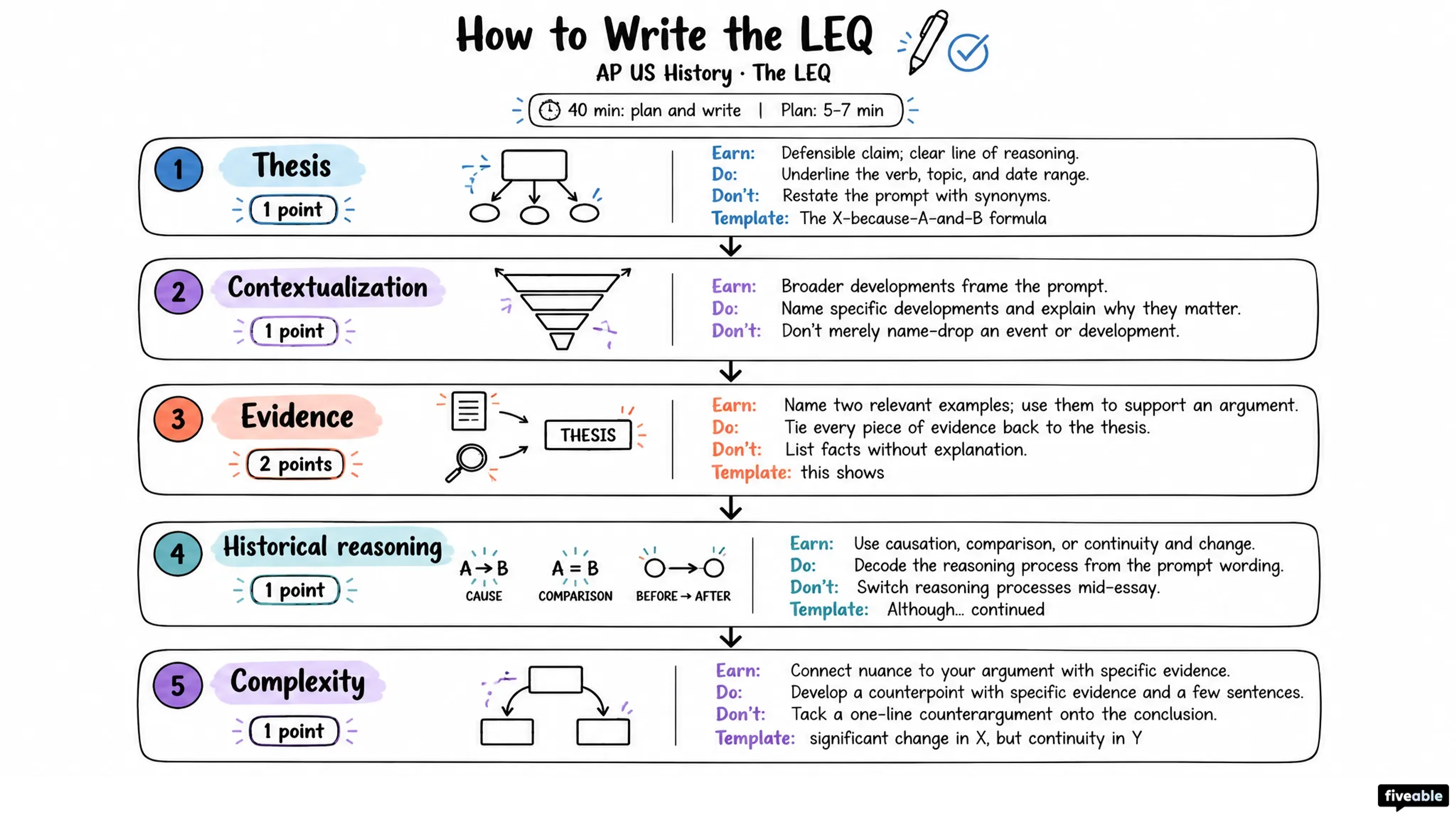
Part A: Thesis
A defensible claim that sets up a line of reasoning
1 pt
Part B: Contextualization
Broader developments that frame the prompt
1 pt
Part C: Evidence
Two specific examples, used to support the argument
2 pts
Part D: Analysis and reasoning
Comparison, causation, or continuity and change, plus a complex understanding
2 pts
LEQ skill sheet
Every rubric point on one page: what earns it, what to do and what to avoid. Tap the sheet to see it full size.
How LEQ practice works
Each question follows the exam’s format, from the full prompt to a score on every part.
Read the full prompt
The prompt with its time period, laid out the way the exam shows it.
Write on a 40-minute timer
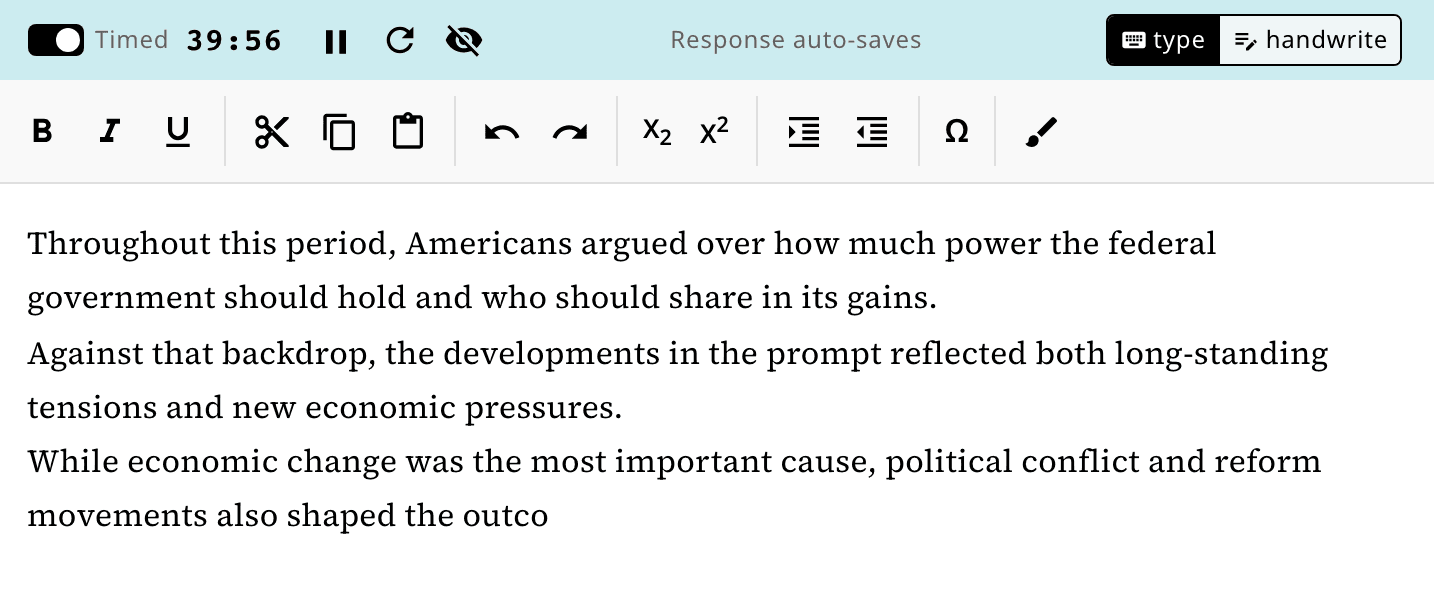
The time to plan for on exam day. Pause it or turn it off, and your response saves as you go.
Submit for a score out of 6
Your response is scored against the scoring guidelines written for that question. Your first score is included.
Feedback on every part
A summary at the top tells you what to work on next. Below it, each part shows whether you earned the point and what the scoring guidelines were looking for.
Detailed Feedback
Part A: 1/1 point
You argue that postwar British taxation and control transformed loyal colonists into opponents of Parliament and the king, establishing a clear line of reasoning about substantial change.
Part B: 0/1 point
You describe the colonies' loyalty in 1754 and Britain's postwar debt, but you do not develop a broader historical context beyond the developments directly at issue in the prompt.
Part C1: 1/1 point
You identify numerous specific, relevant examples, including the Stamp Act, Declaratory Act, and First Continental Congress.
Questions about the LEQ
How many responses can I get scored?
You can read every question without a plan. Your first scored response is included. A plan unlocks unlimited scoring.
Do I still choose between three prompts?
Not on the exam. Beginning with the May 2027 exam, the LEQ is one required broad prompt. Most questions here give you one prompt in that format, and some earlier ones still list three to choose from.
How is the LEQ different from the DBQ?
The LEQ has no documents, so every piece of evidence comes from what you know. The DBQ gives you seven documents and 60 minutes, including a reading period.
What reasoning will the prompt ask for?
Comparison, causation, or continuity and change over time. Row D checks that you use that reasoning to structure your argument.
Can I write my answer by hand?
Yes. Switch the editor to handwrite, write on paper, and add a photo of your page.
More AP US History practice
See the LEQ rubric points students miss most, from responses scored on Fiveable.
Write your first LEQ
Pick one from the list, or let us choose for you.
Teaching AP US History? Assign these LEQs to your class