AP US History DBQ Practice
27 Document-Based Questions written in the AP format. Pick one, read the prompt and all seven documents, and write your essay. Fiveable scores each DBQ response part by part on the AP rubric.
Your first scored response is included. A plan unlocks unlimited scoring.
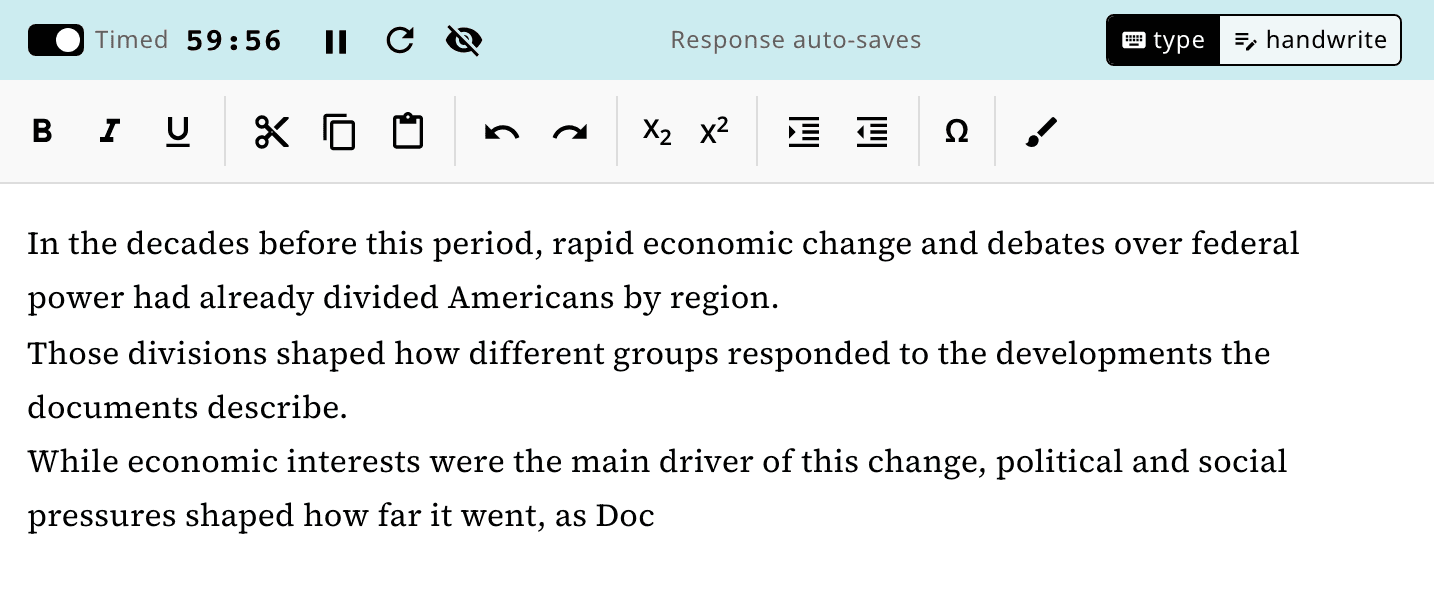
27 questions
sorted by unit
European economic exploitation of Indigenous peoples and resources
Unit 1: Native Societies & Early Encounters, 1491-1607
Evaluate the extent to which economic interests shaped European encounters with Indigenous peoples in North America and the Caribbean from 1492 to 1607.
Respond to the prompt with a historically defensible thesis or claim that establishes a line of reasoning.
Describe a broader historical context relevant to the prompt.
Support an argument using at least four of the provided documents.
Use at least one additional piece of specific historical evidence beyond the documents.
For at least two documents, explain how or why the document's point of view, purpose, historical situation, or audience is relevant.
Demonstrate a complex understanding through sophisticated argumentation and/or effective use of evidence.
Document 1
Source: Christopher Columbus, first-voyage journal, October 1492, as preserved in Bartolomé de las Casas’s abstract; Clements R. Markham translation, 1893. The claims about Indigenous religion are Columbus’s perspective, not established fact. Public-domain text; excerpt, omissions marked.
They should be good servants and intelligent, for I observed that they quickly took in what was said to them, and I believe that they would easily be made Christians, as it appeared to me that they had no religion, our Lord being pleased, will take hence, at the time of my departure, six natives for your Highnesses that they may learn to speak. I saw no beast of any kind except parrots, on this island.
[...]
They brought skeins of cotton thread, parrots, darts, and other small things, which it would be tedious to recount, and they give all in exchange for anything that may be given to them. I was attentive, and took trouble to ascertain if there was gold.
Document 2
Source: Spanish Crown, Requerimiento, 1513, English translation, excerpts. Omissions marked. Source: https://www.sfu.ca/~palys/Requerimiento.pdf
One of these Pontiffs, who succeeded that St. Peter as Lord of the world, in the dignity and seat which I have before mentioned, made donation of these isles and Tierra-firme to the aforesaid King and Queen and to their successors, our lords, with all that there are in these territories [...]
But, if you do not do this, and maliciously make delay in it, I certify to you that, with the help of God, we shall powerfully enter into your country, and shall make war against you in all ways and manners that we can, and shall subject you to the yoke and obedience of the Church and of their Highnesses; we shall take you and your wives and your children, and shall make slaves of them [...]
And that we have said this to you and made this Requisition, we request the notary here present to give us his testimony in writing, and we ask the rest who are present that they should be witnesses of this Requisition.
Document 3
Source: Álvar Núñez Cabeza de Vaca, Narrative, 1542, chapter 16; Buckingham Smith translation, reprinted in Spanish Explorers in the Southern United States, 1528–1543 (1907), pp. 56–57. Excerpt; omissions marked. Source: https://www.gutenberg.org/files/42841/42841-h/42841-h.htm#Page_56
The Indians would beg me to go from one quarter to another for things of which they have need; for in consequence of incessant hostilities, they cannot traverse the country, nor make many exchanges. With my merchandise and trade I went into the interior as far as I pleased, and travelled along the coast forty or fifty leagues. The principal wares were cones and other pieces of sea-snail, conchs used for cutting, and fruit like a bean of the highest value among them, which they use as a medicine and employ in their dances and festivities. Among other matters were sea-beads. Such were what I carried into the interior; and in barter I got and brought back skins, ochre with which they rub and color the face, hard canes of which to make arrows, sinews, cement and flint for the heads, and tassels of the hair of deer that by dyeing they make red. [...] Wherever I went I received fair treatment, and the Indians gave me to eat out of regard to my commodities.
Document 4
Source: Bartolomé de las Casas, Dominican friar, A Brief Account of the Destruction of the Indies, composed 1542 and published 1552, petitioning Spanish royal authority to curb abuse; early English translation reproduced by Project Gutenberg and The American Yawp. His universal claims are advocacy, not neutral statistics. Public-domain text; excerpt, omissions marked.
Now the ultimate end and scope that incited the Spaniards to endeavor the Extirpation and Desolation of this People, was Gold only…
[...]
And this also is as really true that the Spaniards never received any injury from the Indians, but that they rather reverenced them as Persons descended from Heaven, until that they were compelled to take up Arms, provoked thereunto by repeated Injuries, violent Torments, and unjust Butcheries.
Document 5
Source: Pedro de Castañeda, participant in Coronado’s expedition, retrospective narrative written circa 1560 describing the 1541 Tiguex conflict; George Parker Winship translation, The Coronado Expedition, 1540–1542, 1898, pp. 498–499. Indigenous statements are mediated through a Spanish participant’s account. Public-domain text; excerpt, omissions marked.
It was impossible to persuade them to make peace, as they said that the Spaniards would not keep an agreement made with them. So they gave up about a hundred persons, women and boys, who did not want to leave them. Don Lope de Urrea rode up in front of the town without his helmet and received the boys and girls in his arms, and when all of these had been surrendered, Don Lope begged them to make peace, giving them the strongest promises for their safety. They told him to go away, as they did not wish to trust themselves to people who had no regard for friendship or their own word which they had pledged. As he seemed unwilling to go away, one of them put an arrow in his bow ready to shoot, and threatened to shoot him with it unless he went off, and they warned him to put on his helmet, but he was unwilling to do so, saying that they would not hurt him as long as he stayed there.
Document 6
Source: Richard Hakluyt, Discourse on Western Planting, 1584, chapter headings I–III; submitted to Queen Elizabeth I. Spelling modernized; omissions marked. Public-domain text, 1877 edition, pp. 7, 13, 19. Source: https://encyclopediavirginia.org/primary-documents/the-people-of-america-crye-oute-unto-us-an-excerpt-from-discourse-on-western-planting-by-richard-hakluyt-the-younger-1584/
That this Western discovery will be greatly for the enlargement of the gospel of Christ, whereunto the princes of the Reformed Religion are chiefly bound, amongst whom her Majesty is principal.
[...]
That all other English trades are grown beggarly or dangerous, especially dangerous in all the King of Spain his dominions, where our men are driven to fling their Bibles and prayer books into the sea, and to forswear and renounce their religion and conscience, and consequently their obedience to her Majesty.
[...]
That this western voyage will yield unto us all the commodities of Europe, Africa and Asia, as far as we were wont to travel, and supply the wants of all our decayed trades.
Document 7
Source: Engraving after John White, printed in Frankfurt by J. Wechel for de Bry in the 1590 German edition of Thomas Harriot's report on the 'savages in Virginia,' 1590.
What the DBQ asks
The Document-Based Question is Question 1 in Section II of the AP US History exam. You get seven documents and write an essay that builds an argument from them and from your own knowledge of the period.
- 60 min
- including a 15-minute reading period
- 7 points
- across rows A to D
- 25%
- of your exam score
Part A: Thesis
A defensible claim that sets up a line of reasoning
1 pt
Part B: Contextualization
Broader developments that frame the prompt
1 pt
Part C: Evidence
Four documents used to support the argument, plus one example beyond them
3 pts
Part D: Analysis and reasoning
Sourcing for two documents, and a complex understanding of the topic
2 pts
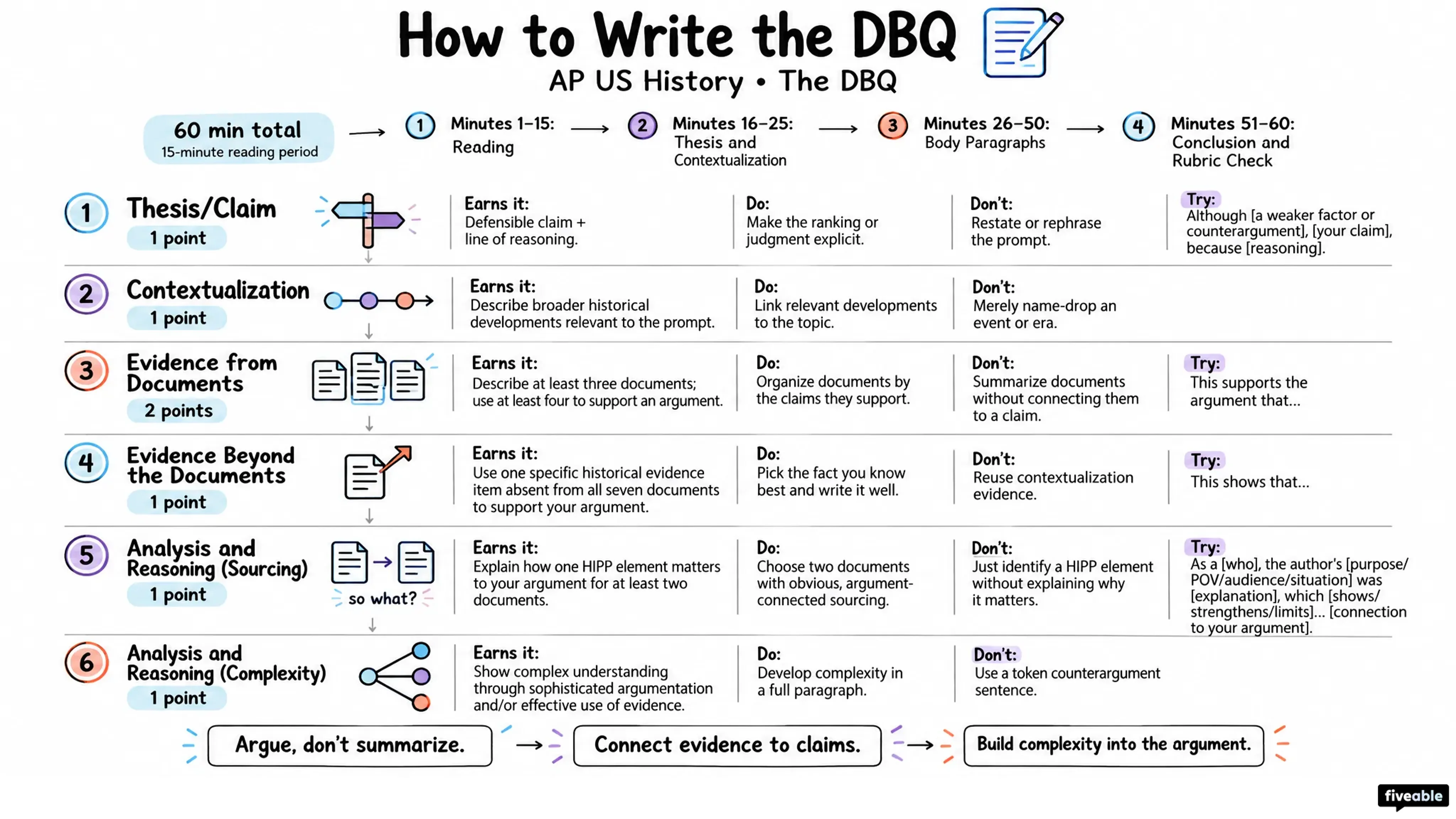
DBQ skill sheet
Every rubric point on one page: what earns it, what to do and what to avoid. Tap the sheet to see it full size.
How DBQ practice works
Each question follows the exam’s format, from the full prompt to a score on every part.
Read the prompt and documents
The prompt and all seven documents, laid out the way the exam shows them.
Write on a 60-minute timer
The time to plan for on exam day, reading period included. Pause it or turn it off, and your response saves as you go.
Submit for a score out of 7
Your response is scored against the scoring guidelines written for that question. Your first score is included.
Feedback on every part
A summary at the top tells you what to work on next. Below it, each part shows whether you earned the point and what the scoring guidelines were looking for.
Detailed Feedback
Part A: 0/1 point
Did not earn the point. Your thesis at the end of the first paragraph establishes categories (reform for marginalized communities, lifestyle reform, national identity controversies), but it does not directly address the core of the prompt. The prompt asks you to evaluate how tensions between traditional values and changing social conditions shaped responses. Your thesis lists the responses but does not connect them to these underlying tensions. To earn this point, you needed to make a clear claim about how the clash between old ways and new changes drove the specific political and cultural movements you discussed.
Part B: 1/1 point
Earned the point. You provided effective contextualization in your first body paragraph by describing the post-Reconstruction era, specifically mentioning the 13th, 14th, and 15th Amendments, Jim Crow laws, and the Freedmen's Bureau. This accurately sets the broader historical stage for your discussion of civil rights and the NAACP.
Part C1: 1/1 point
Earned the point. You accurately described the content of more than three documents.
Questions about the DBQ
How many responses can I get scored?
You can read every question without a plan. Your first scored response is included. A plan unlocks unlimited scoring.
How many documents do I need to use?
Using four documents to support your argument earns both document evidence points. Explaining the point of view, purpose, situation, or audience of two of them earns the sourcing point.
How is the DBQ different from the LEQ?
The DBQ gives you seven documents to build your argument from. The LEQ has no documents, so all of your evidence comes from what you know, and the exam gives it 40 minutes.
Are these real College Board questions?
No. We wrote them in the AP format, with seven documents each, and wrote scoring guidelines for each one.
Can I write my answer by hand?
Yes. Switch the editor to handwrite, write on paper, and add a photo of your page.
More AP US History practice
See the DBQ rubric points students miss most, from responses scored on Fiveable.
Write your first DBQ
Pick one from the list, or let us choose for you.
Teaching AP US History? Assign these DBQs to your class