AMSCO 5.5 Technology in the Industrial Age Notes

🌍AP World History: Modern Review
AMSCO 5.5 Technology in the Industrial Age Notes
🌍 AP World History: Modern
AMSCO 1.1 Developments in East Asia Notes
AMSCO 1.2 Developments in Dar al-Islam Notes
AMSCO 1.3 Developments in South and Southeast Asia Notes
AMSCO 1.4 Developments in the Americas Notes
AMSCO 1.5 Developments in Africa Notes
AMSCO 1.6 Developments in Europe Notes
AMSCO 1.7 Comparison in the Period from c.1200 to c.1450 Notes
AMSCO 2.1 The Silk Roads Notes
AMSCO 2.2 The Mongol Empire and the Modern World Notes
AMSCO 2.3 Exchange in the Indian Ocean Notes
AMSCO 2.4 Trans-Saharan Trade Routes Notes
AMSCO 2.5 Cultural Consequences of Connectivity Notes
AMSCO 2.6 Environmental Consequences of Connectivity Notes
AMSCO 2.7 Comparison of Economic Exchange Notes
AMSCO 3.1 European, East Asian, and Gunpowder Empires Expand Notes
AMSCO 3.2 Empires: Administrations Notes
AMSCO 3.3 Empires: Belief Systems Notes
AMSCO 3.4 Comparison in Land-Based Empires Notes
AMSCO 4.1 Technological Innovations Notes
AMSCO 4.2 Exploration: Causes and Events Notes
AMSCO 4.3 Columbian Exchange Notes
AMSCO 4.4 Maritime Empires Link Regions Notes
AMSCO 4.5 Maritime Empires Develop Notes
AMSCO 4.6 Internal and External Challenges to State Power Notes
AMSCO 4.7 Changing Social Hierarchies Notes
AMSCO 4.8 Continuity and Change from c.1450 to c.1750 Notes
AMSCO 5.1 The Enlightment Notes
AMSCO 5.2 Nationalism and Revolutions Notes
AMSCO 5.3 Industrial Revolution Begins Notes
AMSCO 5.4 Industrialization Spreads Notes
AMSCO 5.5 Technology in the Industrial Age Notes
AMSCO 5.6 Industrialization: Government's Role Notes
AMSCO 5.7 Economic Developments and Innovations Notes
AMSCO 5.8 Reactions to the Industrial Economy Notes
AMSCO 5.9 Society and the Industrial Age Notes
AMSCO 5.10 Continuity and Change in the Industrial Age Notes
AMSCO 6.1 Rationales for Imperialism Notes
AMSCO 6.2 State Expansion Notes
AMSCO 6.3 Indigenous Responses to State Expansion Notes
AMSCO 6.4 Global Economic Development Notes
AMSCO 6.5 Economic Imperialism Notes
AMSCO 6.6 Causes of Migration in an Interconnected World Notes
AMSCO 6.7 Effects of Migration Notes
AMSCO 6.8 Causation in the Imperial Age Notes
AMSCO 7.1 Shifting Power Notes
AMSCO 7.2 Causes of World War I Notes
AMSCO 7.3 Conducting World War I Notes
AMSCO 7.4 Economy in the Interwar Period Notes
AMSCO 7.5 Unresolved Tensions After World War I Notes
AMSCO 7.6 Causes of World War II Notes
AMSCO 7.7 Conducting World War II Notes
AMSCO 7.8 Mass Atrocities Notes
AMSCO 7.9 Causation in Global Conflict Notes
AMSCO 8.1 Setting the Stage for the Cold War and Decolonization Notes
AMSCO 8.2 The Cold War Notes
AMSCO 8.3 Effects of the Cold War Notes
AMSCO 8.4 Spread of Communism Notes
AMSCO 8.5 Decolonization after 1900 Notes
AMSCO 8.6 Newly Independent States Notes
AMSCO 8.7 Global Resistance to Established Power Structure Notes
AMSCO 8.8 End of the Cold War Notes
AMSCO 8.9 Causation in the Age of the Cold Ward and Decolonization Notes
AMSCO 9.1 Advances in Technology and Exchange Notes
AMSCO 9.2 Technological Advancements and Limitations Notes
AMSCO 9.3 Technology and the Environment Notes
AMSCO 9.4 Economics in the Global Age Notes
AMSCO 9.5 Calls for Reforms and Responses Notes
AMSCO 9.6 Globalized Culture Notes
AMSCO 9.7 Resistance to Globalization Notes
AMSCO 9.8 Institutions Developing in a Globalized World Notes
AMSCO 9.9 Continuity and Change in a Globalized World Notes
Overview
AMSCO Topic 5.5, Technology in the Industrial Age (AMSCO p. 310-316), covers how new technologies reshaped economic production between 1750 and 1900. The chapter traces two big waves: the first industrial revolution built on coal, steam power, and iron, and the second industrial revolution built on steel, chemicals, electricity, and precision machinery. It also explains how railroads, steamships, and the telegraph linked interior regions to global trade for the first time.
The chapter's essential question is direct: how did technology shape economic production from 1750 to 1900? The short answer is that fossil fuels (first coal, then oil) gave humans far more energy than ever before, and that energy powered machines that moved goods, people, and information at unprecedented speed. This builds on the spread of industrialization from AMSCO 5.4 and sets up the government and economic responses in AMSCO 5.6.
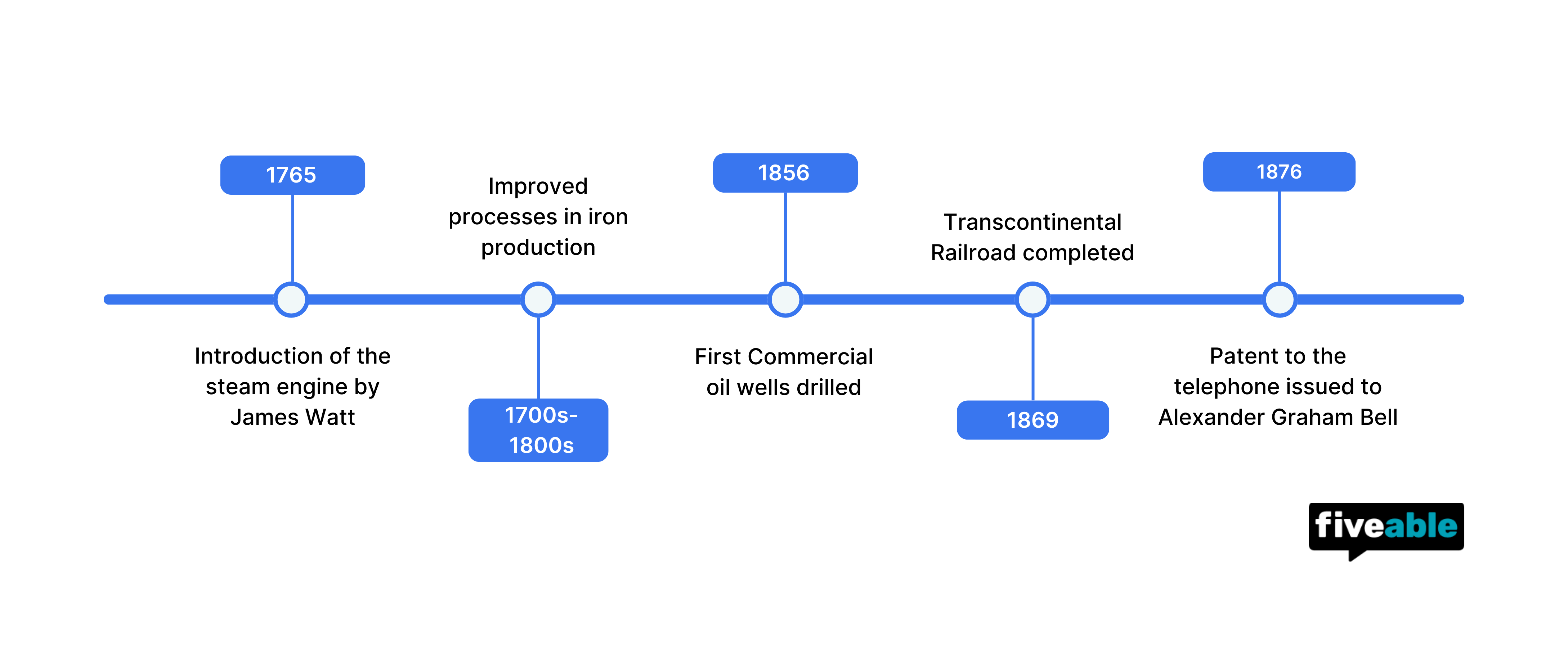
Timeline of technological milestones during the Industrial Age from 1750 to 1900. Image Courtesy of Isaiah Penny
Key Takeaways
- Coal-powered steam engines let factories operate away from rivers, while steamships no longer depended on wind. Coaling stations became a motive for imperialism.
- Coke boosted iron production, Henry Cort's wrought iron was easier to shape than cast iron, and the Bessemer Process made mass-produced steel possible.
- Oil was first valued for kerosene, but gasoline became its leading product after automobiles arrived. Electrification brought street lighting and electric street trains.
- Bell patented the telephone, Edison's improved transmitter made it practical, and Marconi sent a radio signal across the Atlantic.
- Railroads, steamships, and the telegraph opened interior regions to trade and migration; industrialized countries also established colonies to protect access to resources and markets.
The Coal Revolution
Coal was the power source that made the Industrial Revolution mobile. The first factories ran on water power, which chained them to riverbanks. Coal-powered steam engines could be built anywhere, turned on when needed, and turned off when not. That flexibility changed everything.
- James Watt's 1765 version of the steam engine harnessed coal cheaply to create steam, which powered machinery in textile factories.
- Within 50 years, steam was also powering trains.
- Coal, like oil later, is a fossil fuel, an energy source derived from plant and animal remains. The fossil fuels revolution massively increased the energy available to human societies.
Steamships and Water Transportation
Steamships freed water travel from the wind. Ocean-going ships no longer waited on favorable winds, and river steamboats could travel upstream at up to five miles per hour instead of being towed by people and animals along the shore.
- The SS Savannah became the first steam-powered ship to cross the Atlantic Ocean in 1819.
- Over time, steamships replaced sailing ships in worldwide travel.
- Coaling stations at critical points on trade routes, like Cape Colony in South Africa and various Pacific islands, became essential refueling points. Remember these for Unit 6: controlling coaling stations became a motive for imperialism.
Iron
Coal also made the mass production of iron possible. Through the 1700s and early 1800s, improved processes kept boosting iron output.
- Coke, a refined form of coal, allowed much larger iron-producing furnaces.
- Cast iron was strong but brittle, hard to stretch and shape.
- In 1784, Englishman Henry Cort patented the process for making wrought iron, which was less strong but far more workable.
- Both forms were valuable for transportation and industry, but the real upgrade (steel) was still coming.
The Second Industrial Revolution
The second industrial revolution hit in the late 19th and early 20th centuries, led by the United States, Great Britain, and Germany. Here's the contrast worth memorizing: the first industrial revolution was about textiles, steam power, and iron. The second was about steel, chemicals, precision machinery, and electronics.
Steel Production
Steel is an alloy of iron and carbon, and it's both strong and versatile, fixing cast iron's brittleness problem. Mass production became possible with the Bessemer Process in 1856, which blasted molten metal with air to remove impurities and keep the metal from solidifying. Refined over the years, the Bessemer Process made steel the backbone of industrial society, from railroads to buildings to machinery.
Oil
The first commercial oil wells were drilled in the mid-1800s, opening a vast new energy resource. Petroleum's importance shifted over time:
- At first, the key product was kerosene, used for lighting and heaters. In 1847, inventors developed chemical techniques to extract kerosene from petroleum.
- Those techniques fed into precision machinery and the internal combustion engine, which led to automobile and airplane technologies.
- Once automobiles arrived in the early 1900s, gasoline overtook kerosene as petroleum's most important product.
Electricity
Harnessing electrical power required an effective electrical generator. In 1882, the first public power station began production in London. Electrification then brought street lighting and electric street trains in the 1890s, lighting cities and changing urban life.
Communications
Electricity and electronics drove a communications revolution that made worldwide, near-instant communication a reality.
- Inventors had been trying to transmit sound electrically since the early 19th century. Alexander Graham Bell received the patent for the telephone in 1876.
- Early phone systems were notoriously low quality. Thomas Edison's 1886 refined voice transmitter made telephone use practical.
- Radio grew out of the experiments of Italian physicist Guglielmo Marconi, who sent and received a radio signal across the Atlantic Ocean in 1901. After further refinements, radio became a form of popular mass media with an impact unlike anything before it.
Global Trade and Migration
Railroads, steamships, and the telegraph made exploration, development, and communication possible in interior regions around the globe, not just coastal cities. That's the big-picture takeaway the AP exam cares about: these technologies increased trade and migration by opening up the inside of continents.
Railroads and the Telegraph
- The telegraph allowed immediate communication across long distances.
- The Transcontinental Railroad, completed in 1869 in Utah, connected the Atlantic and Pacific oceans and fueled U.S. industrial growth.
- Like canals, railroads were heavily subsidized by public funds.
- The United States' vast natural resources (timber, coal, iron, oil) plus the ability to transport them efficiently turned it into an industrial nation.
Capital, Colonies, and Connection
- The desire for capital, money available to invest in a business, drove expansion at home and abroad.
- The railroad, steamship, and telegraph directly linked farmers, miners, manufacturers, customers, and investors globally for the first time in history.
- As Great Britain, Germany, and the United States intensified industrialization, they needed more resources. Industrialized countries protected their access to resources and markets by establishing colonies. This is the bridge to imperialism in Unit 6.
Key Terms to Know
| Term | Why it matters |
|---|---|
| Coal | The fossil fuel that powered steam engines and factories, replacing fixed water power with mobile, on-demand energy. |
| Steam engine | James Watt's 1765 version cheaply converted coal into power for textile factories, then trains and ships. |
| James Watt | His improved steam engine made coal power inexpensive and practical, kickstarting industrial energy use. |
| Coaling stations | Refueling points at critical spots on trade routes, like Cape Colony, that steamships depended on and empires fought to control. |
| Wrought iron | Henry Cort's 1784 patented process produced workable iron, an upgrade over brittle cast iron for transport and industry. |
| Second industrial revolution | The late 19th and early 20th century wave of steel, chemicals, precision machinery, and electronics led by the US, Britain, and Germany. |
| Steel | An alloy of iron and carbon, strong and versatile, that became the backbone of industrial society. |
| Bessemer Process | The 1856 method of blasting molten metal with air to remove impurities, making mass-produced steel possible. |
| Oil | A fossil fuel tapped by commercial wells in the mid-1800s, first valued for kerosene and later for gasoline. |
| Internal combustion engine | The engine that turned petroleum into automobile and airplane power in the early 1900s. |
| Electrification | The spread of electric power after London's first public power station opened in 1882, bringing street lighting and electric street trains in the 1890s. |
| Alexander Graham Bell | Received the telephone patent in 1876, enabling voice communication across distances. |
| Guglielmo Marconi | Italian physicist whose 1901 transatlantic radio signal launched radio as a mass medium. |
| Telegraph | The technology that made communication immediate and, with railroads and steamships, opened interior regions to trade and migration. |
| Transcontinental Railroad | Completed in 1869, it connected the Atlantic and Pacific and powered U.S. industrial growth with public subsidies. |
| Capital | Money available to invest in a business, the driving force behind industrial expansion at home and abroad. |
Practice and Next Steps
Pair these notes with the Topic 5.5 Technology in the Industrial Age course study guide for the College Board framing of these developments, and browse the full set of AP World AMSCO notes to keep moving through Unit 5. Next up is AMSCO 5.6 on the government's role in industrialization.
To check yourself, run through guided multiple-choice practice on Unit 5, look up any fuzzy vocabulary in the AP World key terms glossary, and try FRQ practice with instant scoring to see how technology-and-economy questions get asked on the exam.
Frequently Asked Questions
What is the second industrial revolution in AP World?
The second industrial revolution was the wave of innovation in the late 19th and early 20th centuries centered on steel, chemicals, precision machinery, and electronics, led by the United States, Great Britain, and Germany. It contrasts with the first industrial revolution, which focused on textiles, steam power, and iron. Key developments include the Bessemer Process (1856) for mass-producing steel and the first public power station in London (1882).
What does AMSCO chapter 5.5 cover in AP World?
AMSCO 5.5, Technology in the Industrial Age (p. 310-316), covers how technology shaped economic production from 1750 to 1900. It moves through the coal and steam revolution, iron production, the second industrial revolution (steel, oil, electricity, communications), and how railroads, steamships, and the telegraph expanded global trade and migration into interior regions.
Why was coal so important to the Industrial Revolution?
Coal made energy mobile and dependable. Water power tied factories to rivers and wind power was unreliable, but coal-fired steam engines could be built anywhere and switched on whenever needed. James Watt's 1765 steam engine harnessed coal cheaply for textile factories, and within 50 years steam was powering trains and ships, with coaling stations like Cape Colony becoming critical refueling points on trade routes.
What's the difference between iron and steel in the Industrial Revolution?
Cast iron was strong but brittle and hard to shape, and Henry Cort's 1794 wrought iron process traded some strength for workability. Steel, an alloy of iron and carbon, is both strong and versatile, but it couldn't be mass-produced until the Bessemer Process in 1856 blasted molten metal with air to remove impurities. That breakthrough made steel the backbone of industrial society.
How does Topic 5.5 show up on the AP World exam?
Topic 5.5 connects to the skill of explaining how technology shaped economic production over time, so expect questions linking fossil fuels and machines to increased production, trade, and migration. The railroad-steamship-telegraph trio opening up interior regions globally is a classic causation point, and coaling stations and colonies set up Unit 6 imperialism arguments. Practice these connections with Fiveable's AP World guided practice.
See Fiveable more often in Google
Mark Fiveable as a preferred source and Google is more likely to show you our guides in Top Stories, with a "preferred" badge in AI Mode and AI Overviews.