What are the AP Physics 1 big ideas?
AP Physics 1 groups all of its content under seven Big Ideas. Rather than treating each unit as a separate topic, the College Board wants you to see recurring patterns: forces cause acceleration, interactions transfer energy, and conservation laws constrain what can happen. The Big Ideas give you that pattern-recognition framework.
The seven Big Ideas are: (1) Objects and Systems, (2) Force Interactions, (3) Force and Motion, (4) Interactions and Energy, (5) Conservation and Transfer, (6) Waves, and (7) Simple Harmonic Motion. They appear across all units and are tested together on every FRQ.
Why Big Ideas matter on the exam
AP Physics 1 FRQs rarely test one idea in isolation. A question about a collision will invoke Big Idea 1 (defining the system), Big Idea 5 (momentum conservation), and Big Idea 4 (energy changes). Knowing which Big Idea applies tells you which tools to reach for.
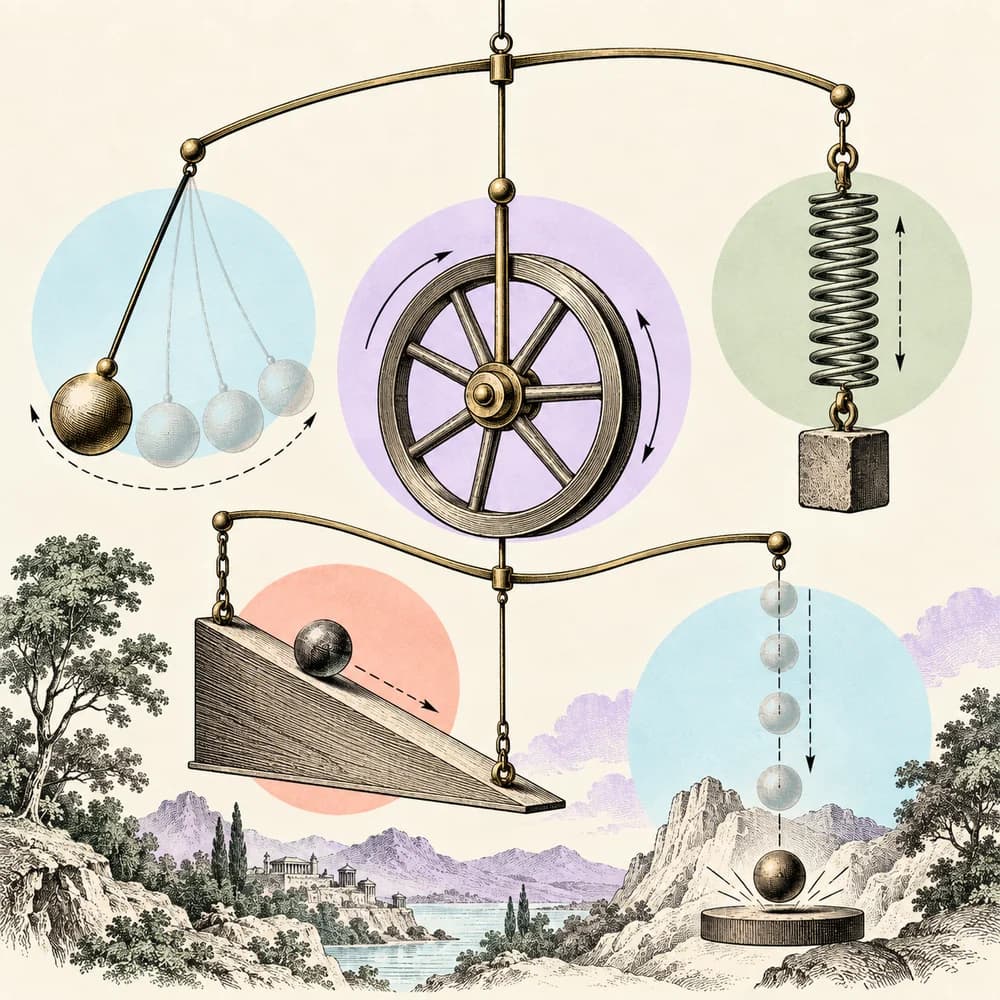
How Big Ideas connect across units
Big Ideas 2 and 3 handle Units 1 through 4 (kinematics, dynamics, circular motion, rotation). Big Ideas 4 and 5 run through Units 4 through 6 (energy, momentum, simple harmonic motion). Big Ideas 6 and 7 anchor Units 7 and 8. Big Idea 1 is the setup layer for every single unit.
Conservation as the unifying thread
Big Ideas 4 and 5 together establish that energy, momentum, and angular momentum are conserved in closed systems. This accounting logic appears in collisions, oscillations, wave energy, and rotational dynamics, making it the most cross-cutting reasoning pattern in the course.
The core insight across all seven Big IdeasPhysics 1 is fundamentally about interactions: what they are (Big Ideas 1 and 2), what they cause (Big Idea 3), what they transfer (Big Idea 4), what they conserve (Big Idea 5), and how they propagate through media (Big Ideas 6 and 7). Every problem you solve is asking you to describe an interaction and predict its outcome using one or more of these frameworks.
Big ideas review notes
Big Idea 1
Objects and Systems
Before any analysis, you must define what you are studying. An object is treated as a point mass when internal structure does not matter. A system is a defined collection of objects, and where you draw the system boundary determines whether forces are internal or external and whether energy or momentum crosses the boundary.
- System boundary: The imaginary line separating the system from its surroundings; forces crossing it are external, forces within it are internal.
- Internal structure: Properties like mass distribution and charge that matter when analyzing rotation, collisions, or electric interactions.
- Point mass approximation: Treating an extended object as if all its mass is at one point, valid when rotation and internal structure are irrelevant.
Can you redraw a scenario with a different system boundary and correctly identify which forces become external?
| Scenario | Useful system choice | Why |
|---|
| Two-cart collision | Both carts together | Internal forces cancel; momentum of system is conserved if no external horizontal force |
| Block on a spring | Block only | Spring force is external; lets you apply Newton's second law directly |
| Earth-ball free fall | Earth plus ball | Gravitational PE is a property of the system, not one object |
Big Idea 2
Force Interactions
Every interaction between two objects can be described as a force. Forces come in contact types (normal, friction, tension, spring) and long-range types (gravity, electric). Newton's third law means every force has an equal and opposite reaction force on the other object. Free-body diagrams are the primary tool for representing this Big Idea.
- Contact force: A force that requires physical contact: normal force, static friction, kinetic friction, tension, spring force.
- Long-range force: A force that acts across a distance without contact: gravity and electric force in AP Physics 1.
- Newton's third law pair: Two forces that are equal in magnitude, opposite in direction, act on different objects, and are of the same type.
Given a scenario, can you identify every Newton's third law pair and confirm they act on different objects?
| Force type | Formula or rule | Direction rule |
|---|
| Gravity (near surface) | Fg = mg | Always straight down toward Earth's center |
| Normal force | Perpendicular to surface | Away from the surface, into the object |
| Kinetic friction | fk = mu_k * N | Opposite to direction of sliding motion |
| Spring force | Fs = -kx (Hooke's law) | Opposite to displacement from equilibrium |
Big Idea 3
Force and Motion
Net force determines acceleration. This Big Idea is Newton's second law in its broadest form: it applies to linear motion (a = Fnet/m), rotational motion (alpha = tau_net/I), and circular motion (Fnet = mv^2/r toward center). Equilibrium is the special case where net force and net torque are both zero.
- Newton's second law (linear): a = Fnet/m; the acceleration of an object equals the net force divided by its mass.
- Rotational analog: alpha = tau_net/I; angular acceleration equals net torque divided by rotational inertia.
- Centripetal acceleration: ac = v^2/r; always directed toward the center of the circular path, produced by the net inward force.
Can you write a correct Newton's second law equation for an object on an incline, in circular motion, and rotating about a fixed axis?
| Motion type | Key equation | What plays the role of 'mass' |
|---|
| Linear | Fnet = ma | Mass m |
| Rotational | tau_net = I * alpha | Rotational inertia I |
| Circular | Fnet = mv^2/r | Mass m (net force is centripetal) |
Big Idea 4
Interactions and Energy
Interactions transfer energy between objects or convert it between forms. The work-energy theorem (W_net = delta KE) connects force and displacement to kinetic energy change. Potential energy (gravitational: mgh, spring: 1/2 kx^2) is stored in systems. Power is the rate of energy transfer: P = W/t = Fv.
- Work-energy theorem: The net work done on an object equals its change in kinetic energy: W_net = delta KE.
- Gravitational PE: Ug = mgh; stored energy due to position in a gravitational field, defined relative to a chosen reference height.
- Elastic PE: Us = 1/2 kx^2; energy stored in a compressed or stretched spring, where x is displacement from equilibrium.
- Power: P = W/t = Fv; the rate at which work is done or energy is transferred.
Can you use energy bar charts (LOL diagrams) to track energy forms before and after an interaction, including thermal energy from friction?
| Energy form | Formula | When it appears |
|---|
| Kinetic | KE = 1/2 mv^2 | Any moving object |
| Gravitational PE | Ug = mgh | Object at height h above reference |
| Elastic PE | Us = 1/2 kx^2 | Spring displaced by x from equilibrium |
| Thermal (internal) | No simple formula; Q = delta E_thermal | Friction or inelastic collision |
Big Idea 5
Conservation and Transfer
Momentum, energy, and angular momentum are conserved in closed systems. Momentum conservation (p_total = constant when Fnet_ext = 0) governs collisions and explosions. Angular momentum conservation (L = I*omega = constant when tau_net_ext = 0) governs spinning systems. Energy is always conserved, but mechanical energy is only conserved when no non-conservative forces do work.
- Linear momentum: p = mv; conserved when no net external force acts on the system.
- Impulse-momentum theorem: J = Fnet * delta t = delta p; impulse equals the change in momentum.
- Angular momentum: L = I * omega; conserved when no net external torque acts on the system.
- Elastic vs. inelastic collision: Elastic: both momentum and kinetic energy conserved. Inelastic: momentum conserved, kinetic energy not fully conserved.
Can you set up a momentum conservation equation for a two-object collision and separately determine whether kinetic energy was conserved?
| Quantity | Conserved when | Equation |
|---|
| Linear momentum | No net external force | m1v1i + m2v2i = m1v1f + m2v2f |
| Angular momentum | No net external torque | I1*omega1 = I2*omega2 |
| Mechanical energy | No non-conservative work | KE_i + PE_i = KE_f + PE_f |
Big Idea 6
Waves
Waves transfer energy and momentum without permanently moving mass. Mechanical waves require a medium; wave speed depends on medium properties. Key relationships: v = f*lambda, and for a string v = sqrt(T/mu). Superposition produces interference (constructive and destructive) and standing waves. Sound is a longitudinal mechanical wave; the Doppler effect shifts observed frequency when source or observer moves.
- Wave speed equation: v = f * lambda; wave speed equals frequency times wavelength.
- Superposition principle: When two waves overlap, the net displacement at any point is the sum of the individual displacements.
- Standing wave: A pattern formed by superposition of two identical waves traveling in opposite directions; nodes are points of zero displacement.
- Doppler effect: The observed frequency of a wave changes when the source and observer move relative to each other; approaching increases frequency, receding decreases it.
Can you determine the wavelengths of the first three harmonics for a string fixed at both ends and for a pipe open at one end?
| Boundary condition | Fundamental wavelength | Harmonic pattern |
|---|
| String fixed at both ends | lambda_1 = 2L | All harmonics: lambda_n = 2L/n |
| Pipe open at both ends | lambda_1 = 2L | All harmonics: lambda_n = 2L/n |
| Pipe closed at one end | lambda_1 = 4L | Odd harmonics only: lambda_n = 4L/n, n = 1,3,5... |
Big Idea 7
Simple Harmonic Motion
SHM occurs when a restoring force is proportional to displacement from equilibrium (F = -kx for springs, F = -mg*sin(theta) approximated as -mg*theta for small-angle pendulums). Period depends on system properties, not amplitude. Energy oscillates between kinetic and potential. SHM connects directly to Big Ideas 4 and 5 through energy conservation.
- Restoring force: A force directed back toward equilibrium, proportional to displacement: F = -kx.
- Period of a mass-spring system: T = 2*pi*sqrt(m/k); depends on mass and spring constant, not amplitude.
- Period of a simple pendulum: T = 2*pi*sqrt(L/g); depends on length and gravitational field strength, not mass or amplitude (for small angles).
- Energy in SHM: Total mechanical energy E = 1/2 kA^2 is constant; KE is maximum at equilibrium, PE is maximum at maximum displacement.
Can you predict how the period of a pendulum changes if you double its length, move it to the Moon, or double the mass of the bob?
| Change | Effect on period of mass-spring | Effect on period of pendulum |
|---|
| Double the mass | Increases by factor of sqrt(2) | No change |
| Double the spring constant / halve the length | Decreases by factor of sqrt(2) | Decreases by factor of sqrt(2) |
| Move to Moon (g decreases) | No change | Increases (longer period) |
| Double the amplitude | No change | No change |