AP English Language Synthesis Essay Practice
45 synthesis essay prompts written in the AP format. Pick one, read the six sources, and write your argument. Fiveable scores each Synthesis Essay response part by part on the AP rubric.
Your first scored response is included. A plan unlocks unlimited scoring.
45 questions
sorted by unit
Congestion pricing fairness and traffic management effectiveness
Traffic congestion imposes significant costs on American cities, from lost time and wasted fuel to air pollution and slower emergency response. One policy response, known as congestion pricing, charges drivers a fee to enter or use crowded roads at busy times. In January 2025, New York City became the first city in the United States to adopt such a program, charging most passenger vehicles nine dollars to enter Manhattan south of 60th Street. Supporters argue that pricing reduces gridlock and funds public transportation, while critics contend that it burdens commuters who have few alternatives to driving. The debate has continued even as remote work, ride-hailing services, and online delivery have changed how people and goods move through cities.
Carefully read the following six sources, including the introductory information for each source. Write an essay that synthesizes material from at least three of the sources and develops your position on whether congestion pricing is a fair and effective way for American cities to manage traffic congestion.
Source A (Short article)
Source B (AbuLibdeh book chapter)
Source C (Badstuber article)
Source D (United States Department of Transportation press release)
Source E (chart from Metropolitan Transportation Authority data)
Source F (chart from Bureau of Transportation Statistics data)
Respond to the prompt with a thesis that presents a defensible position.
Select and use evidence from at least three of the provided sources to support your line of reasoning. Indicate clearly the sources used through direct quotation, paraphrase, or summary. Sources may be cited as Source A, Source B, etc., or by using the description in parentheses.
Explain how the evidence supports your line of reasoning.
Use appropriate grammar and punctuation in communicating your argument.
Source A
Short, John Rennie. "After a Delay, New York City Is Moving Ahead with Congestion Pricing to Improve Traffic, Air Quality and Public Transit." The Conversation, 10 Apr. 2024, updated 15 Nov. 2024.
The following is excerpted from a commentary article by an urban policy scholar. The article was published by The Conversation, a nonprofit news organization that publishes articles by academics and researchers, shortly before New York City's congestion pricing program began.
New York City is poised to launch the first congestion pricing plan to reduce traffic in a major U.S. metropolitan area on Jan. 5, 2025. Like many journeys in the Big Apple, this one has been punctuated by delays, including a pause that Gov. Kathy Hochul imposed in early June 2024 as the plan was about to launch.
Now, however, Hochul has resuscitated the plan with a new US$9 fee for private cars to enter Manhattan, down from $15 in the earlier iteration. It remains to be seen whether this version can withstand resistance and legal challenges from New Jersey officials, car commuters and President-elect Donald Trump.
Assuming that the system starts up, it’s expected to significantly reduce gridlock in Manhattan and generate billions of dollars to improve public transit citywide.
The basic idea is simple. To enter the Congestion Relief Zone, which covers Manhattan south of 60th Street, under new rates announced by Hochul, large trucks will now pay $21.60, small trucks $14.40, passenger vehicles $9 and motorcycles $4.50. Ride-share vehicles and taxis will pay $1.50 and $0.75, respectively. Peak hours run from 5 a.m. to 9 p.m. on weekdays and 9 a.m. to 9 p.m. on weekends; overnight tolls are discounted by 75%.
Passenger vehicles that are not part of the E-ZPass electronic toll collection system will pay $13.50 during peak periods.
Evidence from cities around the world shows that charging motorists fees for driving into city centers during busy periods is a rarity in urban public policy: a measure that works and is cost-effective. Congestion pricing has succeeded in cities including London, Singapore and Stockholm, where it has eased traffic, sped up travel times, reduced pollution and provided funds for public transportation and infrastructure investments.
As an urban policy scholar, I’m looking forward to seeing New York’s plan go into effect. There may well be surprises and adjustments as officials see how it works in practice. But given the heavy costs that traffic imposes on public health and productivity, I’m encouraged to see a major U.S. city finally test this approach.
Congestion pricing in New York City has traveled a long and winding road to adoption.
Congestion pricing is a response to externalities – costs or benefits that are generated by one party but incurred by another. Clogged city streets and air pollution are externalities created by urban car users, many of whom live outside the city.
This concept has been around for some time. British economist Arthur Pigou discussed it as early as 1920 as part of his attempt to remedy the suboptimal workings of the market system. In Pigou’s view, taxing harmful activities would discourage people from engaging in them.
Other thinkers took up this idea. In 1963, Canadian economist William Vickrey, a future Nobel laureate, argued that roads were scarce resources that needed to be valued by imposing costs on users.
This approach is behind behavioral economics, the policy strategy of using “nudges” that preserve choice but encourage certain actions. Congestion pricing assumes that increased prices will make people heading into New York think more carefully about their travel patterns, and about alternatives to driving.
Source B
AbuLibdeh, Ammar. "Traffic Congestion Pricing: Methodologies and Equity Implications." Urban Transport Systems, edited by Hamid Yaghoubi, IntechOpen, 2017, doi:10.5772/66569.
The following is excerpted from a scholarly chapter on congestion pricing published in an open-access academic book on urban transportation.
In transportation planning, equity is a central element because transportation is perceived as a basic right. That is, access to transportation services is a right to members of all social groups within the society. Thus, many scholars have identified equity concerns as one of the main obstacles to public acceptance of congestion pricing proposals. Indeed, a claim that potential equity impacts have not been carefully examined makes the implementation of congestion pricing very slow.
Equity is a major concern that is raised prior to and after congestion pricing implementation. This is due to imposing charges on access to roadways that were previously free, which may be perceived to harm especially lower income groups because they will either have to pay the fees or be priced off the roads. Advocates of congestion pricing argue that implementing this system is more equitable and less regressive than the current systems (e.g., motor fuel taxes, property taxes, license fees and registration fees) to manage the use of roads as well as to fund transportation improvements. In short, drivers who contribute most to road congestion under a congestion pricing scheme will pay more for using transportation facilities. Critiques of the current financing system in North America suggest that it is regressive and not equitable since low-income drivers pay a higher proportion of their income for transportation fees and taxes than the high-income drivers. In terms of congestion pricing, some critics argue that congestion pricing is unfair, particularly to lower income people who need to drive, because it imposes “double charging”, given that drivers already pay registration and fuel taxes. Moreover, some drivers pay more than others which raises debate about what pricing is equitable and how modifications can be fair and advantageous to the drivers. Another dimension of equity of congestion pricing is its ability to reduce air pollution. This is particularly beneficial to low-income neighbourhoods that are sometimes located in the vicinity of major roads and other transportation facilities.
. . .
In terms of equity impacts, the literature on road pricing has focused mainly on income equity issues and to a lesser extent on spatial equity. In general, the three congestion pricing projects that were implemented in the Asian city (Singapore) and the two European cities (London and Stockholm) gave equity only limited attention and evaluation. When charges are imposed on travellers, these result in perceived road user’s “winners” and “losers”. This is attributed to the way that travellers value time savings, where some road users value these savings more than the fees they pay. The losers, who are tolled off, may change their travel routes, shift to off-peak times, change the mode of transportation, shift to carpool or make fewer trips. In Singapore, gainers from congestion pricing project were found to outnumber losers 52 to 48% [50]. Also, after implementing congestion pricing in Singapore it was found that residents outside the priced zone considered this project as negative while residents inside the priced zone considered it positive. The enhancement of public transit before implementing congestion pricing can be considered a way to achieve equity between different income groups. In Stockholm, transit service was extended by 7% by adding 16 new bus lines, additional departure for train lines and new park-ride facilities 4 months before the start of the tolling.
Source C
Badstuber, Nicole. "London Congestion Charge: What Worked, What Didn’t, What Next." The Conversation, 2 Mar. 2018.
The following is excerpted from a commentary article by a researcher who studies urban transport governance at University College London. London has charged drivers to enter its city center since 2003.
When London’s congestion charge was introduced by the city’s first mayor, Ken Livingstone, he hoped the charge would reduce congestion, radically improve bus services, make journey times more consistent for drivers and increase efficiency for those distributing goods and services throughout the city.
Key measures show it has been a success: in 2006, Transport for London (TfL) reported that the charge reduced traffic by 15% and congestion – that is, the extra time a trip would take because of traffic – by 30%. This effect has continued to today. Traffic volumes in the charging zone are now nearly a quarter lower than a decade ago, allowing central London road space to be given over to cyclists and pedestrians.
The charge covers a 21km² area in London. It’s a simple system: if you enter the zone between 7am and 6pm on a weekday, you pay a flat daily rate. The charge has risen gradually from £5 in 2003 to £11.50 today. Residents receive a 90% discount and registered disabled people can travel for free. Emergency services, motorcycles, taxis and minicabs are exempt.
. . .
London’s congestion charge succeeded for two key reasons: it had a clear and convincing premise, and it was just one part of larger efforts to improve travel across all forms of transport in the city. The case for congestion charging was simple: the charge would reduce traffic in the city centre and generate funds to reinvest in improving public transport services.
On the day the congestion charge was introduced in London, 300 extra buses were added to the Central London bus network to give people an alternative to driving and avert the anticipated mayhem. One year later, Livingstone reported that 29,000 more passengers had entered the charging zone by bus during the morning rush hour, compared to a year before. Between 2002 and 2014, the number of private cars coming into the zone fell by 39%.
But while car numbers are down, the number of private for hire vehicles – your minicabs and Ubers – is up. Trips by taxi and private for hire vehicle as the main mode of the journey increased by 9.8% between 2015 and 2016 alone – and 29.2% since 2000. Today, more than 18,000 different private hire vehicles enter the congestion charging zone each day, with peaks on Friday and Saturday nights.
This has reduced the speed of traffic through the city centre, which in turn has affected the bus network. City Hall investigated and concluded that traffic congestion was the primary reason why bus usage was down in London: the slower the speed along bus routes, the greater the fall in passenger numbers.
Taxis and minicabs are exempt from paying the congestion charge, presenting a further, financial challenge for TfL. While minicab registrations have soared from 49,854 in 2013 to 87,409 in 2017, the income from the congestion charge has flat-lined.
minicabs:
cars with drivers that must be booked in advance, similar to ride-hailing vehicles
Source D
U.S. Department of Transportation. "U.S. Department of Transportation Terminates Tolling Approval for New York City’s Cordon Pricing Program." Press release, 19 Feb. 2025.
The following is excerpted from a press release issued by the United States Department of Transportation announcing the termination of federal approval for New York City’s congestion pricing program. The program continued to operate while the termination was challenged in federal court.
The U.S. Department of Transportation’s Federal Highway Administration today terminated approval of the pilot for New York’s Central Business District Tolling Program (CBDTP). In a letter to New York Governor Kathy Hochul, the Department rescinded a November 21, 2024 agreement signed under the Value Pricing Pilot Program (VPPP) that effectively ends tolling authority for New York City’s cordon pricing plan, which imposes tolls on drivers entering Manhattan below 60th Street.
“New York State’s congestion pricing plan is a slap in the face to working class Americans and small business owners,” said U.S. Transportation Secretary Sean P. Duffy. “Commuters using the highway system to enter New York City have already financed the construction and improvement of these highways through the payment of gas taxes and other taxes. But now the toll program leaves drivers without any free highway alternative, and instead, takes more money from working people to pay for a transit system and not highways. It’s backwards and unfair. The program also hurts small businesses in New York that rely on customers from New Jersey and Connecticut. Finally, it impedes the flow of commerce into New York by increasing costs for trucks, which in turn could make goods more expensive for consumer. Every American should be able to access New York City regardless of their economic means. It shouldn’t be reserved for an elite few.”
. . .
As detailed in the letter, the Secretary is terminating the pilot for two reasons. First, the scope of the CBDTP is unprecedented and provides no toll-free option for many drivers who want or need to travel by vehicle in this major urbanized area. Second, the toll rate was set primarily to raise revenue for transit, rather than at an amount needed to reduce congestion. By doing so, the pilot runs contrary to the purpose of the VPPP, which is to impose tolls for congestion reduction – not transit revenue generation.
Source E
"MTA Congestion Relief Zone Vehicle Entries: Beginning 2025." New York State Open Data, Metropolitan Transportation Authority, data.ny.gov.
The following chart is based on vehicle-entry data published by the Metropolitan Transportation Authority, which operates New York City's congestion pricing program. Tolling began on January 5, 2025.
Figure Source E. Average Vehicles Entering the Congestion Relief Zone per Day, by Month
Values are total monthly congestion-relief-zone entries divided by the number of tolled days in the month.
January 2025 covers January 5-31, the first 27 days of tolling.
Entries count vehicle crossings into the zone and do not reflect tolls paid or exemptions.
Source: Metropolitan Transportation Authority, MTA Congestion Relief Zone Vehicle Entries, New York State Open Data.
Source F
"Annual Person-Hours of Highway Traffic Delay per Auto Commuter." National Transportation Statistics, Table 1-69, Bureau of Transportation Statistics, U.S. Department of Transportation, 2025.
The following chart is based on federal transportation statistics estimating the number of hours each year that the average auto commuter in the New York-Newark urban area loses to traffic delay.
Figure Source F. Annual Hours of Traffic Delay per Auto Commuter, New York-Newark Urban Area, Selected Years
Data are estimates from the Texas A&M Transportation Institute Urban Mobility Report as compiled by the Bureau of Transportation Statistics.
The 2020 decline reflects reduced travel during the COVID-19 pandemic.
Selected years are shown; the underlying table reports estimates for each year from 1982 through 2024.
Source: Bureau of Transportation Statistics, National Transportation Statistics, Table 1-69.
What the Synthesis Essay asks
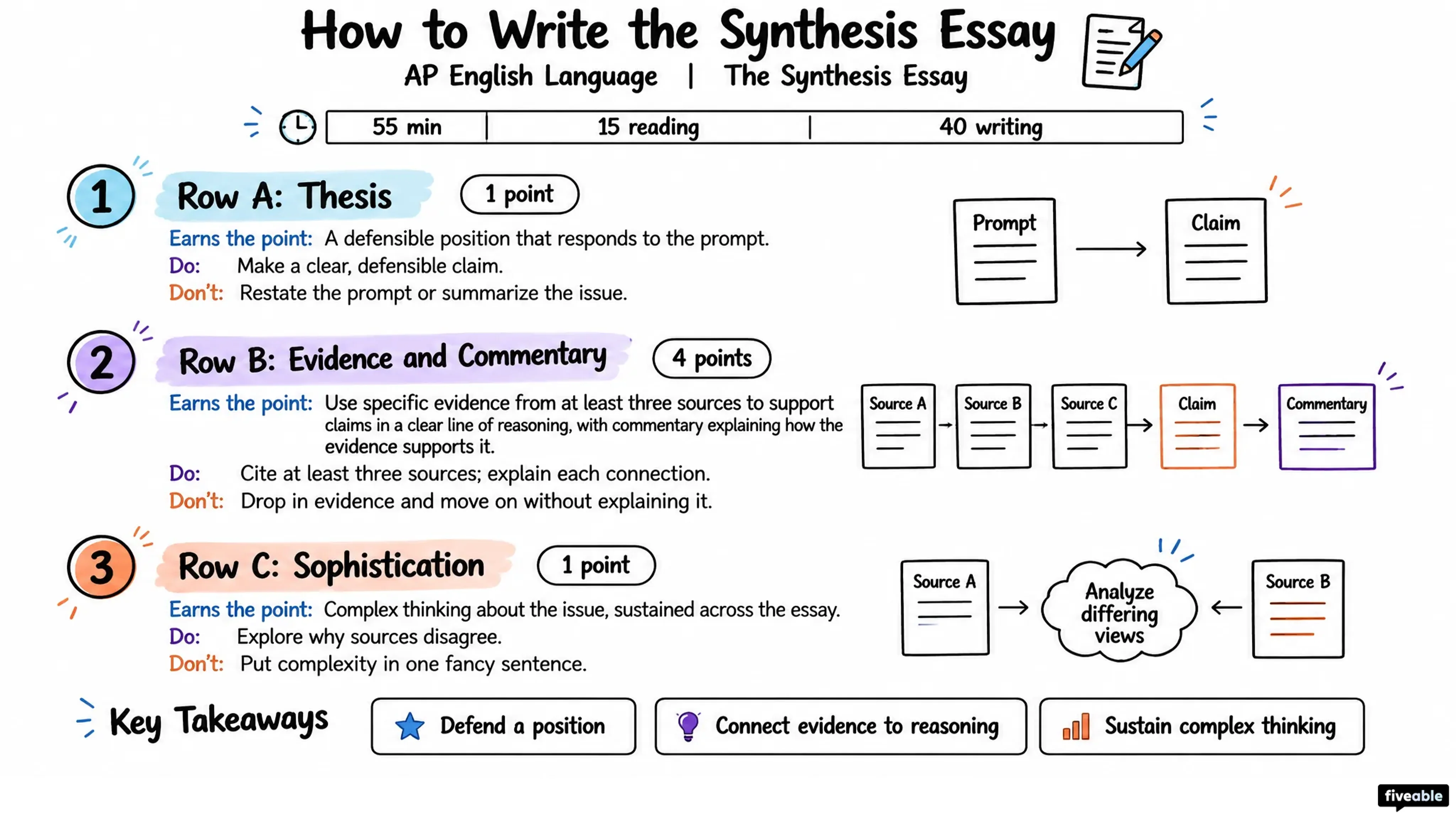
The synthesis essay is FRQ 1 on the AP English Language exam. You get six sources on one topic and write an essay that uses at least three of them to develop your own position.
- 55 min
- 15 reading, 40 writing
- 6 points
- across rows A to C
- 55%
- of your score, across all three essays
Part A: Thesis
A defensible position that responds to the prompt
1 pt
Part B: Evidence and commentary
Evidence from at least three sources, with commentary that explains your reasoning
4 pts
Part C: Sophistication
Complex thinking about the issue, sustained across the essay
1 pt
Synthesis Essay skill sheet
Every rubric point on one page: what earns it, what to do and what to avoid. Tap the sheet to see it full size.
How Synthesis Essay practice works
Each question follows the exam’s format, from the full prompt to a score on every part.
Read the prompt and sources
The topic introduction, the prompt, and all six sources, laid out the way the exam shows them.
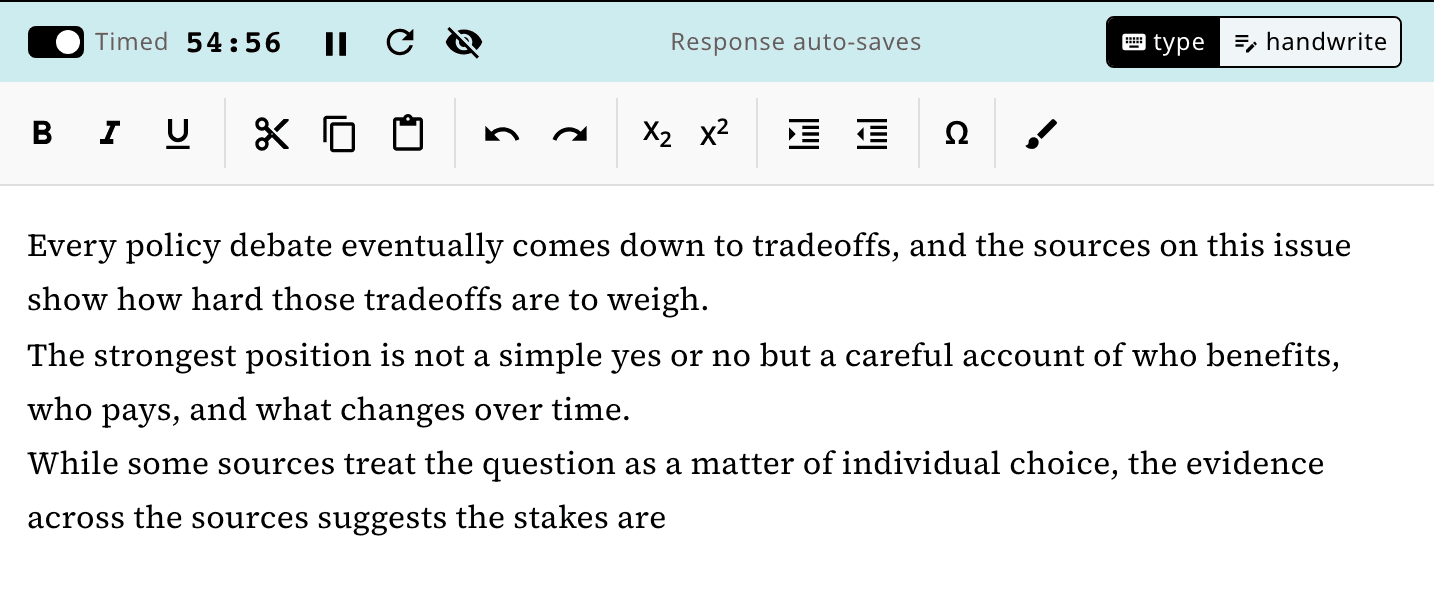
Write on a 55-minute timer
The 15-minute reading period plus 40 minutes of writing. Pause it or turn it off, and your response saves as you go.
Submit for a score out of 6
Your response is scored against the scoring guidelines written for that question. Your first score is included.
Feedback on every part
A summary at the top tells you what to work on next. Below it, each part shows whether you earned the point and what the scoring guidelines were looking for.
Detailed Feedback
Part A(Thesis): 1/1 point
The student earns the thesis point. The opening paragraph presents a defensible, specific claim: 'Regulators should take strong action to require that cancellation be as simple as sign-up, because the current system allows businesses to exploit consumers financially and emotionally.' This goes beyond merely restating the prompt and establishes a clear line of reasoning about exploitation and the need for regulatory intervention.
Part A(Sophistication): 0/1 point
The student does not earn the sophistication point. While the essay acknowledges a counterargument from Source B, it dismisses the procedural concern too quickly — calling it 'a technicality' — rather than genuinely engaging with the complexity of balancing regulatory authority with consumer protection. The essay's structure is competent but formulaic, moving predictably from data to anecdote to counterargument to state-level solution without demonstrating a nuanced understanding of the broader implications of the issue. There is no attempt to explore tensions within the pro-regulation position (e.g., which industries should be exempt, as Connecticut's law exempts utilities and banks) or to consider the economic consequences for businesses. The writing is clear but does not rise to the level of sophistication required for this point.
Questions about the Synthesis Essay
How many responses can I get scored?
You can read every question without a plan. Your first scored response is included. A plan unlocks unlimited scoring.
What do the sources look like?
Six short sources on one topic, such as articles, reports, and official statements. Many sets include a chart or table. You don’t need to know the topic ahead of time.
How many sources should I use?
At least three. Row B rewards using three sources well, with commentary that ties each one to your argument. Citing more than three earns nothing extra.
Are these real College Board questions?
No. We wrote them in the AP format, with six sources and the same 6-point rubric, and wrote scoring guidelines for each one.
Can I write my answer by hand?
Yes. Switch the editor to handwrite, write on paper, and add a photo of your page.
More AP English Language practice
Rhetorical Analysis Essay practice
Rhetorical analysis prompts with the full passage and its context.
Argument Essay practice
Argument essay prompts with the full quotation and its context.
AP English Language FRQs
Every FRQ type for AP English Language, with practice for each.
See the Synthesis Essay rubric points students miss most, from responses scored on Fiveable.
Write your first Synthesis Essay
Pick one from the list, or let us choose for you.
Teaching AP English Language? Assign these Synthesis Essays to your class