AP English Language Argument Essay Practice
26 argument essay prompts written in the AP format. Pick one, read the full prompt, and write your argument. Fiveable scores each Argument Essay response part by part on the AP rubric.
Your first scored response is included. A plan unlocks unlimited scoring.
26 questions
sorted by unit
Individual action's effectiveness in climate change mitigation
Author and environmentalist Bill McKibben, who has spent decades organizing climate campaigns, has often told audiences: "The most important thing an individual can do is not be an individual." He argues that people should join together in movements rather than rely on personal consumer choices to address the climate crisis.
Write an essay that argues your position on the extent to which McKibben's claim about the role of individual action in addressing climate change is valid.
Respond to the prompt with a thesis that presents a defensible position.
Provide evidence to support your line of reasoning.
Explain how the evidence supports your line of reasoning.
Use appropriate grammar and punctuation in communicating your argument.
What the Argument Essay asks
The argument essay is FRQ 3 on the AP English Language exam. You get a short quotation or claim and write an essay that argues your own position, using evidence you bring yourself.
- 40 min
- suggested time
- 6 points
- across rows A to C
- 55%
- of your score, across all three essays
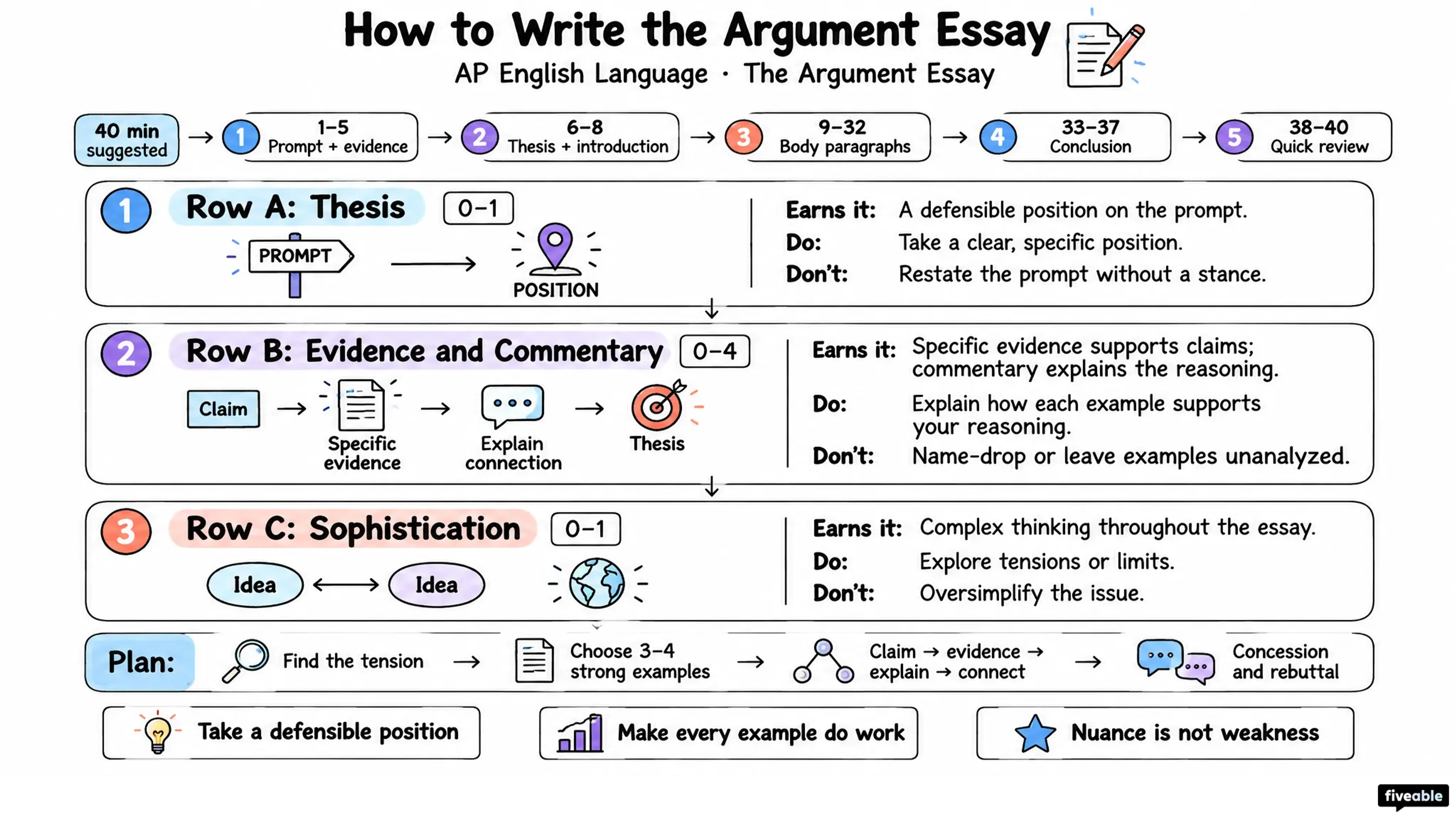
Part A: Thesis
A defensible position on the claim in the prompt
1 pt
Part B: Evidence and commentary
Specific examples you bring, with commentary that explains your reasoning
4 pts
Part C: Sophistication
Nuance, such as the limits of your position or why others disagree
1 pt
Argument Essay skill sheet
Every rubric point on one page: what earns it, what to do and what to avoid. Tap the sheet to see it full size.
How Argument Essay practice works
Each question follows the exam’s format, from the full prompt to a score on every part.
Read the full prompt
The quotation, its context, and the prompt, laid out the way the exam shows them.
Write on a 40-minute timer
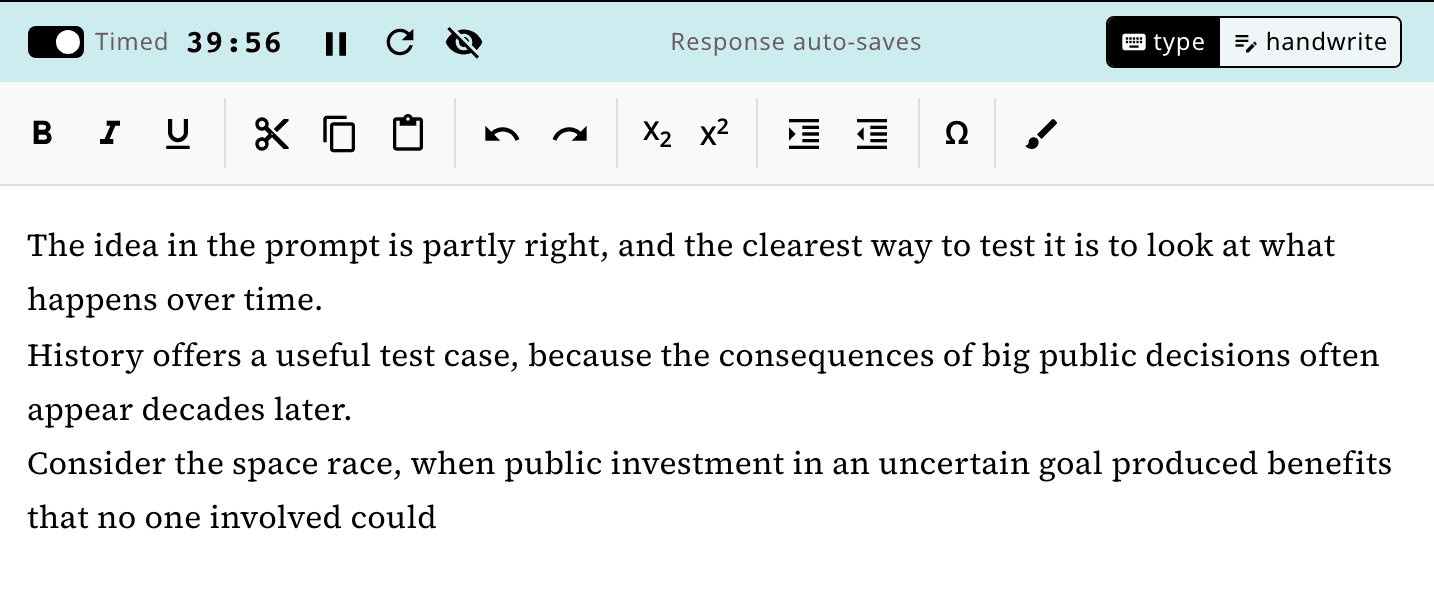
The time to plan for on exam day. Pause it or turn it off, and your response saves as you go.
Submit for a score out of 6
Your response is scored against the scoring guidelines written for that question. Your first score is included.
Feedback on every part
A summary at the top tells you what to work on next. Below it, each part shows whether you earned the point and what the scoring guidelines were looking for.
Detailed Feedback
Part A: 1/1 point
Earned the point. You responded to the prompt with a clear, defensible thesis ('Ginny Rometty’s claim is largely valid because growth requires stepping beyond familiar limits, overcoming fear, and adapting to new challenges...') that establishes a line of reasoning for your essay.
Part C: 0/1 point
Did not earn the point. Your argument was clear and functional, but it did not demonstrate the sophistication of thought required for this point. To earn the sophistication point, you might explore the nuances or tensions in the prompt (e.g., discussing situations where comfort is necessary for growth) or situate your argument within a broader, more complex context.
Questions about the Argument Essay
How many responses can I get scored?
You can read every question without a plan. Your first scored response is included. A plan unlocks unlimited scoring.
Where does my evidence come from?
From you: history, current events, literature, or your own experience. There are no sources to cite, so specific examples carry the essay.
How is the argument essay different from the synthesis essay?
The synthesis essay gives you six sources and asks you to use at least three. The argument essay gives you no sources, so all of your evidence is your own.
Are these real College Board questions?
No. We wrote them in the AP format, with the same 6-point rubric, and wrote scoring guidelines for each one.
Can I write my answer by hand?
Yes. Switch the editor to handwrite, write on paper, and add a photo of your page.
More AP English Language practice
Synthesis Essay practice
Synthesis essay prompts with the topic introduction and all six sources.
Rhetorical Analysis Essay practice
Rhetorical analysis prompts with the full passage and its context.
AP English Language FRQs
Every FRQ type for AP English Language, with practice for each.
See the Argument Essay rubric points students miss most, from responses scored on Fiveable.
Write your first Argument Essay
Pick one from the list, or let us choose for you.
Teaching AP English Language? Assign these Argument Essays to your class