AP English Language Rhetorical Analysis Essay Practice
81 rhetorical analysis prompts written in the AP format. Pick one, read the full passage, and write your analysis. Fiveable scores each Rhetorical Analysis Essay response part by part on the AP rubric.
Your first scored response is included. A plan unlocks unlimited scoring.
81 questions
sorted by unit
Individual moral responsibility against unjust laws
The following passage is an excerpt from Henry David Thoreau's essay "On the Duty of Civil Disobedience." In the essay, Thoreau reflects on the relationship between the individual and the state, addressing the moral responsibilities of citizens in the face of unjust government actions. Read the passage carefully. Then, in a well-written essay, analyze the rhetorical choices the writer makes to develop his argument about the individual's moral responsibility to resist unjust laws.
Respond to the prompt with a thesis that analyzes the writer's rhetorical choices.
Select and use evidence to support your line of reasoning.
Explain how the evidence supports your line of reasoning.
Demonstrate an understanding of the rhetorical situation.
Use appropriate grammar and punctuation in communicating your argument.
The broadest and most prevalent error requires the most disinterested virtue to sustain it. The slight reproach to which the virtue of patriotism is commonly liable, the noble are most likely to incur. Those who, while they disapprove of the character and measures of a government, yield to it their allegiance and support, are undoubtedly its most conscientious supporters, and so frequently the most serious obstacles to reform. Some are petitioning the State to dissolve the Union, to disregard the requisitions of the President. Why do they not dissolve it themselves,—the union between themselves and the State,—and refuse to pay their quota into its treasury? Do not they stand in same relation to the State, that the State does to the Union? And have not the same reasons prevented the State from resisting the Union, which have prevented them from resisting the State?
How can a man be satisfied to entertain an opinion merely, and enjoy it? Is there any enjoyment in it, if his opinion is that he is aggrieved? If you are cheated out of a single dollar by your neighbor, you do not rest satisfied with knowing you are cheated, or with saying that you are cheated, or even with petitioning him to pay you your due; but you take effectual steps at once to obtain the full amount, and see that you are never cheated again. Action from principle,—the perception and the performance of right,—changes things and relations; it is essentially revolutionary, and does not consist wholly with anything which was. It not only divided states and churches, it divides families; aye, it divides the individual, separating the diabolical in him from the divine.
Unjust laws exist: shall we be content to obey them, or shall we endeavor to amend them, and obey them until we have succeeded, or shall we transgress them at once? Men generally, under such a government as this, think that they ought to wait until they have persuaded the majority to alter them. They think that, if they should resist, the remedy would be worse than the evil. But it is the fault of the government itself that the remedy is worse than the evil. It makes it worse. Why is it not more apt to anticipate and provide for reform? Why does it not cherish its wise minority? Why does it cry and resist before it is hurt? Why does it not encourage its citizens to be on the alert to point out its faults, and do better than it would have them? Why does it always crucify Christ, and excommunicate Copernicus and Luther, and pronounce Washington and Franklin rebels?
One would think, that a deliberate and practical denial of its authority was the only offence never contemplated by government; else, why has it not assigned its definite, its suitable and proportionate penalty? If a man who has no property refuses but once to earn nine shillings for the State, he is put in prison for a period unlimited by any law that I know, and determined only by the discretion of those who placed him there; but if he should steal ninety times nine shillings from the State, he is soon permitted to go at large again.
If the injustice is part of the necessary friction of the machine of government, let it go, let it go: perchance it will wear smooth,—certainly the machine will wear out. If the injustice has a spring, or a pulley, or a rope, or a crank, exclusively for itself, then perhaps you may consider whether the remedy will not be worse than the evil; but if it is of such a nature that it requires you to be the agent of injustice to another, then, I say, break the law. Let your life be a counter friction to stop the machine. What I have to do is to see, at any rate, that I do not lend myself to the wrong which I condemn.
As for adopting the ways which the State has provided for remedying the evil, I know not of such ways. They take too much time, and a man’s life will be gone. I have other affairs to attend to. I came into this world, not chiefly to make this a good place to live in, but to live in it, be it good or bad. A man has not every thing to do, but something; and because he cannot do every thing, it is not necessary that he should do something wrong. It is not my business to be petitioning the Governor or the Legislature any more than it is theirs to petition me; and, if they should not hear my petition, what should I do then? But in this case the State has provided no way: its very Constitution is the evil. This may seem to be harsh and stubborn and unconcilliatory; but it is to treat with the utmost kindness and consideration the only spirit that can appreciate or deserves it. So is all change for the better, like birth and death which convulse the body.
Source: Henry David Thoreau, On the Duty of Civil Disobedience, Project Gutenberg
What the Rhetorical Analysis Essay asks
The rhetorical analysis essay is FRQ 2 on the AP English Language exam. You read a nonfiction passage and write an essay analyzing the rhetorical choices the writer makes to achieve a purpose.
- 40 min
- suggested time
- 6 points
- across rows A to C
- 55%
- of your score, across all three essays
Part A: Thesis
A defensible thesis about the writer’s rhetorical choices
1 pt
Part B: Evidence and commentary
Evidence from the passage, with commentary on how several choices serve the writer’s purpose
4 pts
Part C: Sophistication
A complex understanding of the rhetorical situation
1 pt
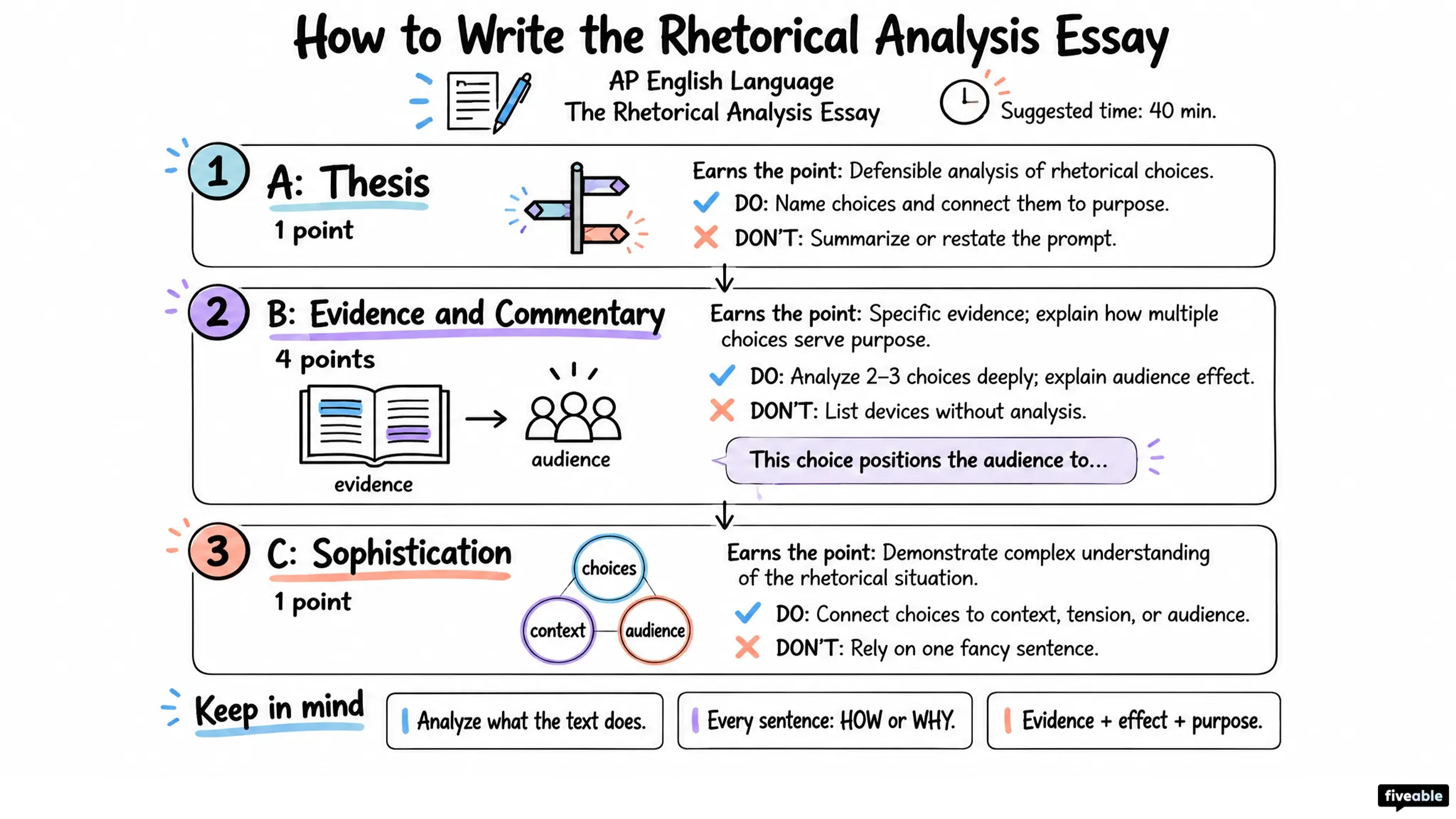
Rhetorical Analysis Essay skill sheet
Every rubric point on one page: what earns it, what to do and what to avoid. Tap the sheet to see it full size.
How Rhetorical Analysis Essay practice works
Each question follows the exam’s format, from the full prompt to a score on every part.
Read the full passage
The background on the writer and occasion, the prompt, and the passage, laid out the way the exam shows them.
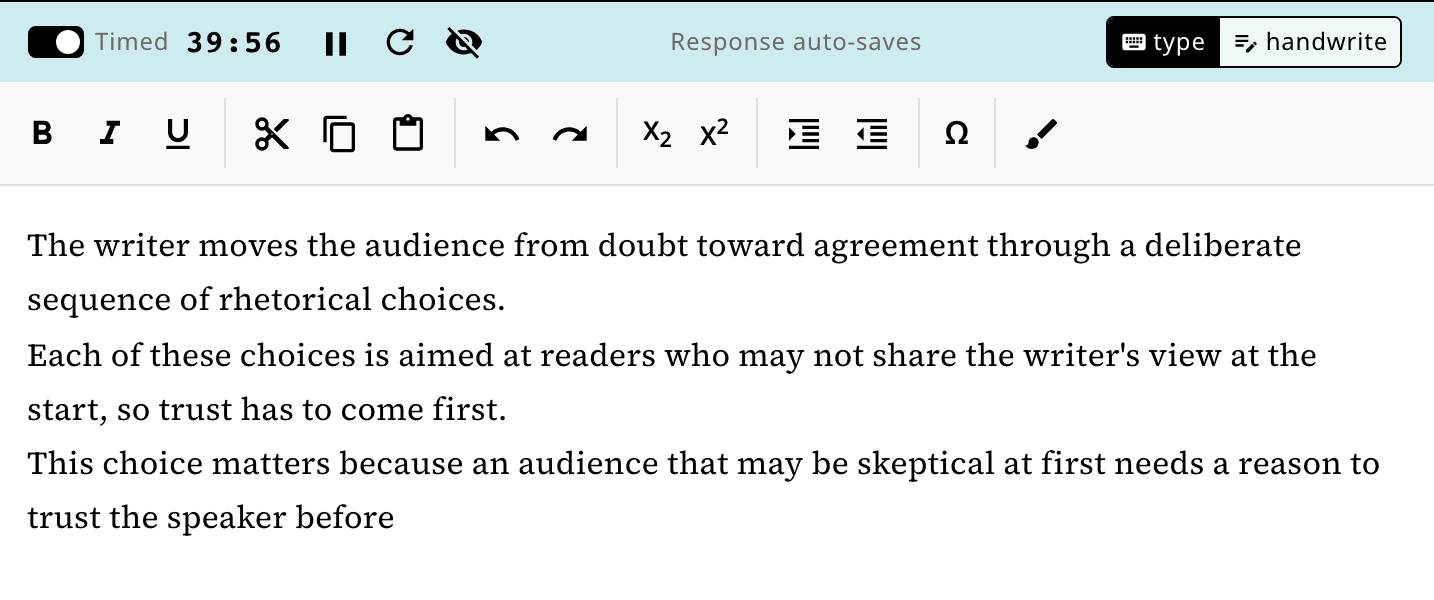
Write on a 40-minute timer
The time to plan for on exam day. Pause it or turn it off, and your response saves as you go.
Submit for a score out of 6
Your response is scored against the scoring guidelines written for that question. Your first score is included.
Feedback on every part
A summary at the top tells you what to work on next. Below it, each part shows whether you earned the point and what the scoring guidelines were looking for.
Detailed Feedback
Part A: 1/1 point
Earned the point. You provided a defensible thesis in your conclusion by stating that Descartes uses rhetorical choices to "describe to the reader of his thoughts processes and how he came to the conclusion that he had something missing in his 'nature'." To make this even stronger, place your thesis in the introduction and clearly connect his thought process to the prompt's focus on his journey from "uncertainty to knowledge."
Part C: 0/1 point
Did not earn the point. To earn the sophistication point, your argument would need to demonstrate a more complex understanding of the rhetorical situation, such as exploring the historical context of his philosophical reasoning or analyzing how his different rhetorical choices interact to achieve a deeper persuasive purpose.
What 277 scored Rhetorical Analysis Essays show
Patterns from the practice Rhetorical Analysis Essays students have turned in on Fiveable. Students lose the most points on Part C: sophistication.
A: Thesis
95%
B: Evidence and commentary
63%
C: Sophistication
17%
14%
of responses earned all 6 points
3.7 of 6
average score
+0.7 points
average gain when students rewrote the same Rhetorical Analysis Essay after feedback
277 practice responses from 172 students, scored on Fiveable through October 25, 2026.
Questions about the Rhetorical Analysis Essay
How many responses can I get scored?
You can read every question without a plan. Your first scored response is included. A plan unlocks unlimited scoring.
What kind of passage will I get?
A nonfiction text such as a speech, letter, or essay, with a short note on who wrote it and why. You don’t need to know it ahead of time.
How is rhetorical analysis different from the argument essay?
Rhetorical analysis asks how another writer’s choices work on an audience. The argument essay asks you to take your own position and support it with evidence you bring yourself.
Are these real College Board questions?
No. We wrote them in the AP format, with the same 6-point rubric, and wrote scoring guidelines for each one.
Can I write my answer by hand?
Yes. Switch the editor to handwrite, write on paper, and add a photo of your page.
More AP English Language practice
Synthesis Essay practice
Synthesis essay prompts with the topic introduction and all six sources.
Argument Essay practice
Argument essay prompts with the full quotation and its context.
AP English Language FRQs
Every FRQ type for AP English Language, with practice for each.
See the Rhetorical Analysis Essay rubric points students miss most, from responses scored on Fiveable.
Write your first Rhetorical Analysis Essay
Pick one from the list, or let us choose for you.
Teaching AP English Language? Assign these Rhetorical Analysis Essays to your class