AP European History LEQ Practice
365 Long Essay Questions written in the AP format. Pick one, read the full prompt, and write your essay from what you know. Fiveable scores each LEQ response part by part on the AP rubric.
Your first scored response is included. A plan unlocks unlimited scoring.

365 questions
sorted by unit
Commercial Revolution's societal effects, 1500-1700
Respond to the prompt with a historically defensible thesis or claim that establishes a line of reasoning.
Describe a broader historical context relevant to the prompt.
Support an argument in response to the prompt using at least two pieces of specific and relevant evidence.
Use historical reasoning (e.g., comparison, causation, continuity or change over time) to frame or structure an argument that addresses the prompt.
Demonstrate a complex understanding of a historical development related to the prompt through sophisticated argumentation and/or effective use of evidence.
1. Between 1500 and 1700, expanding Atlantic trade and overseas colonization connected European markets to new sources of goods and wealth. Banking, commercial investment, and changing patterns of production developed alongside shifts in urban life, rural labor, and social hierarchies.
Evaluate the relative importance of the effects of the Commercial Revolution on European society in the period from 1500 to 1700.
Your response may focus on any effect(s) of the Commercial Revolution on European society during the period 1500 to 1700. You are not expected to address the entire time period in your response.
What the LEQ asks
The Long Essay Question is one required broad prompt in Section II of the AP European History exam. There are no documents, so you build a historical argument with evidence from your own knowledge.
- 40 min
- to plan and write
- 6 points
- across rows A to D
- 15%
- of your exam score
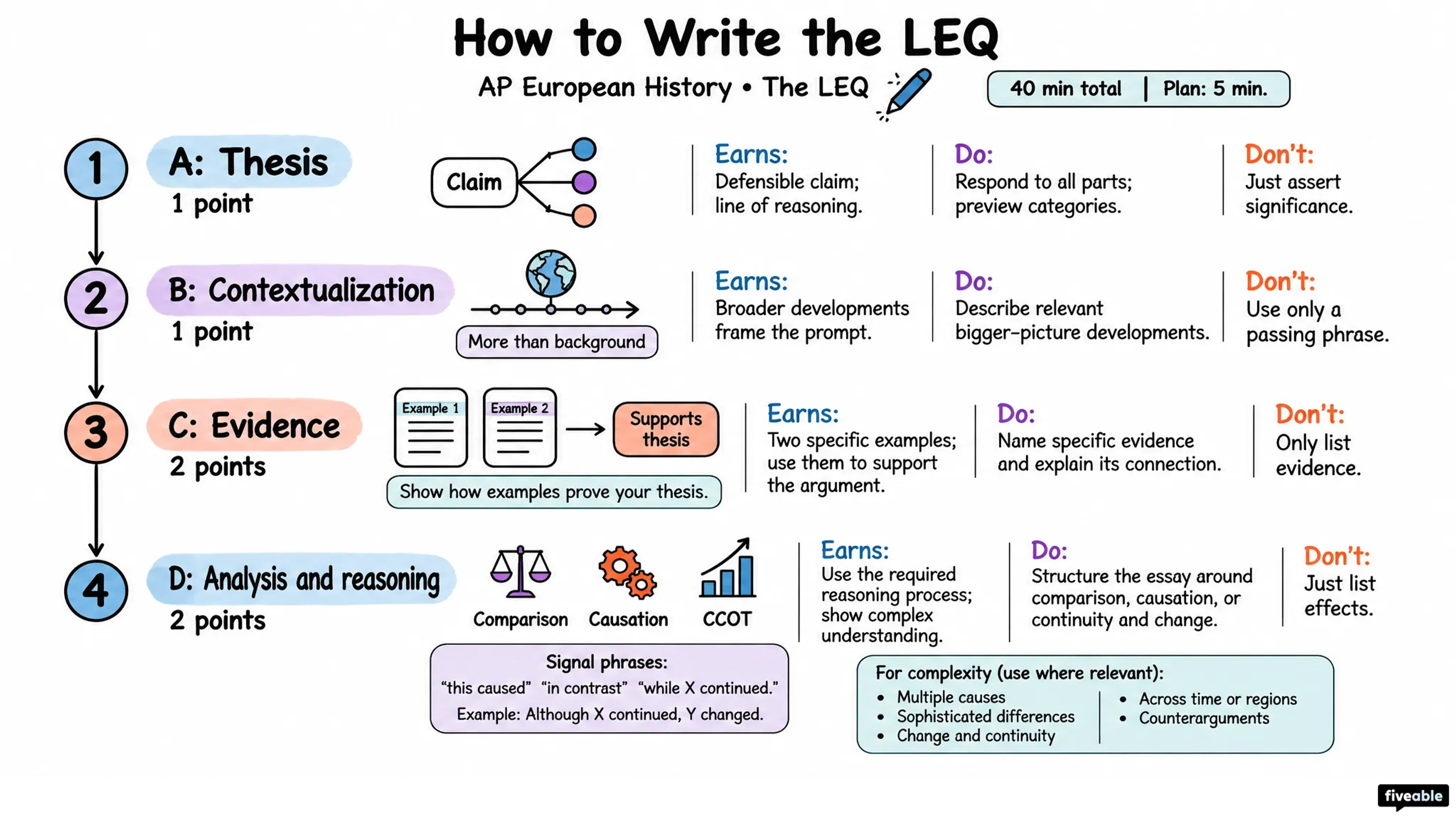
Part A: Thesis
A defensible claim that sets up a line of reasoning
1 pt
Part B: Contextualization
Broader developments that frame the prompt
1 pt
Part C: Evidence
Two specific examples, used to support the argument
2 pts
Part D: Analysis and reasoning
Comparison, causation, or continuity and change, plus a complex understanding
2 pts
LEQ skill sheet
Every rubric point on one page: what earns it, what to do and what to avoid. Tap the sheet to see it full size.
How LEQ practice works
Each question follows the exam’s format, from the full prompt to a score on every part.
Read the full prompt
One broad prompt with its time period, laid out the way the exam shows it.
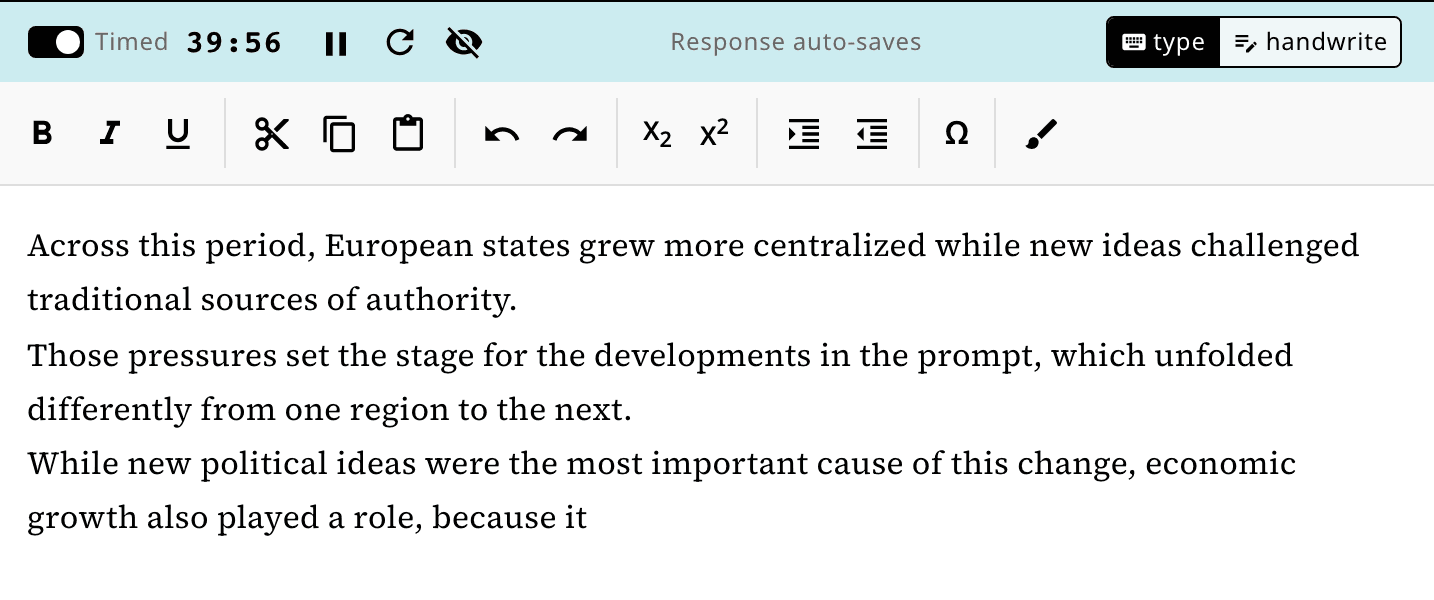
Write on a 40-minute timer
The time to plan for on exam day. Pause it or turn it off, and your response saves as you go.
Submit for a score out of 6
Your response is scored against the scoring guidelines written for that question. Your first score is included.
Feedback on every part
A summary at the top tells you what to work on next. Below it, each part shows whether you earned the point and what the scoring guidelines were looking for.
Detailed Feedback
Part A: 1/1 point
Earned the point. You provided a historically defensible claim that the state became less involved in the economy due to the shift from mercantilism to capitalism.
Part B: 1/1 point
Earned the point. You successfully established the broader historical context by describing the pre-industrial reliance on subsistence agriculture and mercantilist policies.
Part C1: 0/1 point
Did not earn the point. While you discussed broad economic theories like capitalism, socialism, and communism, you did not provide specific historical examples of state actions or policies (such as the repeal of the Corn Laws, Bismarck's welfare state, or the Factory Acts).
Questions about the LEQ
How many responses can I get scored?
You can read every question without a plan. Your first scored response is included. A plan unlocks unlimited scoring.
Do I still choose between three prompts?
No. Beginning with the May 2027 exam, the LEQ is one required broad prompt, and each question here gives you one prompt. Your choice is which developments and evidence to use.
How is the LEQ different from the DBQ?
The LEQ has no documents, so every piece of evidence comes from what you know. The DBQ gives you seven documents and 60 minutes, including a reading period.
What reasoning will the prompt ask for?
Comparison, causation, or continuity and change over time. Row D checks that you use that reasoning to structure your argument.
Can I write my answer by hand?
Yes. Switch the editor to handwrite, write on paper, and add a photo of your page.
More AP European History practice
AP European History FRQs
Every FRQ type for AP European History, with practice for each.
See the LEQ rubric points students miss most, from responses scored on Fiveable.
Write your first LEQ
Pick one from the list, or let us choose for you.
Teaching AP European History? Assign these LEQs to your class