AP European History DBQ Practice
35 Document-Based Questions written in the AP format. Pick one, read the prompt and all seven documents, and write your essay. Fiveable scores each DBQ response part by part on the AP rubric.
Your first scored response is included. A plan unlocks unlimited scoring.

35 questions
sorted by unit
Religious reform and political authority consolidation
Evaluate the extent to which monarchs successfully used religious reform and religious authority to strengthen their political power in Europe between 1500 and 1650.
Respond to the prompt with a historically defensible thesis or claim that establishes a line of reasoning.
Describe a broader historical context relevant to the prompt.
Support an argument using at least four of the provided documents.
Use at least one additional piece of specific historical evidence beyond the documents.
For at least two documents, explain how or why the document's point of view, purpose, historical situation, or audience is relevant.
Demonstrate a complex understanding through sophisticated argumentation and/or effective use of evidence.
Document 1
Source: Parliament of England, Act of Supremacy, 1559.
The queen’s highness is the only supreme governor* of this realm and of all other her highness’s dominions and countries, as well in all spiritual or ecclesiastical things or causes as temporal, and no foreign prince, person, prelate, state, or potentate hath or ought to have any jurisdiction, power, superiority, pre-eminence, or authority, ecclesiastical or spiritual, within this realm. * The first Act of Supremacy in 1534 declared Henry VIII “Supreme Head” of the Church of England.
Document 2
Source: Titian, Venetian painter, oil on canvas, c. 1573-1575, celebrating the Catholic coalition's victory over the Ottoman Turks at Lepanto (1571) and the birth of a male heir to King Philip II of Spain. Caption (translated): MAIORA TIBI (Latin): "Greater things [are] for you."
Document 3
Source: Jacques Bochetel de La Forest, French ambassador to England, report on Elizabeth I’s response to a proposed Parliamentary petition on the succession question, 1566.
What they asked was nothing less than wishing her to dig her grave before she was dead ... [Then], addressing herself to the Lords, she said: "My Lords, do what you will. As for myself, I shall do nothing but according to my pleasure. All the resolutions which you may make have no force without my consent and authority; besides what you desire is an affair of much too great importance to be declared to a knot of harebrains. I will take counsel with men who understand justice and the laws, as I am deliberating to do: I will choose half a dozen of the most able I can find in my kingdom for consultation, and after having their advice, I will then discover to you my will." On this she dismissed them in great anger.
Document 4
Source: Leonhard von Eck, Chancellor of Bavaria, report to Duke Ludwig of Bavaria, February 15, 1525.
This rebellion has been undertaken to repress the princes and the nobility and has its ultimate source in Lutheran teaching, for the peasants relate the majority of their demands to the Word of God, the Gospel, and brotherly love. The peasants are blinded, led astray, and made witless. If these peasants promised today that they would give their lords no further trouble, they could change their minds within an hour.
Document 5
Source: Henry VIII, pardon granted to marchers, London, December 1536.
Let it be confessed that you, the King's subjects and commoners, have recently committed rebellion that might have ruined your country. You have given comfort to your enemies the Scots, to the high displeasure of God who commands you to obey your sovereign in all things. Nevertheless, the royal majesty, duly informed that your offenses proceeded from ignorance and false tales, is inclined to extend his most gracious pity and mercy towards you and to grant to you his free pardon provided that you heartily repent your offenses and make humble submission to his highness.
Document 6
Source: Selections from the constitution of the Bohemian Federation, a coalition of nobles and city governments, 1619
Since the Almighty has also given his grace and blessing as this Confederation is solely in defense of religion, the territories have agreed that each and every one of their coreligionists should follow a Christian life according to the Calvinist teaching and faith, avoid and prevent sin, vice, public trouble, hypocrisy, in whatever form, and follow strictly the admonishments from the pulpit and the authorities. . . . All churches in these united territories currently in Calvinist hands are to remain so in perpetuity. . . . The free exercise of Calvinist religion is extended to every man and woman in all united territories and towns regardless as to whether they belong to the king or queen, permitting the construction of churches, schools, and cemeteries, and the appointment of Calvinist pastors and schoolteachers. Everyone shall be allowed to follow the old ceremonies of their Christian conscience in their own church. However, to ensure better unity and to prevent all kinds of difficulties and bitterness, there are to be no insults or personal attacks from the pulpit upon pain of removal from office. . . . Should, contrary to hope, a king attempt anything contravening the religious concessions, unions, and this constitution, and thereby force the territories to take defensive measures, then all of these united kingdoms and provinces are released from their duty and cannot be subsequently held to account for any insults to the royal sovereignty and majesty.
Document 7
Source: Henri, Prince of Condé, sword nobleman, pamphlet, Paris, 1614.
The prices of all judicial and financial offices have risen to excessive heights. There is no longer any reward for virtue, since all power now belongs to favors, alliances, kinship, and money. The sword nobility is now banished from judicial and financial affairs for lack of money.
What the DBQ asks
The Document-Based Question is Question 1 in Section II of the AP European History exam. You get seven documents about a historical development and write an essay that builds an argument from them and from your own knowledge.
- 60 min
- including a 15-minute reading period
- 7 points
- across rows A to D
- 25%
- of your exam score
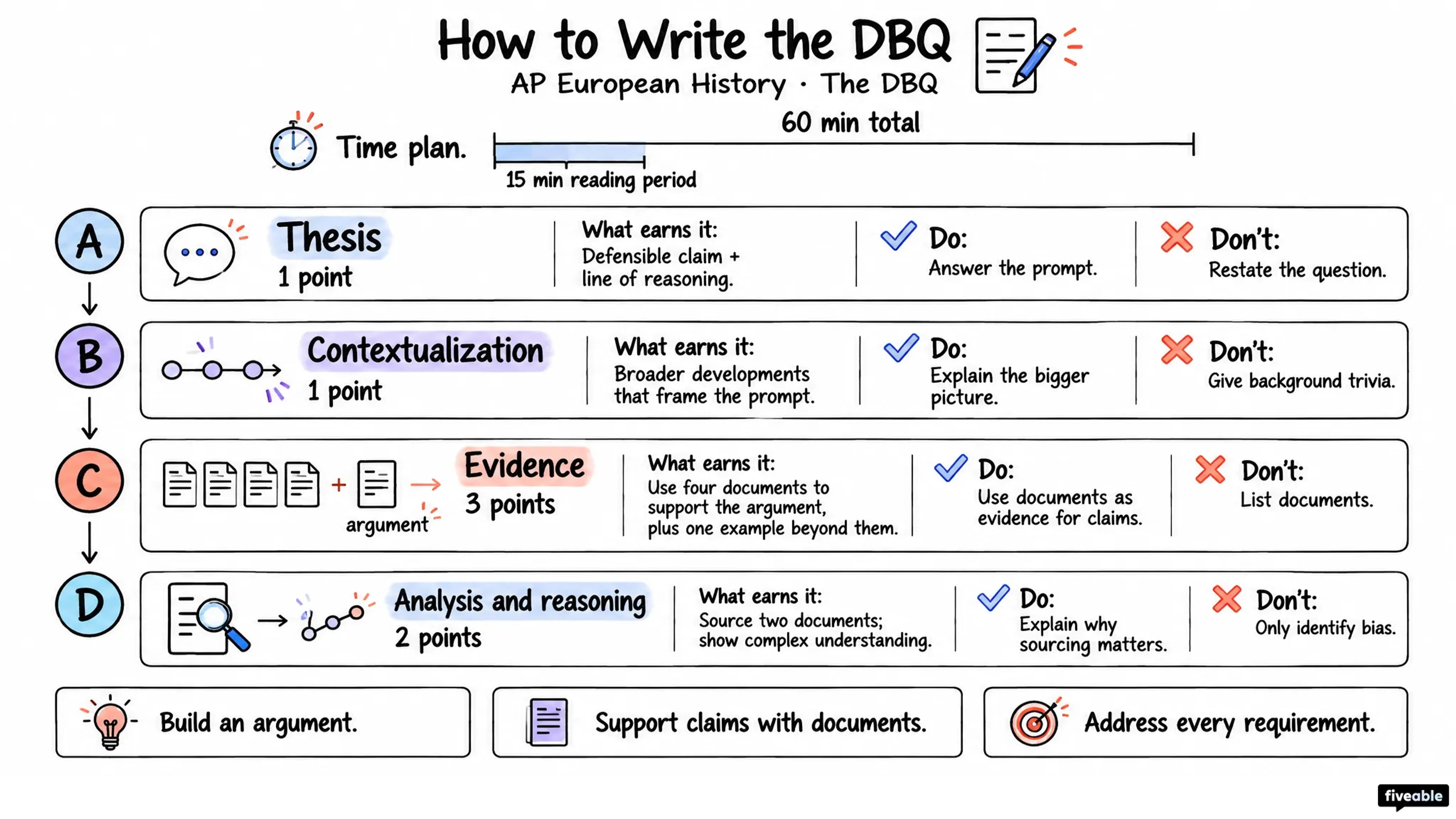
Part A: Thesis
A defensible claim that sets up a line of reasoning
1 pt
Part B: Contextualization
Broader developments that frame the prompt
1 pt
Part C: Evidence
Four documents used to support the argument, plus one example beyond them
3 pts
Part D: Analysis and reasoning
Sourcing for two documents, and a complex understanding of the topic
2 pts
DBQ skill sheet
Every rubric point on one page: what earns it, what to do and what to avoid. Tap the sheet to see it full size.
How DBQ practice works
Each question follows the exam’s format, from the full prompt to a score on every part.
Read the prompt and documents
The prompt and all seven documents, laid out the way the exam shows them.
Write on a 60-minute timer
The time to plan for on exam day, reading period included. Pause it or turn it off, and your response saves as you go.
Submit for a score out of 7
Your response is scored against the scoring guidelines written for that question. Your first score is included.
Feedback on every part
A summary at the top tells you what to work on next. Below it, each part shows whether you earned the point and what the scoring guidelines were looking for.
Detailed Feedback
Part A: 1/1 point
Earned the point, but this is on the thin side of what earns it. You established a line of reasoning by arguing that monarchs used religion to legitimize their rule and also suppressed the nobility to centralize power. To make this stronger, include more specific analytical categories or reasons in your thesis, such as mentioning specific regions or the exact mechanisms monarchs used to control the church.
Part B: 1/1 point
Earned the point. You provided strong contextualization by discussing the Protestant Reformation, the sale of indulgences, and Martin Luther's 95 Theses, and you effectively connected this background to the monarchs' opportunity to strengthen their power.
Part C2: 0/1 point
Did not earn the point. You used the content of three documents (1, 3, and 7) to support your argument. However, your use of Document 5 relied on outside information (Henry VIII creating the Church of England) rather than the actual content of the document (the pardon of the Pilgrimage of Grace). To earn this point, you must accurately use the content of at least four documents to support your argument.
Questions about the DBQ
How many responses can I get scored?
You can read every question without a plan. Your first scored response is included. A plan unlocks unlimited scoring.
How many documents do I need to use?
Using the content of three documents accurately earns one evidence point. Using four of them to support your argument earns both.
What counts as sourcing?
Explaining how a document’s point of view, purpose, historical situation, or audience matters for your argument, for at least two documents. Calling a document biased doesn’t earn the point.
How is the DBQ different from the LEQ?
The DBQ gives you seven documents to build your argument from. The LEQ has no documents, so all of your evidence comes from what you know, and the exam gives it 40 minutes.
Can I write my answer by hand?
Yes. Switch the editor to handwrite, write on paper, and add a photo of your page.
More AP European History practice
AP European History FRQs
Every FRQ type for AP European History, with practice for each.
See the DBQ rubric points students miss most, from responses scored on Fiveable.
Write your first DBQ
Pick one from the list, or let us choose for you.
Teaching AP European History? Assign these DBQs to your class