
Air Column Vibrations in Wind Instruments
Wind instruments produce sound through vibrating columns of air trapped inside a tube. The length and shape of that air column determine which frequencies resonate, which directly controls the pitch and timbre you hear. Understanding how standing waves behave in open vs. closed pipes is the foundation for everything else in this topic.
Principles of Air Column Vibrations
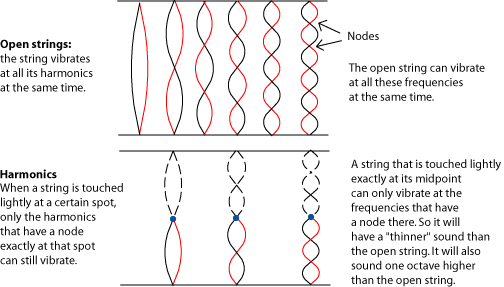
When a player excites the air inside a wind instrument, waves travel down the tube, reflect off the ends, and interfere with each other. This interference creates standing waves, which are patterns of fixed nodes (points of no displacement) and antinodes (points of maximum displacement).
The lowest frequency that a given air column supports is the fundamental frequency. Higher frequencies that also resonate are called overtones or harmonics. Which harmonics are present depends on whether the pipe is open at both ends or closed at one end.
A few key points about what's happening inside the column:
- Pressure and air velocity behave inversely along the standing wave. Where pressure variation is greatest (a pressure antinode), air velocity is near zero, and vice versa.
- At an open end, you always get a pressure node (the air pressure stays close to atmospheric) and a displacement antinode.
- At a closed end, you get a pressure antinode and a displacement node (the air can't move past the wall).
- Energy transfers continuously from the player into the air column, sustaining the standing wave against losses from radiation and friction.
Role of Mouthpiece and Embouchure
The mouthpiece is where the player's energy enters the system. It couples the player's body to the air column and shapes the airflow so vibrations can be sustained efficiently. Different instrument families use fundamentally different excitation methods:
- Air jet (flute family): The player directs a stream of air across a sharp edge. The air jet oscillates above and below the edge, periodically injecting energy into the column. There's no reed involved.
- Single reed (clarinet, saxophone): A thin cane reed vibrates against a mouthpiece opening. The reed alternately opens and closes the airflow into the column.
- Double reed (oboe, bassoon): Two thin cane reeds vibrate against each other, controlling airflow in a similar periodic fashion.
- Lip reed (brass): The player's lips themselves act as the vibrating element, buzzing into a cup- or funnel-shaped mouthpiece.
Embouchure refers to the way a player shapes and controls their lips, facial muscles, and airflow. Adjusting lip tension and air pressure lets the player select different harmonics and fine-tune pitch. This is especially critical for brass players, who rely almost entirely on embouchure to move between notes within a given valve combination.

Air Column Length vs. Pitch
Wavelength and frequency are inversely related: a longer air column supports a longer wavelength, which means a lower frequency (lower pitch). The two fundamental formulas you need to know:
- Open pipe (open at both ends, e.g., flute):
where (all harmonics present), is the speed of sound, and is the effective length of the pipe.
- Closed pipe (closed at one end, e.g., clarinet approximation):
where (only odd harmonics present).
Notice that for the same length , a closed pipe's fundamental is half that of an open pipe. This is why a clarinet sounds roughly an octave lower than a flute of similar length.
How players change pitch in practice:
- Brass instruments use valves (trumpet, tuba) or a slide (trombone) to add tubing length, lowering the resonant frequencies. Between valve combinations, the player selects different harmonics using embouchure.
- Woodwinds use keys and tone holes. Opening a tone hole effectively shortens the vibrating air column, raising the pitch.
Bore shape also matters. A cylindrical bore (like a clarinet) behaves more like a closed pipe and emphasizes odd harmonics. A conical bore (like an oboe or saxophone) behaves acoustically more like an open pipe, supporting the full harmonic series despite being closed at the reed end. This is a point that often trips students up: the conical taper changes the boundary conditions so that even harmonics appear.
Brass vs. Woodwind Acoustics
These two families differ in excitation, bore geometry, and how players control sound.
Excitation mechanism: Brass instruments use a lip-reed system where the player's vibrating lips are the sound source. Woodwinds use either a mechanical reed (single or double) or an air jet. The lip-reed system gives brass players more direct control over which harmonic they excite, since lip tension selects the mode of vibration.
Bore shape and harmonic content:
- Cylindrical closed pipes (clarinet) produce predominantly odd harmonics (1st, 3rd, 5th...), giving a hollow, woody tone.
- Conical bores (oboe, saxophone) and open cylindrical pipes (flute) produce all harmonics, resulting in a brighter, fuller sound.
- Brass instruments typically have a partly cylindrical, partly conical bore that flares into a bell. The bell's shape strongly affects which harmonics radiate efficiently and how directional the sound is at high frequencies.
Timbre and directivity: The bell on a brass instrument acts as an impedance-matching device, helping sound radiate into the room. Larger bells radiate lower frequencies more effectively. At higher frequencies, the sound becomes more directional, projecting forward in a narrower beam. Woodwinds radiate sound from multiple tone holes along the body, producing a more diffuse radiation pattern.
Dynamic range: Brass instruments generally have a wider dynamic range. A trumpet can go from very soft to extremely loud partly because the lip-reed system can be driven harder without the physical limits that a cane reed faces. Woodwinds have a more constrained dynamic range, though skilled players extend it considerably through technique.
Pitch control summary:
Brass: Valve/slide changes tube length + embouchure selects the harmonic. Woodwinds: Key/tone hole combinations set the effective column length + reed/air jet provides the excitation.