8.4 Portuguese South America

💣World History – 1400 to Present Unit 8 Review
8.4 Portuguese South America
💣 World History – 1400 to Present
Portuguese South America and Brazilian Independence
Brazil's path to independence stands apart from the rest of Latin America. While Spanish colonies fought prolonged wars to break free, Brazil's transition was relatively peaceful, driven not by a revolutionary uprising but by the Portuguese royal family's own relocation to the colony. Understanding this unique process helps explain why Brazil emerged as a monarchy rather than a republic.

Top images from around the web for Brazil's Colonial Period
File:Coffee Plantation.jpg - Wikimedia Commons View original
Is this image relevant?
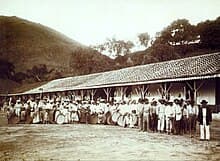
Coffee production in Brazil - Wikipedia View original
Is this image relevant?
File:Coffee Plantation.jpg - Wikimedia Commons View original
Is this image relevant?
Coffee production in Brazil - Wikipedia View original
Is this image relevant?
Brazil's Colonial Period
From the 16th century onward, Brazil was Portugal's most valuable colony, producing sugar, coffee, and other agricultural exports. The colony relied heavily on enslaved African labor, particularly on sugar plantations in the northeast.
Everything changed in 1808 when Napoleon's armies invaded Portugal. The Portuguese royal family, led by Prince Regent João (later King João VI), fled across the Atlantic to Brazil. This event, known as the Transfer of the Portuguese Court, had enormous consequences:
- Rio de Janeiro became the de facto capital of the entire Portuguese Empire
- Brazil gained new institutions: universities, a national bank, printing presses, and open ports for international trade
- The colony's economy and political importance grew rapidly
For the first time, a European colony was hosting its own imperial government rather than being ruled from abroad.
Transition to Kingdom
In 1815, Brazil was elevated from colony to kingdom, making it legally equal in status to Portugal itself. This was unprecedented and reflected Brazil's growing importance.
When liberal revolutions swept Portugal in 1820, the Portuguese Cortes (parliament) demanded that João VI return to Lisbon. He complied in 1821, but left his son Pedro behind as regent to govern Brazil.
The Cortes then moved to reverse Brazil's gains, attempting to reduce it back to colonial status. This provoked widespread resentment among Brazilians and Portuguese settlers alike.

Declaration of Independence
Tensions escalated when the Cortes ordered Pedro to return to Portugal as well. On January 9, 1822, Pedro refused, famously declaring "Fico" ("I stay"). This moment signaled his alignment with Brazilian interests over Portuguese authority.
Over the following months, Pedro moved steadily toward a full break:
- He dismissed Portuguese-born ministers and appointed Brazilian advisors
- He called for a constituent assembly to draft a Brazilian constitution
- On September 7, 1822, Pedro formally declared Brazilian independence along the banks of the Ipiranga River
- On October 12, 1822, he was crowned Emperor Pedro I of the new Empire of Brazil
Brazil became an independent constitutional monarchy, a form of government it maintained until 1889.
Pedro I's Reign
Pedro I's time as emperor was significant but turbulent. He promulgated the Constitution of 1824, which created a centralized government with four branches of power (executive, legislative, judicial, and a unique "moderating power" held by the emperor). Suffrage was limited, excluding most of the population.
His reign faced serious challenges:
- Disputes with parliament over the extent of imperial authority
- Regional revolts, particularly in the northeast
- A costly and unsuccessful war over the Cisplatina province (which became Uruguay in 1828)
- Growing criticism of his authoritarian tendencies
Pedro I abdicated in 1831 in favor of his young son, Pedro II, who would go on to rule Brazil for nearly 50 years. Despite his short reign, Pedro I is recognized as the central figure in Brazil's transition to independence.
Foreign Perspectives: Maria Graham
Maria Graham, a British writer and artist, traveled to Brazil during the early 1820s and published Journal of a Voyage to Brazil, and Residence There, During Part of the Years 1821, 1822, 1823. Her account is one of the most detailed foreign observations of Brazil during the independence era.
Graham documented the social, cultural, and political realities she encountered, including:
- The sharp divide between the wealthy elite and the impoverished majority
- The conditions of enslaved Africans, who made up a large portion of the population
- The marginalization of indigenous peoples
- The complex racial hierarchies that shaped Brazilian society
As a British observer, Graham's perspective carried Eurocentric biases. She sometimes judged Brazilian customs and institutions against British standards, which limits the objectivity of her account. Still, her detailed descriptions provide historians with a valuable primary source for understanding what Brazilian society looked like at this turning point. Foreign accounts like hers contribute to a fuller picture of the independence era, as long as readers remain aware of the author's cultural lens.
See Fiveable more often in Google
Mark Fiveable as a preferred source and Google is more likely to show you our guides in Top Stories, with a "preferred" badge in AI Mode and AI Overviews.