
Expected value is a fundamental concept in probability theory and statistics, quantifying the average outcome of a random variable. It serves as a measure of central tendency for probability distributions, enabling predictions and comparisons across various statistical applications.
Calculating expected value involves probability-weighted averages for discrete cases and integration for continuous cases. Understanding its properties, such as linearity and non-negativity, is crucial for deriving statistical theorems and conducting advanced analyses in theoretical statistics.
Definition of expected value
- Expected value forms a fundamental concept in probability theory and statistics, quantifying the average outcome of a random variable
- In theoretical statistics, expected value provides a measure of central tendency for probability distributions, enabling predictions and comparisons
- Serves as a crucial tool for analyzing and interpreting data in various statistical applications
Probability-weighted average
- Calculates the sum of all possible values multiplied by their respective probabilities
- Represents the long-term average outcome if an experiment is repeated infinitely
- Denoted mathematically as for discrete random variables
- Accounts for both the magnitude of outcomes and their likelihood of occurrence
Discrete vs continuous cases
- Discrete case involves summing over finite or countably infinite set of possible values
- Continuous case requires integration over the entire range of the random variable
- Continuous expected value expressed as where f(x) is the probability density function
- Transition from discrete to continuous involves replacing summation with integration and probability mass function with probability density function
Properties of expected value
- Expected value exhibits several key properties that make it a powerful tool in theoretical statistics
- These properties allow for manipulation and analysis of complex probabilistic scenarios
- Understanding these properties is crucial for deriving statistical theorems and conducting advanced analyses
Linearity of expectation
- States that the expected value of a sum equals the sum of individual expected values
- Expressed mathematically as for constants a and b and random variables X and Y
- Holds true even when random variables are dependent, making it a powerful tool in probability calculations
- Allows for simplification of complex problems by breaking them down into simpler components
Expected value of constants
- Expected value of a constant is the constant itself: for any constant c
- Implies that adding or subtracting a constant from a random variable shifts its expected value by that amount
- Useful in standardizing random variables and transforming probability distributions
- Helps in understanding the impact of deterministic components in probabilistic models
Non-negativity
- Expected value of a non-negative random variable is always non-negative
- If X ≥ 0, then
- Extends to absolute values:
- Provides bounds and constraints in probability inequalities and statistical estimations
Calculation methods
- Various techniques exist for calculating expected values, depending on the nature of the random variable
- Selection of appropriate method is crucial for accurate results and efficient computation
- Understanding these methods is essential for applying expected value concepts to real-world problems
Discrete random variables
- Utilizes probability mass function (PMF) to compute expected value
- Involves summing the product of each possible value and its probability
- Formula: where x ranges over all possible values of X
- Applicable to finite and countably infinite sample spaces (coin flips, dice rolls)
Continuous random variables
- Employs probability density function (PDF) to calculate expected value
- Requires integration over the entire range of the random variable
- Formula: where f(x) is the PDF of X
- Used for variables with uncountably infinite possible values (time intervals, measurements)
Using probability distributions
- Leverages known properties of standard probability distributions to compute expected values
- Involves identifying the distribution type and its parameters
- Utilizes pre-derived formulas for expected values of common distributions (normal, exponential, Poisson)
- Simplifies calculations for well-studied probability models in theoretical statistics
Conditional expected value
- Extends the concept of expected value to scenarios where additional information is available
- Plays a crucial role in Bayesian statistics and decision theory
- Allows for more precise predictions by incorporating relevant contextual information
Definition and interpretation
- Represents the expected value of a random variable given that another event has occurred
- Denoted as for random variables X and Y
- Calculated using the conditional probability distribution of X given Y
- Provides a way to update expectations based on new information or observations
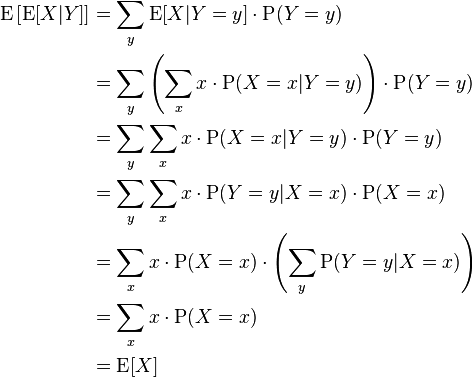
Law of total expectation
- Also known as the law of iterated expectation or tower property
- States that for random variables X and Y
- Allows decomposition of expected value calculations into conditional components
- Useful in solving complex probability problems and deriving statistical theorems
- Applications in decision trees, Markov chains, and hierarchical models
Applications in statistics
- Expected value concepts find widespread use across various domains of statistical analysis
- Serve as foundational tools for developing statistical models and making inferences
- Enable quantitative decision-making in uncertain environments
Mean of probability distributions
- Expected value represents the theoretical mean or average of a probability distribution
- Provides a measure of central tendency for symmetric and asymmetric distributions
- Used to characterize and compare different probability models
- Essential in hypothesis testing and parameter estimation (sample mean as estimator of population mean)
Risk assessment and decision theory
- Utilizes expected value to quantify potential outcomes in uncertain scenarios
- Helps in evaluating and comparing different strategies or decisions
- Applied in fields like insurance, finance, and project management
- Incorporates utility functions to account for risk preferences in decision-making processes
Financial modeling
- Expected value concepts crucial in pricing financial instruments (options, futures)
- Used in portfolio theory to optimize risk-return tradeoffs
- Employed in calculating present and future values of cash flows
- Fundamental in assessing investment strategies and conducting risk analysis
Variance and expected value
- Variance and expected value are closely related concepts in probability theory
- Together, they provide a comprehensive description of a random variable's distribution
- Understanding their relationship is crucial for advanced statistical analyses
Relationship between variance and expectation
- Variance measures the spread or dispersion of a random variable around its expected value
- Defined as the expected value of the squared deviation from the mean:
- Alternative formula:
- Variance is always non-negative, equaling zero only for constants
Covariance and correlation
- Covariance extends the concept of variance to measure the joint variability of two random variables
- Defined as
- Correlation normalizes covariance to provide a standardized measure of association
- Correlation coefficient:
- Both concepts crucial in multivariate analysis, regression, and time series modeling
Moment-generating functions
- Powerful tool in theoretical statistics for analyzing probability distributions
- Encapsulates all moments of a distribution in a single function
- Facilitates derivation of distribution properties and proving theoretical results
Definition and properties
- Moment-generating function (MGF) of a random variable X defined as
- Exists only if the expectation is finite for t in some neighborhood of 0
- Uniquely determines the probability distribution if it exists
- Useful for proving convergence in distribution and deriving distribution of transformed random variables

Deriving expected value
- Expected value can be obtained by evaluating the first derivative of MGF at t = 0
- where M'_X(t) denotes the derivative of MGF with respect to t
- Higher-order moments derived similarly: where M^(n)_X(t) is the nth derivative
- Provides an alternative method for calculating expected values and moments of distributions
Inequalities involving expected value
- Expected value inequalities provide bounds and constraints on probabilities and random variables
- Essential tools in theoretical statistics for proving theorems and deriving approximations
- Aid in understanding limitations and relationships between different probabilistic quantities
Markov's inequality
- Provides an upper bound on the probability that a non-negative random variable exceeds a certain value
- States that for a non-negative random variable X and a > 0,
- Useful when only the expected value of a distribution is known
- Forms the basis for proving other probability inequalities (Chebyshev's inequality)
Jensen's inequality
- Applies to convex functions and expected values
- States that for a convex function f and random variable X,
- For concave functions, the inequality is reversed
- Has applications in information theory, optimization, and economic theory
- Used to derive bounds on expected values of transformed random variables
Expected value in specific distributions
- Understanding expected values of common probability distributions is crucial in theoretical statistics
- Provides insights into the behavior and properties of these distributions
- Facilitates modeling and analysis of various real-world phenomena
Bernoulli and binomial distributions
- Bernoulli distribution: where p is the probability of success
- Binomial distribution: where n is the number of trials
- Models discrete events with two possible outcomes (success/failure, yes/no)
- Applications in quality control, epidemiology, and survey sampling
Poisson distribution
- Expected value equals the rate parameter:
- Models rare events occurring in a fixed interval of time or space
- Variance also equals λ, a unique property of the Poisson distribution
- Used in queueing theory, reliability analysis, and modeling count data
Normal distribution
- Expected value equals the location parameter μ:
- Symmetric distribution with bell-shaped curve
- Central to many statistical theories due to the Central Limit Theorem
- Widely used in natural and social sciences for modeling continuous variables
Estimation of expected value
- Estimating expected values from sample data is a fundamental task in statistical inference
- Bridges the gap between theoretical concepts and practical applications of statistics
- Crucial for making inferences about population parameters based on limited data
Sample mean as estimator
- Sample mean (x̄) serves as an unbiased estimator of the population mean (μ)
- Calculated as for a sample of size n
- Converges to the true expected value as sample size increases (law of large numbers)
- Forms the basis for many statistical procedures (hypothesis tests, confidence intervals)
Properties of estimators
- Unbiasedness: (sample mean is an unbiased estimator of population mean)
- Consistency: estimator converges in probability to the true parameter as sample size increases
- Efficiency: measures the variance of the estimator relative to the theoretical lower bound
- Robustness: ability of the estimator to perform well under departures from assumed conditions
- Trade-offs often exist between these properties, influencing choice of estimators in practice