
Second-order logic packs a punch in the world of mathematical reasoning. It can express complex ideas like the natural numbers and real numbers uniquely, something first-order logic can't do. This added power comes with trade-offs though.
While second-order logic is more expressive, it loses some nice properties of first-order logic. It's not compact and doesn't have the Löwenheim-Skolem theorems. But it can categorically define important mathematical structures, making it a powerful tool for formalizing mathematics.
Fundamental Theorems
Completeness and Compactness
- Completeness theorem states that every valid formula in second-order logic is provable from the axioms and rules of inference
- Ensures that second-order logic is a sound and complete system
- Guarantees that any logical consequence of a set of axioms can be formally derived within the system
- Compactness theorem does not hold for second-order logic
- In first-order logic, compactness states that if every finite subset of a set of formulas is satisfiable, then the entire set is satisfiable
- Lack of compactness in second-order logic means that there can be infinite sets of formulas where every finite subset is satisfiable, but the entire set is not
Löwenheim-Skolem Theorems and Categoricity
- Löwenheim-Skolem theorems do not hold for second-order logic
- In first-order logic, these theorems state that if a theory has an infinite model, then it has models of every infinite cardinality
- Second-order logic allows for categorical axiomatizations, meaning a theory can have a unique model up to isomorphism
- Categoricity is possible in second-order logic
- A theory is categorical if it has a unique model up to isomorphism
- Second-order logic can express concepts like "the natural numbers" or "the real numbers" categorically
- Categoricity is not possible in first-order logic due to the Löwenheim-Skolem theorems
Arithmetic and Induction
Peano Arithmetic in Second-Order Logic
- Peano arithmetic can be fully axiomatized in second-order logic
- Includes axioms for the successor function, addition, multiplication, and the induction axiom
- Second-order induction axiom captures the full strength of mathematical induction
- Categorically defines the structure of the natural numbers
- Second-order Peano arithmetic is categorical
- Has a unique model up to isomorphism, the standard model of the natural numbers
- Avoids non-standard models that exist in first-order Peano arithmetic (models with "infinite" natural numbers)
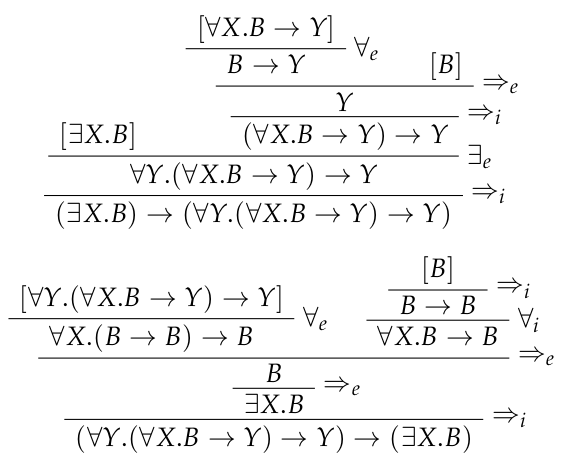
Induction Axiom and Its Consequences
- Second-order induction axiom is more powerful than first-order induction
- Allows induction over predicates and sets, not just properties definable by formulas
- Enables proofs of statements that are not provable in first-order Peano arithmetic (Goodstein's theorem)
- Induction axiom implies the well-ordering of the natural numbers
- Every non-empty subset of the natural numbers has a least element
- Crucial for proving many fundamental properties of the natural numbers (every non-zero natural number has a unique predecessor)
Set Theory and Continuum Hypothesis
Expressive Power of Second-Order Logic
- Second-order logic can express many concepts not definable in first-order logic
- Finiteness, countability, uncountability, connectedness of graphs, well-foundedness
- Allows for categorical axiomatizations of structures like the real numbers or the power set of the natural numbers
- Second-order logic is powerful enough to express most of classical mathematics
- Can formalize set theory, analysis, topology, abstract algebra
- Provides a foundation for mathematics alternative to first-order set theory (ZFC)
Continuum Hypothesis and Its Independence
- Continuum hypothesis states that there is no set whose cardinality is strictly between that of the natural numbers and the real numbers
- Can be formulated in second-order logic using the power set operation and the concept of bijection
- Remains independent of the axioms of second-order ZFC (Zermelo-Fraenkel set theory with the axiom of choice)
- Independence of the continuum hypothesis from second-order ZFC
- Proven by Cohen's forcing method, building on Gödel's constructible universe
- Shows that the continuum hypothesis can neither be proved nor disproved from the axioms of second-order ZFC
- Highlights the limitations of second-order logic in resolving certain fundamental questions in set theory