8.3 Progressive Aspect and Perfect Progressive Tenses

📏English Grammar and Usage Unit 8 Review
8.3 Progressive Aspect and Perfect Progressive Tenses
📏 English Grammar and Usage
Progressive Aspect and Perfect Progressive Tenses
Progressive and perfect progressive tenses let you describe actions that are ongoing, in progress, or have been happening over a stretch of time. They're essential for showing when something is happening and how long it's been going on, which gives your writing much more precision than simple tenses alone.
Progressive Tenses
Present, Past, and Future Progressive
Progressive tenses are built from a form of "be" + the present participle (-ing form) of the main verb. Each one places an ongoing action in a different time frame.
- Present progressive describes actions happening right now or around the current moment: I am writing a letter.
- Past progressive describes actions that were in progress at a specific past time: They were playing soccer when it started raining.
- Future progressive describes actions that will be ongoing at a future time: We will be traveling to Europe next month.
Beyond these core uses, progressive tenses also handle a few other situations:
- Temporary situations: The economy is improving (not necessarily permanent).
- Planned future actions: I'm meeting my friends for dinner tonight (present progressive used for a scheduled event).
- Time expressions like "now," "at the moment," and "these days" often signal that a progressive tense is the right choice.
Characteristics and Usage of Progressive Tenses
Progressive tenses do more than just mark an action as ongoing. They serve several specific purposes in writing and speech:
- Narrative vividness: They make storytelling feel immediate. The sun was setting as we arrived puts the reader right in the scene.
- Simultaneous actions: While I was cooking, she was setting the table. The past progressive in both clauses shows two actions happening at the same time.
- Changing or developing situations: The city is growing rapidly emphasizes that the change is in progress.
- Irritation or criticism with "always": He's always complaining uses the progressive to express annoyance about a repeated behavior. With simple present (He always complains), the tone is more neutral.
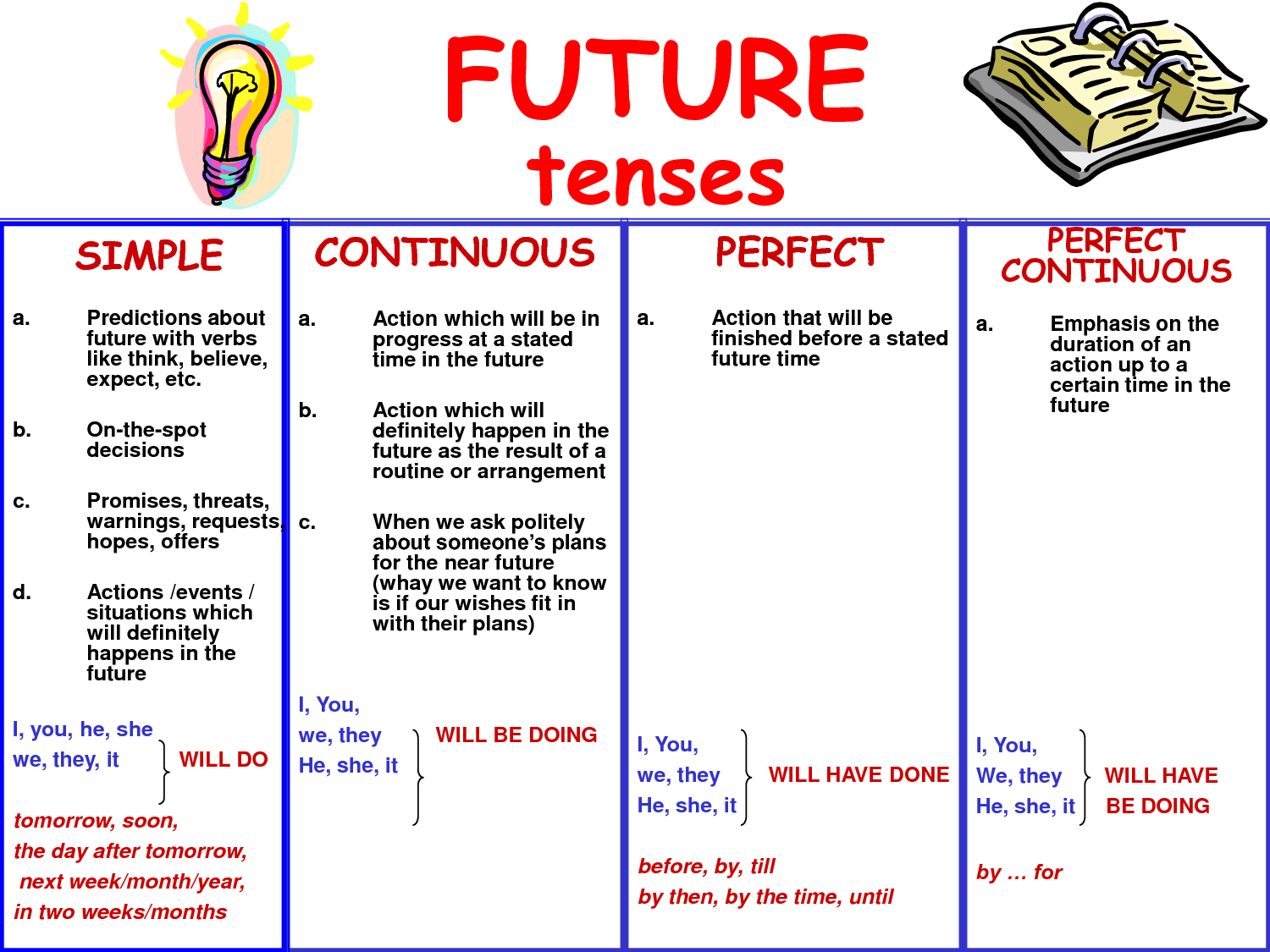
Perfect Progressive Tenses
Formation and Basic Usage
Perfect progressive tenses combine the perfect aspect (have/has/had/will have) with the progressive aspect (been + -ing). The result emphasizes both the duration of an action and the fact that it connects to a reference point in time.
Here's how each one is formed:
- Present perfect progressive: have/has been + verb-ing
- Past perfect progressive: had been + verb-ing
- Future perfect progressive: will have been + verb-ing
These tenses are commonly paired with duration markers like "for," "since," and "all day" because their whole purpose is to highlight how long something has been going on.
Specific Applications of Perfect Progressive Tenses
Each perfect progressive tense connects an ongoing action to a different reference point:
- Present perfect progressive links a past action to the present moment: I have been studying for three hours. (You started three hours ago and you're still at it, or you just stopped.)
- Past perfect progressive links an ongoing action to another past event: She had been working on the project for months before the deadline. (The ongoing work came first; the deadline came second.)
- Future perfect progressive projects forward to a future reference point: By next year, I will have been living in this city for a decade.
These tenses also explain present results of past actions. If you say I'm tired because I've been working all day, the present perfect progressive shows the cause (extended work) behind the present result (tiredness).
Like the regular progressive, perfect progressives can express criticism: He has been leaving his dirty dishes in the sink all week carries a tone of frustration that He left his dirty dishes does not.
Progressive Tense Components
Auxiliary Verb "Be" in Progressive Constructions
The verb "be" is the backbone of every progressive tense. It carries the tense and agreement information while the main verb stays in its -ing form.
- In present progressive, "be" appears as am, is, or are depending on the subject: She is working. They are working.
- In past progressive, it becomes was or were: I was reading. We were reading.
- In future progressive, it appears as will be: He will be arriving soon.
- In perfect progressive tenses, "be" combines with "have": have been, had been, will have been.
"Be" also controls question formation. You invert it with the subject: Are you leaving? / Was she listening?
In spoken and informal written English, "be" often contracts with the subject: I'm, he's, they're, we're.
Present Participle and Its Role
The present participle is formed by adding -ing to the base verb. A few spelling rules apply:
- Drop a silent final "e" before adding -ing: make → making
- Double the final consonant if the verb ends in a single stressed vowel + consonant: run → running, sit → sitting
- Don't double if the final syllable is unstressed: open → opening
The present participle is the main verb in every progressive construction, but it also shows up in other roles: as an adjective (the sleeping cat), as a gerund/noun (Swimming is good exercise), and in reduced clauses (The man sitting in the corner is my uncle).
Stative verbs like know, believe, want, own, and belong are rarely used in progressive forms because they describe states rather than actions. You'd say I know the answer, not I am knowing the answer. However, some stative verbs shift meaning in the progressive: I'm thinking about it (active process) vs. I think it's correct (opinion).
See Fiveable more often in Google
Mark Fiveable as a preferred source and Google is more likely to show you our guides in Top Stories, with a "preferred" badge in AI Mode and AI Overviews.