
Nanostructured Polymers and Nanocomposites
Nanostructured polymers and nanocomposites are materials engineered with features at the nanoscale (1–100 nm). At this scale, the ratio of surface area to volume becomes enormous, which fundamentally changes how the material behaves compared to its bulk counterpart. These materials show up across electronics, aerospace, and energy storage because they can deliver dramatic improvements in strength, thermal stability, and conductivity without adding much weight.
Defining the Two Categories
Nanostructured polymers have structural features in the 1–100 nm range. Compared to conventional bulk polymers, they can exhibit:
- Enhanced mechanical strength (higher tensile strength and modulus)
- Improved thermal stability (higher glass transition temperature and melting temperature )
- Increased electrical conductivity when conductive nanofillers like carbon nanotubes or graphene are incorporated
Nanocomposites are composite materials where at least one component has nanoscale dimensions. They consist of a matrix (the continuous phase, typically a polymer) and a reinforcement (the dispersed nanoscale phase). The key idea is that the interaction between matrix and reinforcement produces synergistic properties that neither component achieves alone. These include:
- Improved stiffness and strength from efficient load transfer between the matrix and reinforcement
- Enhanced barrier properties (reduced permeability to gases and liquids), useful for packaging
- Increased flame retardancy through char layer formation or release of flame-retardant agents
Synthesis Methods for Nanostructures
There are four main routes to producing nanostructured polymers and nanocomposites, each with distinct trade-offs.
In-situ polymerization starts with monomers and nanoscale reinforcements mixed together. The monomers then polymerize around the nanofillers. This produces strong interfacial interactions and good dispersion because the nanofillers are present from the very beginning of chain growth.
Solution blending dissolves both the polymer and the nanoscale reinforcements in a common solvent. After mixing, the solvent is removed by evaporation or precipitation, leaving behind the nanocomposite. Dispersion quality depends heavily on solvent choice and mixing conditions.
Melt blending skips solvents entirely. The polymer is melted and mixed with nanoscale reinforcements using high shear forces (extrusion or injection molding). This is the most economical and scalable method, which makes it attractive for industrial production, though achieving uniform dispersion can be more challenging.
Template synthesis uses nanoporous templates (such as anodic aluminum oxide or self-assembled block copolymers) to physically guide where the polymer forms. This gives precise control over the size and shape of the resulting nanostructures, producing well-defined nanorods, nanotubes, or nanopores.

Effects of Nanoscale Reinforcements on Properties
The reason nanofillers are so effective comes down to their enormous surface-area-to-volume ratio. Even at low loading levels, they create a massive interfacial region that restricts polymer chain mobility and enables efficient stress transfer.
Mechanical properties:
- Modulus and strength increase because load transfers efficiently from the softer polymer matrix to the high-stiffness nanoscale reinforcements
- Toughness and impact resistance improve through energy dissipation mechanisms at the matrix-reinforcement interface, including crack deflection and localized plastic deformation
- Fatigue and creep resistance improve because nanoscale reinforcements restrict polymer chain mobility, making the material more dimensionally stable under sustained or cyclic loads
Thermal properties:
- and both increase due to restricted chain mobility near nanofiller surfaces
- Thermal stability improves and thermal expansion decreases, especially with ceramic nanoparticles or carbon nanotubes that are inherently thermally stable
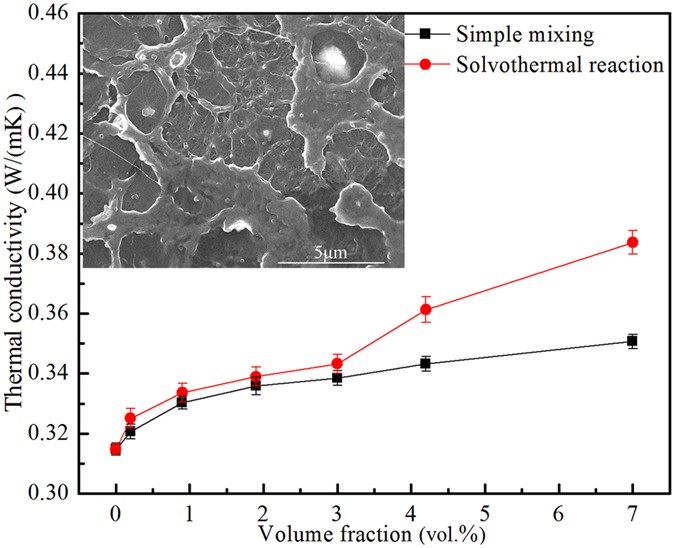
- Thermal conductivity can increase significantly with high-aspect-ratio nanofillers (carbon nanotubes, graphene), which is useful for heat dissipation in electronics
Electrical properties:
- Electrical conductivity rises sharply once conductive nanofillers (carbon nanotubes, graphene, metal nanoparticles) reach the percolation threshold, the critical concentration where conductive pathways form through the material. A major advantage of nanoscale fillers is that this threshold can be very low (often just a few weight percent).
- Dielectric properties improve with high-permittivity ceramic nanoparticles, which matters for energy storage applications like embedded capacitors
- Electromagnetic interference (EMI) shielding effectiveness increases when conductive nanofillers form a percolating network throughout the composite
Applications of Nanostructured Materials
Electronics:
- Conductive nanocomposites enable printed electronics such as flexible circuits, RFID tags, and sensors (strain gauges, chemical sensors)
- Dielectric nanocomposites serve in high-performance capacitors for embedded energy storage
- Nanostructured polymers are used in organic solar cells (bulk heterojunction morphology controls charge separation) and LEDs (quantum dot-polymer nanocomposites for tunable emission)
Aerospace:
- Lightweight, high-strength nanocomposites replace heavier materials in aircraft fuselage and wing components, reducing fuel consumption
- Nanostructured coatings create superhydrophobic surfaces for anti-icing and self-cleaning
- Carbon nanotube-polymer nanocomposites improve flame retardancy and fire resistance, a critical safety requirement
Energy storage:
- Nanocomposite electrodes boost lithium-ion battery capacity (e.g., silicon nanoparticle anodes that store far more lithium than conventional graphite, or lithium iron phosphate cathodes)
- Nanostructured polymer electrolytes, such as block copolymer electrolytes, are being developed for solid-state batteries that avoid flammable liquid electrolytes
- Supercapacitors benefit from carbon nanotube-conducting polymer nanocomposites that combine high surface area with good conductivity, and nanostructured proton exchange membranes improve fuel cell performance