10.3 Language classification and genetic relationships

🤌🏽Intro to Linguistics Unit 10 Review
10.3 Language classification and genetic relationships
🤌🏽 Intro to Linguistics
Language Classification Principles and Methods
Language classification is how linguists figure out which languages are related to each other and how they're related. By grouping languages into families based on shared ancestry, we can trace not just how languages evolved, but also how human populations migrated and how cultures spread. Think of it as using language as a window into prehistory.
Principles of language classification
Several methods exist for determining whether languages share a common ancestor. Each has different strengths and limitations.
- Comparative method: The gold standard. You systematically compare cognates (words with a shared origin) across languages, identify regular sound correspondences between them, and use those patterns to reconstruct the proto-language they all descended from.
- Lexicostatistics: A more quantitative approach. You take a standardized list of basic vocabulary (called a Swadesh list, typically 100 or 200 core words like "water," "mother," "eye") and calculate the percentage of cognates shared between languages. Higher percentages suggest closer relationships.
- Mass comparison: Developed by Joseph Greenberg, this method looks at large numbers of languages simultaneously for broad similarities. It's useful for proposing possible genetic relationships, but it's controversial because it can't easily distinguish inherited similarities from borrowings or coincidences.
- Internal reconstruction: Instead of comparing multiple languages, you analyze patterns within a single language. Alternations in word forms (like English sing/sang/sung) can reveal historical sound changes, such as the ablaut patterns inherited from Proto-Indo-European.
- Shared innovations: Languages that underwent the same changes after splitting from the proto-language are grouped into subgroups. For example, the Germanic consonant shift (Grimm's Law) is a shared innovation that links English, German, Dutch, and the other Germanic languages.
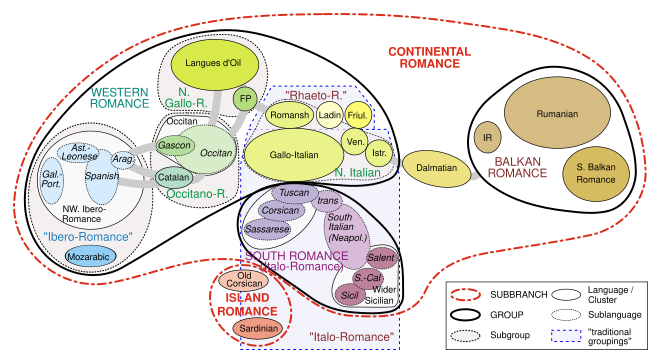
Genetic vs. typological classifications
These are two fundamentally different ways to classify languages, and it's important not to confuse them.
Genetic classification groups languages by common ancestry. It focuses on inherited features and produces family trees. English, Hindi, and Greek all belong to the Indo-European family because they descend from the same proto-language, even though they look and sound very different today.
Typological classification groups languages by structural similarities, regardless of whether they're historically related. Two languages can share a feature purely by coincidence or because certain structures are common across human languages. Typological categories include:
- Morphological types: How languages build words. Isolating languages like Mandarin Chinese use mostly separate words with little inflection. Agglutinative languages like Turkish stack affixes onto a root in a predictable way. Fusional languages like Latin pack multiple grammatical meanings into single affixes.
- Word order patterns: The default order of subject (S), verb (V), and object (O). English is SVO (The cat chased the mouse), Japanese is SOV, and Welsh is VSO.
- Phonological characteristics: Features of the sound system. Mandarin is a tonal language (pitch changes word meaning), while Xhosa uses click consonants.
A key point: Mandarin and Yoruba are both tonal, but that doesn't mean they're genetically related. Typological similarity ≠ genetic relationship.

Linguistic data and family trees
Building a language family tree involves a specific process:
- Identify cognates across potentially related languages. English father, German Vater, and Latin pater all look similar and mean the same thing.
- Establish regular sound correspondences. The resemblance between father, Vater, and pater isn't random. Grimm's Law describes a systematic shift where Proto-Indo-European p became f in Germanic languages. That same shift shows up across hundreds of words, which is what makes it convincing.
- Reconstruct proto-forms. Based on the correspondences, you hypothesize what the ancestral word looked like. For "father," linguists reconstruct Proto-Indo-European .
- Identify shared innovations and lexical isoglosses (geographic or genealogical boundaries for specific features) to determine which languages form subgroups.
- Construct a tree diagram that represents how and roughly when languages split from each other, ordering the branches chronologically.
Evidence for language relationships
Several types of evidence can support (or challenge) claims that languages are related.
Supporting evidence:
- Lexical similarities: Shared vocabulary, especially basic vocabulary less likely to be borrowed. Spanish agua and Italian acqua (both meaning "water") reflect their shared Latin ancestry.
- Grammatical correspondences: Similar morphological or syntactic structures. The Romance languages all form the future tense in a similar way, tracing back to a Late Latin construction.
- Regular sound changes: Systematic phonetic shifts across many words. Latin initial c (pronounced /k/) shifted in predictable ways across the Romance languages.
When evaluating a proposed relationship, linguists look for correspondences that are systematic (not just a handful of similar-sounding words) and supported by both quantity and quality of shared features.
Potential pitfalls:
- Borrowing and language contact can make unrelated languages look related. Japanese has thousands of English loanwords, but that doesn't make them genetically related.
- Chance similarities can be misleading. English bad and Persian bad (meaning "bad") look like cognates but are completely unrelated.
- Convergent evolution means unrelated languages can independently develop similar features. Several unrelated language families in East and Southeast Asia developed tonal systems (tonogenesis) independently.
Language classification and human history
Language classification does more than organize languages. It connects to archaeology, genetics, and anthropology to help reconstruct human prehistory.
- Population genetics: Language family boundaries often correlate with genetic patterns. Studies have found connections between the spread of Indo-European languages and specific Y-chromosome haplogroups, suggesting that language and genes sometimes traveled together.
- Prehistoric migrations: Language evidence helps trace major population movements. The Indo-European expansion spread languages across Eurasia, while the Austronesian dispersal carried related languages from Taiwan across the Pacific islands to Madagascar.
- Archaeological dating: Reconstructed vocabulary can help date proto-languages. Proto-Indo-European has reconstructed words for "wheel," "axle," and "yoke," which places the language no earlier than about 3500 BCE, when wheeled vehicles were invented.
- Cultural reconstruction: Proto-language vocabulary reveals what ancestral communities knew and believed. The reconstructed Proto-Indo-European phrase ("sky father") points to shared religious concepts across early Indo-European cultures.
Aligning linguistic evidence with archaeological and genetic findings isn't always straightforward. Languages can spread without large population movements (through cultural adoption), and populations can shift languages entirely. This is why the field increasingly relies on interdisciplinary collaboration across historical linguistics, anthropology, archaeology, and population genetics.
See Fiveable more often in Google
Mark Fiveable as a preferred source and Google is more likely to show you our guides in Top Stories, with a "preferred" badge in AI Mode and AI Overviews.