
Electric propulsion systems use electrical energy to accelerate propellant, producing high efficiency at the cost of low thrust. These systems are critical for missions requiring large total velocity changes (delta-V), because they dramatically reduce the amount of propellant a spacecraft needs to carry, which in turn cuts launch mass and cost compared to chemical rockets.
This section covers the main types of electric propulsion, how they work, and several advanced propulsion concepts that could shape the future of spaceflight.
Electric Propulsion Systems
Principles of electric spacecraft propulsion
Chemical rockets burn fuel to produce hot gas and push it out a nozzle. Electric propulsion takes a fundamentally different approach: it uses electrical energy to ionize a propellant (often xenon gas) and then accelerates those ions using electric or magnetic fields. The exhaust velocities are much higher than chemical rockets can achieve, which is why electric propulsion is so efficient.
That efficiency is captured by specific impulse (), which measures how much thrust you get per unit of propellant consumed over time. Higher means less propellant needed for a given mission.
- Electric propulsion systems typically achieve values of 1,000–10,000 seconds, compared to roughly 300–450 seconds for chemical rockets
- Thrust levels are low (0.01–1 N), but the engines can fire continuously for months or even years
- This makes them ideal for deep space exploration, where you need a large total delta-V but can afford to accelerate gradually
- The trade-off is clear: you get far better fuel economy, but you can't produce the sudden, powerful bursts that chemical rockets deliver

Types of electric propulsion systems
Three main types of electric thrusters show up in this course, each occupying a different spot on the thrust-vs-efficiency spectrum.
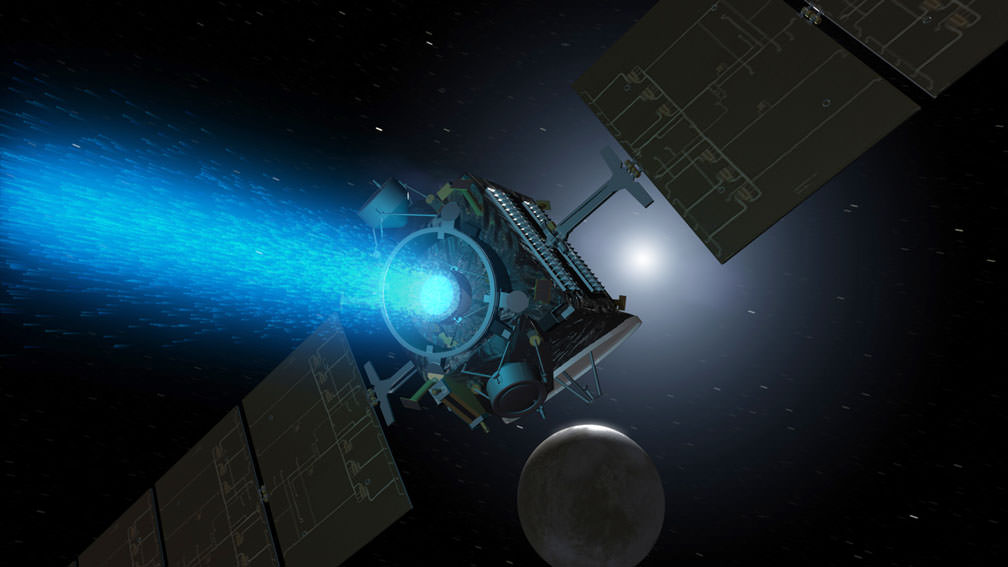
Ion engines accelerate ionized propellant through electrostatic grids. Electrons are stripped from propellant atoms (usually xenon) to create positive ions, and those ions are pulled through a series of charged grids to very high exhaust velocities.
- : 2,000–10,000 seconds
- Efficiency: 60–80%
- Thrust: 0.01–0.5 N (very low, requiring long operating times)
- Real-world use: NASA's Deep Space 1 (first spacecraft to use ion propulsion as its primary engine) and the Dawn mission, which orbited both the asteroid Vesta and the dwarf planet Ceres
Hall thrusters also ionize propellant, but they use a combination of electric and magnetic fields to accelerate ions. A radial magnetic field traps electrons in a circular drift, and the resulting electric field accelerates ions out the back of the thruster. The design is simpler and more compact than a gridded ion engine.
- : 1,000–3,000 seconds
- Efficiency: 50–60%
- Thrust: 0.1–1 N (higher than ion engines, but at the cost of lower )
- Real-world use: SpaceX's Starlink satellites use krypton-fueled Hall thrusters for orbit raising and station-keeping; ESA's SMART-1 mission used a Hall thruster to reach the Moon
Magnetoplasmadynamic (MPD) thrusters pass a high-current electric arc through the propellant, ionizing it into a plasma. The interaction between the current and its self-generated magnetic field (via the Lorentz force) accelerates the plasma out of the thruster.
- : 1,000–5,000 seconds
- Efficiency: 30–50%
- Thrust: 1–100 N (much higher than ion or Hall thrusters)
- Power requirements are steep: 100 kW to 1 MW, which is far beyond what most current spacecraft power systems can supply
- MPD thrusters are less mature than ion and Hall thrusters, but they're candidates for future high-power missions like crewed Mars transits or large cargo transport
Quick comparison: Ion engines maximize efficiency, Hall thrusters balance efficiency and thrust, and MPD thrusters prioritize thrust but need enormous power supplies.
Advanced Space Propulsion Concepts
Advanced space propulsion concepts
Beyond electric propulsion, several concepts could eventually enable missions that are impossible with current technology.
Solar sails don't carry propellant at all. Instead, they use radiation pressure from sunlight pushing on a large, reflective surface to generate thrust. Each photon that bounces off the sail transfers a tiny amount of momentum to the spacecraft.
- The sail material must be extremely large and lightweight (materials like Mylar or Kapton, only a few micrometers thick)
- is theoretically infinite because no propellant is consumed, but thrust is extremely small
- Best suited for long-duration missions where gradual acceleration adds up over time, such as asteroid or comet rendezvous
- JAXA's IKAROS (launched 2010) was the first spacecraft to successfully demonstrate solar sail propulsion in interplanetary space
Nuclear propulsion uses nuclear fission (or potentially fusion) reactions to heat a propellant, typically hydrogen, to very high temperatures before expelling it through a nozzle.
- : roughly 800–1,000 seconds for nuclear thermal designs (about twice that of the best chemical rockets)
- Thrust: 1–100 kN, comparable to chemical engines
- This combination of high thrust and high is what makes nuclear propulsion attractive for crewed missions to Mars and the outer planets
- NASA's NERVA program (1960s–70s) successfully ground-tested nuclear thermal rocket engines; current efforts like NASA's proposed Nuclear Thermal Propulsion (NTP) systems aim to revive this technology
Antimatter propulsion would generate energy through matter-antimatter annihilation, the most energy-dense reaction known in physics. When a particle meets its antiparticle, their entire mass converts to energy according to .
- Theoretical : 1,000,000+ seconds
- The energy density dwarfs every other propulsion concept
- The catch: producing antimatter is extraordinarily expensive and inefficient (current global production is measured in nanograms per year), and storing it requires magnetic confinement to prevent contact with normal matter
- This remains firmly in the theoretical/experimental stage, but it's the kind of technology that could one day make interstellar travel feasible
Challenges of advanced propulsion technologies
Most of these advanced concepts face significant hurdles before they can fly on real missions.
- Technological readiness: Many are at early development stages (low Technology Readiness Levels, or TRLs), requiring years of research, ground testing, and flight demonstrations
- Cost: Developing new propulsion systems demands large R&D budgets and specialized infrastructure (test facilities, nuclear-rated hardware, etc.)
- Safety and regulation: Nuclear propulsion raises concerns about radioactive material during launch and in-space operations. International treaties and national regulations add complexity to development and deployment
Despite these challenges, the potential payoff is substantial. Higher-efficiency propulsion reduces the propellant mass a spacecraft must carry, which shrinks launch costs and opens up missions to destinations that are currently out of reach. Faster transit times also reduce crew radiation exposure on long missions, a real concern for human exploration beyond low Earth orbit.