
Hydrograph Analysis
Hydrograph analysis is how hydrologists figure out what a watershed actually did during a rainfall event. By separating baseflow from direct runoff and calculating metrics like runoff volume and peak discharge, you can assess flood risks and make informed water management decisions.
The core challenge is that a stream's total discharge during a storm combines water from different sources: groundwater feeding the stream (baseflow) and rainfall running off the land surface (direct runoff). Separating these two components requires judgment calls, and different methods give different answers.
Graphical Baseflow Separation Methods
Three standard graphical methods are used to draw the line between baseflow and direct runoff on a hydrograph. Each makes different assumptions about how baseflow behaves during a storm event.
Constant Discharge Method
This is the simplest approach. It assumes baseflow stays the same throughout the entire event.
- Identify the discharge at the start of the rising limb (the pre-event baseflow level).
- Draw a horizontal line at that discharge value across the hydrograph.
- Everything above the line is direct runoff; everything below is baseflow.
The method is easy to apply, but it ignores the fact that baseflow typically increases during a storm as infiltrating water recharges groundwater. This means it tends to overestimate direct runoff and underestimate baseflow.
Constant Slope Method
This method assumes baseflow increases linearly during the event rather than staying flat.
- Mark the start of the rising limb.
- Find the inflection point on the falling limb, where the rate of decline changes. Mathematically, this is where .
- Draw a straight line connecting the start of the rising limb to the inflection point.
This gives a more balanced estimate than the constant discharge method because it accounts for rising baseflow. However, picking the exact inflection point can be subjective, and different analysts may choose slightly different locations on the curve.
Concave Method
This method tries to follow the natural shape of baseflow recession, which typically decays along a concave (exponential or logarithmic) curve.
- Extrapolate the pre-storm baseflow recession curve forward beneath the rising limb and peak.
- From the peak, project the post-storm recession curve backward.
- Connect these two curves, usually at a point beneath or just after the peak.
The concave method most closely represents how baseflow actually behaves, but it requires fitting a mathematical function to the recession curve, which introduces uncertainty. Watershed characteristics like geology and groundwater storage strongly influence the recession shape. For example, karst systems with large underground conduits may show much more rapid baseflow recession than watersheds underlain by dense clay.
Hydrograph Data Calculations
Once you've separated baseflow from direct runoff, you can extract several key metrics from the hydrograph.
- Runoff volume is the total volume of water discharged during the event. You calculate it by integrating the area under the hydrograph curve:
The result is in units of volume ( or ) and tells you the total water yield from the watershed for that event. In practice, with discrete time-step data, you'd approximate this using trapezoidal summation.
- Peak discharge is the maximum flow rate recorded on the hydrograph. This is the single most important number for flood risk assessment because infrastructure like bridges and culverts must handle this maximum flow. Peak discharge is driven by precipitation intensity, watershed size, and land use. Urbanization increases peak discharge because impervious surfaces (roads, rooftops) prevent infiltration and accelerate runoff.
- Time to peak is the duration from the start of the rising limb to the moment of peak discharge. It reflects how quickly the watershed responds to rainfall. Shorter time to peak typically indicates smaller or steeper watersheds, more impervious cover, or less vegetative interception. A heavily urbanized catchment might have a time to peak of under an hour, while a large forested basin could take many hours or even days.
Hydrograph Separation Techniques
Limitations of Separation Techniques
Every separation method involves simplifying assumptions, and none perfectly captures what's happening underground.
- The constant discharge method ignores that groundwater recharge during a storm gradually raises baseflow. In watersheds with permeable soils and active groundwater systems, this assumption breaks down significantly.
- The constant slope method improves on this by allowing baseflow to rise, but it assumes a linear increase. Real baseflow response is rarely linear. The method is also sensitive to where you place the inflection point, and small shifts in that choice can meaningfully change your baseflow/direct runoff split.
- The concave method is the most physically realistic, but it requires you to fit a recession curve equation to the data. The shape of that curve depends on geology, soil properties, and aquifer characteristics, all of which vary across watersheds and may not be well known. Fitting the wrong function introduces systematic error.
Comparison of Separation Methods
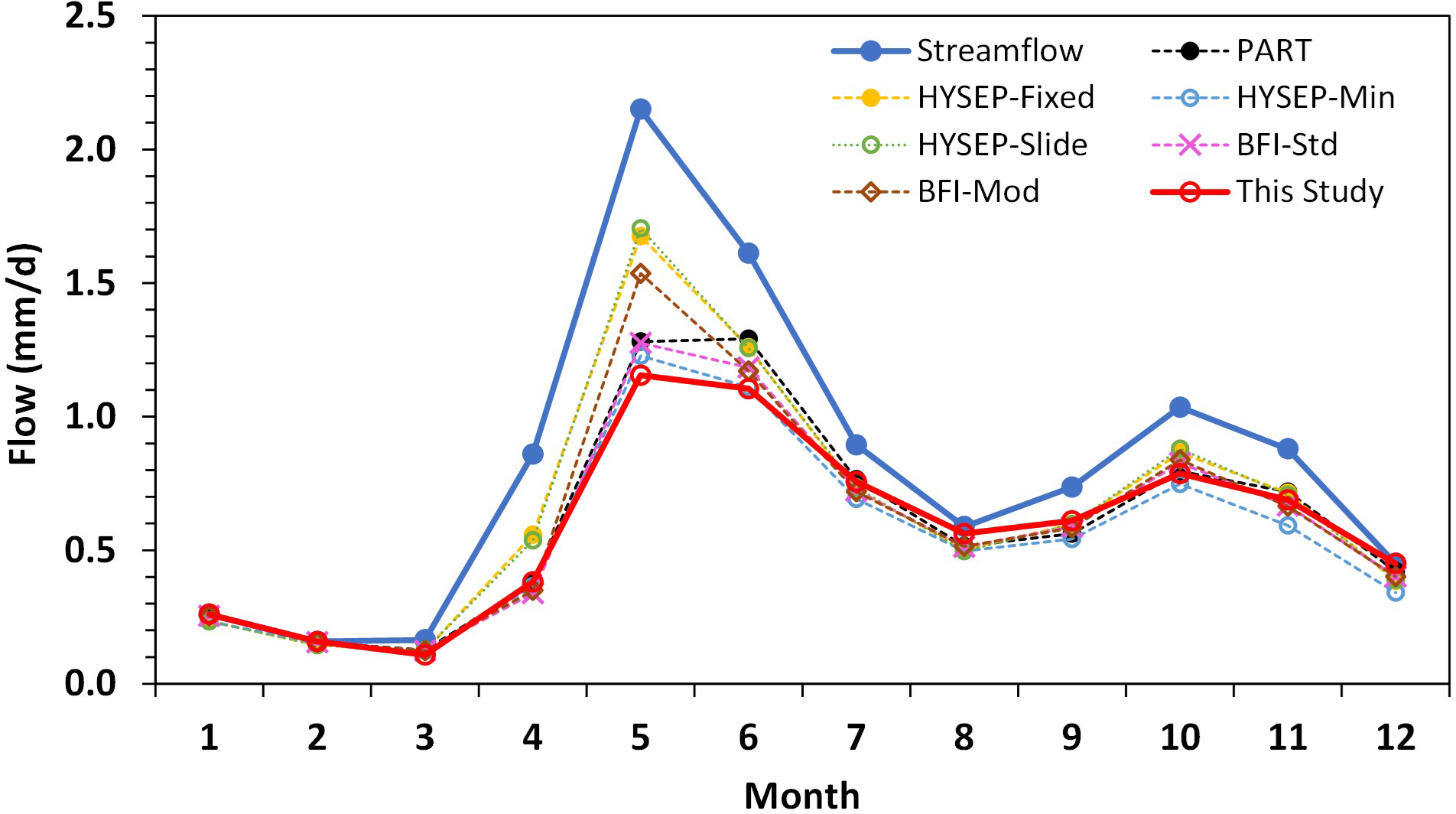
Different methods applied to the same hydrograph will produce different estimates of baseflow and direct runoff. Understanding these differences matters because they propagate into every calculation that follows.
- The constant discharge method generally attributes the most flow to direct runoff, since it holds baseflow at its lowest (pre-event) level throughout.
- The constant slope method typically falls in the middle, providing a moderate split between baseflow and direct runoff.
- The concave method usually assigns the most flow to baseflow and the least to direct runoff, particularly in watersheds with slow groundwater response.
These differences directly affect estimated runoff volumes and peak discharges. Overestimating direct runoff leads to higher calculated volumes and peaks, which could result in over-designed (and more expensive) flood infrastructure. Underestimating direct runoff could leave communities under-protected.
Choosing the right method depends on your watershed and your goals:
- Watershed characteristics like bedrock type, soil permeability, and land use (agricultural vs. urban) influence which assumptions are most reasonable. A thin-soiled, steep, urban catchment may behave close to the constant discharge assumption. A deep-soiled, flat, rural basin may be better represented by the concave method.
- Analysis objectives matter too. Flood risk assessment may call for conservative (higher) runoff estimates, while groundwater recharge studies need the most accurate baseflow separation possible.
- Using multiple methods on the same hydrograph is good practice. Comparing results gives you a range of estimates and a sense of the uncertainty in your separation, which is valuable information for any decision that depends on these numbers.