10.3 The G.I. Bill and democratization of higher education

✏️History of Education Unit 10 Review
10.3 The G.I. Bill and democratization of higher education
✏️ History of Education
The G.I. Bill, passed in 1944, provided tuition assistance and living allowances for World War II veterans, opening college doors to millions who previously couldn't afford it. The resulting flood of new students reshaped American higher education, expanded the middle class, and fueled decades of economic growth.
The G.I. Bill and its Provisions

Top images from around the web for Servicemen's Readjustment Act of 1944
Bethel and the G.I. Bill | Bethel at War 1914 - 2014 View original
Is this image relevant?
The Challenges of Peacetime | United States History II View original
Is this image relevant?
Bethel and the G.I. Bill | Bethel at War 1914 - 2014 View original
Is this image relevant?
The Challenges of Peacetime | United States History II View original
Is this image relevant?
Servicemen's Readjustment Act of 1944
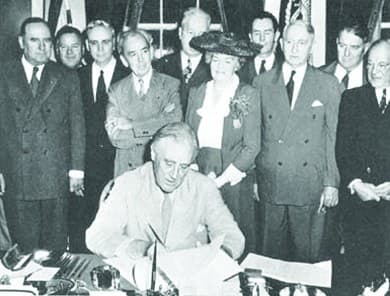
President Franklin D. Roosevelt signed the Servicemen's Readjustment Act into law on June 22, 1944. Most people just call it the G.I. Bill. The law offered a range of benefits designed to help returning World War II veterans readjust to civilian life, with education and financial assistance at its core.
Veterans' Education Benefits
The education provisions were the most transformative part of the bill. Veterans could attend college or vocational school with the government covering:
- Tuition, fees, books, and supplies up to $500 per year (roughly $7,500 in 2021 dollars)
- A monthly living allowance for full-time students
- Up to 4 years of education or training
Before the G.I. Bill, most families simply couldn't afford to send their children to college. These benefits removed that financial barrier for millions of veterans overnight.
Vocational Training Opportunities
College wasn't the only path the G.I. Bill supported. Veterans could also attend technical schools, trade schools, or apprenticeship programs. Popular vocational tracks included mechanics, welding, and agriculture. This mattered because not every veteran wanted or needed a four-year degree, but they still needed marketable skills to re-enter the workforce.
Impact on Higher Education
College Enrollment Boom
The numbers tell the story clearly. Total college enrollment jumped from roughly 1.5 million in 1940 to about 2.7 million by 1950. By 1947, veterans made up 49% of all college admissions. Campuses that had been half-empty during the war were suddenly overflowing, and colleges scrambled to expand facilities, hire faculty, and add new programs to keep up.

Democratization of Higher Education
Before World War II, college was largely reserved for the wealthy. The G.I. Bill broke that pattern. Veterans from working-class and lower-income families could now afford to attend, which meant the student body started to look much more like the country itself. Sons of factory workers, farmers, and immigrants sat in the same classrooms as sons of professionals. This shift didn't just change who went to college; it changed what Americans believed college was for.
Expansion of Community Colleges
The surge in demand also accelerated the growth of community colleges. These institutions offered lower tuition and more flexible scheduling than traditional four-year schools, making them attractive to veterans who wanted vocational training or a stepping stone toward a bachelor's degree. The number of community colleges in the U.S. roughly doubled, growing from about 450 in 1944 to around 1,000 by 1960.
Impact on Women and Minorities
The G.I. Bill's benefits were not distributed equally. The vast majority of beneficiaries were white men, and the bill did nothing to directly address racial segregation in education. In the South, many Black veterans were steered toward underfunded Black colleges with limited capacity, or were denied admission to white institutions altogether. Historian Ira Katznelson has argued that the G.I. Bill actually widened the racial wealth gap because white veterans could access its benefits far more easily than Black veterans.
That said, the bill did produce some gains. Some women veterans used their benefits for college or vocational training, and the overall expansion of higher education created more seats at more institutions. Black enrollment at historically Black colleges and universities (HBCUs) did increase. But it's important not to overstate the bill's inclusiveness. The democratization it achieved was real but incomplete, and its uneven application is a significant part of the story.
Societal and Economic Effects
Social Mobility and the Middle Class
The G.I. Bill is one of the single largest drivers of middle-class expansion in American history. By giving veterans access to college degrees and vocational credentials, it enabled millions of families to move into higher-paying jobs than their parents had held. This upward mobility translated into higher rates of homeownership (aided by the bill's home loan provisions), greater consumer spending, and the suburban growth that defined the 1950s.
Contribution to Post-World War II Economic Growth
The economic returns were enormous. A more educated workforce meant higher productivity and more innovation across industries. The construction of new campus buildings and facilities generated economic activity on its own. Estimates suggest that for every dollar the government invested in the G.I. Bill, the economy saw a return of $5 to $12 in tax revenue and economic output. The bill demonstrated that public investment in education could pay for itself many times over, an argument that shaped higher education policy for decades afterward.
See Fiveable more often in Google
Mark Fiveable as a preferred source and Google is more likely to show you our guides in Top Stories, with a "preferred" badge in AI Mode and AI Overviews.