1.1 European Alliances and Balance of Power

🌹World War I Unit 1 Review
1.1 European Alliances and Balance of Power
🌹 World War I
European alliances and the balance of power were central factors on the road to World War I. The major powers locked themselves into defensive pacts that were supposed to prevent war by making the cost of aggression too high. Instead, these alliances created a web of obligations that turned a regional crisis into a continental catastrophe.
The balance of power concept aimed for stability by keeping any single nation from becoming too dominant. But shifts like German unification in 1871 and the scramble for colonies strained the system beyond repair, setting the stage for 1914.
European Alliances in the Early 20th Century

Top images from around the web for Formation of Major Alliances
Triple-Entente - Vikidia, l’encyclopédie des 8-13 ans View original
Is this image relevant?
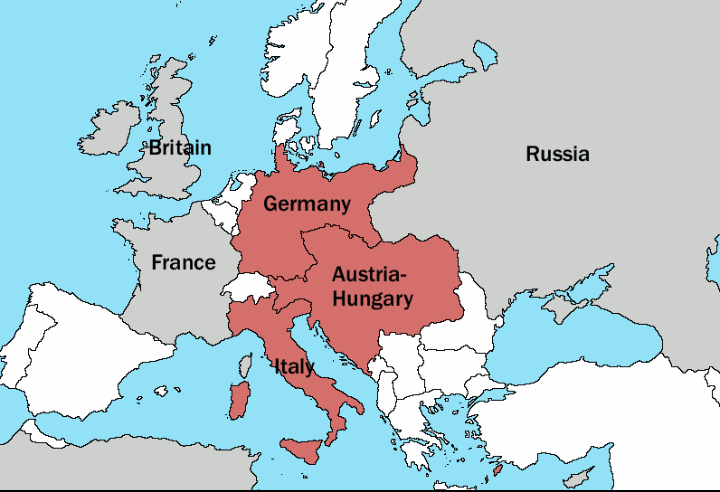
File:Triple Alliance.png - Wikimedia Commons View original
Is this image relevant?
Map Of Triple Alliance And Triple Entente | Triple Alliance … | Flickr View original
Is this image relevant?
Triple-Entente - Vikidia, l’encyclopédie des 8-13 ans View original
Is this image relevant?
File:Triple Alliance.png - Wikimedia Commons View original
Is this image relevant?
Formation of Major Alliances
By the early 1900s, Europe's great powers had sorted themselves into two rival blocs. Understanding who joined which side, and why, is essential for grasping how the war spread so quickly.
- Triple Alliance (1882): Germany, Austria-Hungary, and Italy agreed to a defensive pact primarily aimed at countering France and Russia. For Germany, this meant security on two fronts. For Austria-Hungary, it meant backing against Russian ambitions in the Balkans. Italy's commitment, though, was always shaky.
- Franco-Russian Alliance (1894): After Germany let its Reinsurance Treaty with Russia lapse in 1890, Russia turned to France. This military agreement meant Germany now faced the nightmare scenario of a two-front war. Both nations pledged mutual support if attacked by Germany or its allies.
- Entente Cordiale (1904): Britain and France signed this agreement, ending centuries of rivalry stretching back through the Napoleonic Wars and even the Hundred Years' War. It wasn't a formal military alliance, but a diplomatic understanding that resolved colonial disputes (especially over Egypt and Morocco) and signaled that Britain would not stand aside if France were threatened. This further isolated Germany.
- Triple Entente (1907): When Britain reached a similar understanding with Russia, the Triple Entente took shape, linking Britain, France, and Russia. Germany and Austria-Hungary now found themselves effectively encircled.
Implications of Alliance Systems
These alliances had consequences that went far beyond diplomacy.
- Escalation risk: A conflict between two nations could drag in all the others through their treaty obligations. The Balkans were especially dangerous because both Austria-Hungary and Russia had direct interests there.
- Secrecy bred suspicion: Many alliance clauses were kept secret, so governments couldn't be sure exactly what they were up against. This uncertainty fueled the Anglo-German naval arms race, as each side built warships to prepare for a conflict it couldn't fully predict.
- Loss of diplomatic flexibility: Once the alliance blocs hardened, leaders found it much harder to back down during crises without appearing to abandon their allies. The July Crisis of 1914 is the clearest example: what began as an Austro-Serbian dispute pulled in Russia, then Germany, then France, then Britain within a matter of days.
- Atmosphere of tension: The alliance system reinforced nationalism and militarism. Governments justified massive military spending by pointing to the threat posed by the opposing bloc, which in turn made the other side spend more.

Balance of Power in Europe
Concept and Maintenance
The balance of power is the idea that peace is most likely when no single state is strong enough to dominate the others. European leaders pursued this through military alliances, territorial adjustments, and diplomatic negotiations.
The Congress of Vienna (1814–1815) established the framework after the Napoleonic Wars. Its goal was to prevent any one power from achieving the kind of dominance France had under Napoleon. This system shaped European diplomacy for most of the 19th century, but by the early 1900s, several developments had undermined it:
- Decline of the Ottoman Empire: Often called the "Sick Man of Europe," the Ottoman Empire's slow collapse left a power vacuum in the Balkans that Austria-Hungary, Russia, and smaller nations all rushed to fill.
- Rise of unified Germany (1871): Germany's unification under Prussian leadership created a powerful new state in the center of Europe, fundamentally altering the old balance.
- Naval arms race: Britain and Germany competed to build the most powerful navy, with the introduction of the HMS Dreadnought in 1906 making all previous warships obsolete and resetting the competition.
- Colonial expansion: The Scramble for Africa and rivalries in Asia gave European powers new arenas for competition, adding friction on top of continental tensions.

Challenges and Criticisms
Each of these pressures deserves a closer look, because they show how the balance of power broke down in practice.
The Ottoman decline turned the Balkans into Europe's most volatile region. Austria-Hungary wanted to control the area to prevent Slavic nationalism from destabilizing its own multi-ethnic empire. Russia saw itself as protector of Slavic peoples and wanted access to warm-water ports. These competing goals made every Balkan crisis a potential trigger for wider war.
German unification didn't just add a new great power; it created one with the largest army on the continent and a rapidly growing industrial economy. Britain and France, long accustomed to their dominant positions, viewed Germany's rise with alarm.
The naval arms race is a textbook example of a security dilemma: Germany built a larger navy to protect its interests, which Britain interpreted as a direct threat to its naval supremacy, prompting Britain to build even more ships. Neither side felt safer.
Colonial rivalries produced real crises. The Fashoda Incident (1898) nearly led to war between Britain and France over Sudan. The Moroccan Crises of 1905 and 1911 pitted Germany against France and Britain over influence in North Africa.
Critics of the balance of power concept argue that it actually increased instability by encouraging arms races and aggressive foreign policies. Rather than preventing war, the system created conditions where war became more likely and, once it started, far more destructive.
Shifting Alliances Leading to World War I
Key Diplomatic Developments
Alliances weren't static. They shifted in ways that made the situation progressively more dangerous.
- Reinsurance Treaty (1887): Bismarck negotiated this secret agreement to keep Russia friendly with Germany, even while Germany was allied with Austria-Hungary. When Kaiser Wilhelm II let the treaty lapse in 1890, it removed the main barrier keeping Russia and France apart. Within four years, they had their own alliance.
- Weakening of the Triple Alliance: Italy grew increasingly unreliable as an ally. It had territorial disputes with Austria-Hungary over areas like Trentino and Trieste, regions with Italian-speaking populations. When war came in 1914, Italy initially stayed neutral, then joined the Entente in 1915 after being promised those territories in the Treaty of London.
- Moroccan Crises (1905 and 1911): Germany challenged French influence in Morocco, partly to test whether the Entente Cordiale would hold. It did. Both crises ended with France's position strengthened and Anglo-French cooperation deepened, while Germany felt increasingly encircled.
- Bosnian Crisis (1908–1909): Austria-Hungary annexed Bosnia-Herzegovina, enraging Serbia and its backer, Russia. Russia was forced to back down because it wasn't militarily ready, but the humiliation pushed Russia to accelerate its military buildup and strengthen ties with Serbia.
Impact on International Relations
- Balkan Wars (1912–1913): These wars redrew the map of Southeastern Europe. Serbia emerged larger and more confident, alarming Austria-Hungary. Bulgaria, defeated in the Second Balkan War, drifted toward the Central Powers. The region became even more unstable.
- Assassination of Archduke Franz Ferdinand (June 28, 1914): The assassination in Sarajevo set off a chain reaction of alliance obligations. Austria-Hungary issued an ultimatum to Serbia. Russia mobilized to support Serbia. Germany backed Austria-Hungary and declared war on Russia, then France. Britain entered when Germany invaded Belgium. Within six weeks, most of Europe was at war.
- The broader pattern: By 1914, the alliance system had created an environment where diplomats couldn't accurately gauge the consequences of their actions. Each crisis over the previous decade had been resolved short of war, which may have made leaders overconfident that brinkmanship would work again. In July 1914, it didn't.
- Long-term consequences: The war that followed destroyed four empires (Ottoman, Austro-Hungarian, Russian, and German), killed millions, and reshaped global power dynamics in ways that set the stage for World War II and the Cold War.
See Fiveable more often in Google
Mark Fiveable as a preferred source and Google is more likely to show you our guides in Top Stories, with a "preferred" badge in AI Mode and AI Overviews.