
Optimal design theory helps researchers create efficient experiments. Alphabetic optimality criteria, like A, D, E, and G, provide different ways to measure a design's quality. Each criterion focuses on specific aspects of precision in parameter estimation or prediction.
These criteria help balance trade-offs in experimental design. A-optimality minimizes average variance, D-optimality maximizes overall precision, E-optimality focuses on worst-case scenarios, and G-optimality improves prediction accuracy across the design space.
Information-based Optimality Criteria
Trace Criterion (A-optimality)
- A-optimality minimizes the average variance of the parameter estimates
- Aims to minimize the trace of the inverse of the information matrix
- Equivalent to minimizing the average variance of the parameter estimates
- Focuses on the precision of the parameter estimates
- Useful when all parameters are of equal importance (treatment effects in a clinical trial)
Determinant Criterion (D-optimality)
- D-optimality maximizes the determinant of the information matrix
- Equivalent to minimizing the generalized variance of the parameter estimates
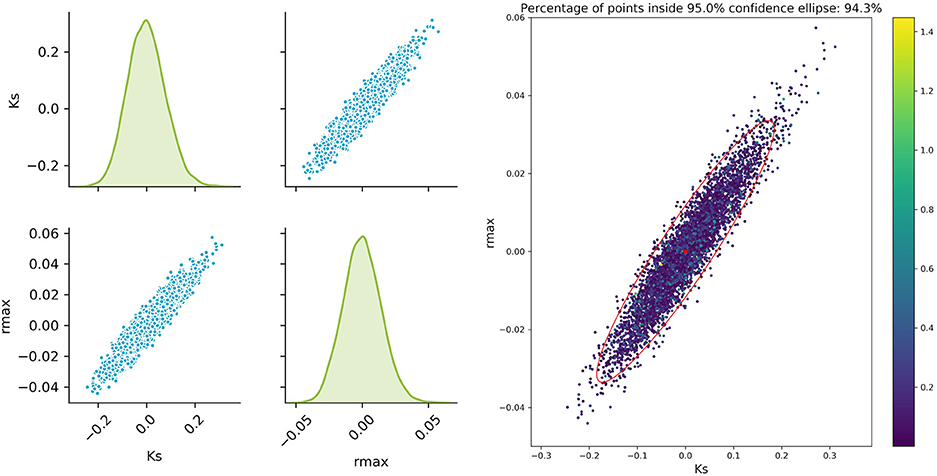
- Aims to minimize the volume of the joint confidence ellipsoid of the parameters
- Focuses on the overall precision of the parameter estimates
- Useful when the overall precision of the estimates is important (response surface modeling)
Eigenvalue Criterion (E-optimality)
- E-optimality maximizes the minimum eigenvalue of the information matrix
- Aims to minimize the maximum variance of the parameter estimates
- Focuses on the worst-case precision of the parameter estimates
- Useful when the worst-case precision is important (ensuring all parameters are estimated with a minimum precision)
Prediction-based Optimality Criteria
Maximum Prediction Variance (G-optimality)
- G-optimality minimizes the maximum prediction variance over the design space
- Aims to minimize the worst-case prediction variance
- Focuses on the precision of the predicted response over the entire design space
- Useful when the goal is to make precise predictions throughout the design space (response surface modeling, process optimization)
- Equivalent to D-optimality for linear models (General Equivalence Theorem)
Minimax Prediction Variance
- Minimax prediction variance minimizes the maximum prediction variance over a specific set of points
- Aims to minimize the worst-case prediction variance over a subset of the design space
- Focuses on the precision of the predicted response over a subset of the design space
- Useful when precise predictions are required at specific locations (critical points in a process)
Advanced Optimality Concepts
General Equivalence Theorem
- Establishes the equivalence between D-optimality and G-optimality for linear models
- States that a design is D-optimal if and only if it is G-optimal
- Provides a unified framework for information-based and prediction-based optimality criteria
- Allows for the verification of optimality using the equivalence theorem
- Enables the construction of optimal designs using iterative algorithms (Fedorov-Wynn algorithm)
Compound Criteria
- Compound criteria combine multiple optimality criteria into a single objective function
- Allow for the balancing of different optimality goals (precision of estimates and predictions)
- Examples include the weighted sum of A-optimality and D-optimality
- Enables the construction of designs that satisfy multiple optimality criteria simultaneously
- Useful when multiple objectives need to be considered (balancing parameter estimation and prediction precision)