6.1 Establishment and structure of NATO

🇪🇺European History – 1945 to Present Unit 6 Review
6.1 Establishment and structure of NATO
🇪🇺 European History – 1945 to Present
NATO emerged in 1949 as a military alliance to counter Soviet influence in Europe. Twelve founding members signed the Washington Treaty, establishing collective defense as the core principle, with Article 5 declaring an attack on one as an attack on all.
NATO aimed to deter Soviet aggression and prevent communism's spread. It created a framework for political and military cooperation, developing standardized procedures and equipment to enhance member states' interoperability in the face of Cold War tensions.
Founding of NATO

Top images from around the web for Origins and Treaty Formation
Harry S. Truman - Wikipedia View original
Is this image relevant?
НАТО — Википедија View original
Is this image relevant?
NATO - Wikipedia View original
Is this image relevant?
Harry S. Truman - Wikipedia View original
Is this image relevant?
НАТО — Википедија View original
Is this image relevant?
Origins and Treaty Formation
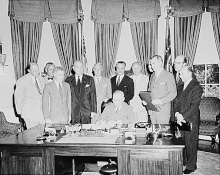
- North Atlantic Treaty Organization (NATO) established in 1949 as a military alliance between North American and European countries
- Washington Treaty signed on April 4, 1949, by 12 founding members (United States, Canada, United Kingdom, France, Italy, Belgium, Netherlands, Luxembourg, Denmark, Norway, Iceland, Portugal)
- Collective defense principle forms the core of NATO's founding agreement
- Article 5 of the Washington Treaty stipulates that an attack against one member is considered an attack against all
- Truman Doctrine influenced NATO's formation by pledging U.S. support to democratic nations against communist expansion
NATO's Purpose and Early Development
- Created as a counterbalance to the growing influence of the Soviet Union in Europe
- Aimed to provide collective security and maintain peace in the North Atlantic region
- Focused on deterring Soviet aggression and preventing the spread of communism
- Established a framework for political and military cooperation among member states
- Developed standardized military procedures and equipment to enhance interoperability

NATO Leadership and Organization
Command Structure and Decision-Making
- Supreme Allied Commander Europe (SACEUR) serves as the head of Allied Command Operations
- SACEUR traditionally held by a U.S. general or admiral, emphasizing U.S. commitment to European security
- North Atlantic Council functions as NATO's principal political decision-making body
- Council consists of permanent representatives from all member countries
- Decisions within NATO require unanimous consensus among all members

Military Standardization and Cooperation
- Military standardization programs implemented to ensure interoperability among member forces
- Standardization includes common operational procedures, logistics, and equipment specifications
- NATO Standardization Office (NSO) coordinates standardization efforts across the alliance
- Joint military exercises conducted regularly to enhance coordination and readiness
- Shared intelligence and early warning systems developed to improve collective defense capabilities
Cold War Context
Economic and Political Backdrop
- Marshall Plan launched in 1948 to provide economic aid to Western European countries
- Plan aimed to rebuild war-torn economies and create stable, democratic allies
- Containment policy adopted by the United States to prevent the spread of communism globally
- Cold War emerged as a period of geopolitical tension between the United States and Soviet Union
- Western Bloc formed, consisting of NATO members and other U.S.-aligned countries
Strategic Considerations and Alliances
- NATO served as a key instrument in implementing the containment policy
- Deterrence strategy employed to prevent Soviet aggression through the threat of massive retaliation
- Nuclear deterrence became a central component of NATO's defense posture
- Alliance expanded over time to include Greece and Turkey (1952) and West Germany (1955)
- Warsaw Pact established in 1955 as a Soviet-led counterpart to NATO in Eastern Europe
See Fiveable more often in Google
Mark Fiveable as a preferred source and Google is more likely to show you our guides in Top Stories, with a "preferred" badge in AI Mode and AI Overviews.