
Electrode reaction rates and exchange current density are crucial concepts in electrochemistry. They describe how quickly electrons transfer at electrode surfaces and how easily reactions occur. Understanding these factors helps predict and control electrochemical processes in various applications.
Exchange current density quantifies electron transfer rates at equilibrium. It's influenced by electrode material, reactant concentrations, temperature, and mass transport. These factors determine whether reactions are activation-controlled or mass transport-controlled, affecting overall reaction kinetics and efficiency.
Electrode Reaction Rates and Exchange Current Density
Exchange current density concept
- Quantifies rate of electron transfer at electrode-electrolyte interface when net current is zero
- Represents dynamic equilibrium between forward and reverse reactions (oxidation and reduction)
- Higher exchange current density indicates faster electrode kinetics and more reversible reactions (platinum)
- Determines ease of electrode reaction occurrence
- High exchange current density reactions require lower overpotentials to drive net reaction (hydrogen evolution)
- Low exchange current density reactions require higher overpotentials to achieve significant net current (oxygen reduction)
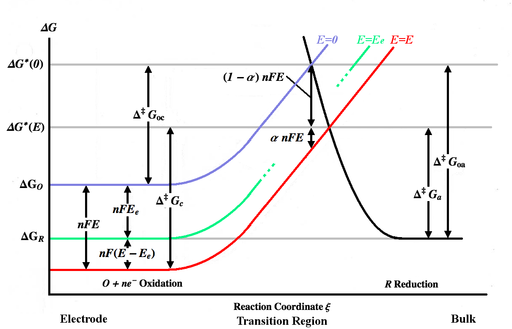
Factors in electrode reaction rates
- Electrode material nature
- Catalytic properties and surface structure affect activation energy barrier (platinum vs. carbon)
- Materials with lower activation energy barriers exhibit higher reaction rates (palladium)
- Reactant and product concentrations
- Higher reactant concentration increases reaction rate (concentrated vs. dilute solutions)
- Higher product concentration slows down reaction rate (buildup of products near electrode)
- Temperature effects
- Increasing temperature typically enhances reaction rates by providing more energy for overcoming activation barriers (room temperature vs. elevated temperature)
- Electrode potential
- Overpotential, deviation from equilibrium potential, drives net reaction (positive vs. negative overpotentials)
- Higher overpotentials lead to faster reaction rates (higher current densities)
- Reactant and product mass transport
- Diffusion, migration, and convection influence species availability at electrode surface (stagnant vs. stirred solutions)
- Efficient mass transport ensures steady supply of reactants and removal of products (rotating disk electrode)

Activation vs mass transport control
- Activation-controlled reactions
- Reaction rate determined by electron transfer kinetics at electrode surface
- Governed by activation energy barrier and applied overpotential
- Characterized by exponential dependence of current on overpotential (Butler-Volmer equation)
- Mass transport-controlled reactions
- Reaction rate limited by reactant transport to or product transport from electrode surface
- Influenced by diffusion, migration, and convection processes
- Characterized by linear dependence of current on overpotential (Nernst-Planck equation)
- Mixed control reactions
- Some reactions exhibit both activation and mass transport control depending on applied overpotential and experimental conditions (intermediate overpotentials)
- Slower process (activation or mass transport) determines overall reaction rate
Calculation of exchange current density
- Arrhenius equation relates exchange current density to temperature and activation energy
-
- : pre-exponential factor, related to frequency of collisions and orientation of reactants
- : activation energy barrier for electrode reaction (J/mol)
- : universal gas constant (8.314 J/mol·K)
- : absolute temperature (K)
-
- Determination of and
- Measure exchange current density at different temperatures experimentally
- Plot vs. to obtain straight line with slope and intercept
- Calculating exchange current density at specific temperature
- Once and are known, exchange current density can be calculated for any temperature using Arrhenius equation
- Higher temperatures lead to higher exchange current densities, indicating faster electrode kinetics (room temperature vs. elevated temperature)