
Cosmic Microwave Background (CMB) Radiation
The cosmic microwave background is relic radiation from the early universe, originating about 380,000 years after the Big Bang. It formed when the universe cooled enough for neutral atoms to form, allowing photons to travel freely for the first time. By analyzing the CMB's temperature fluctuations and polarization patterns, cosmologists can pin down key parameters that describe the universe's geometry, composition, and evolution.
Origin of the CMB
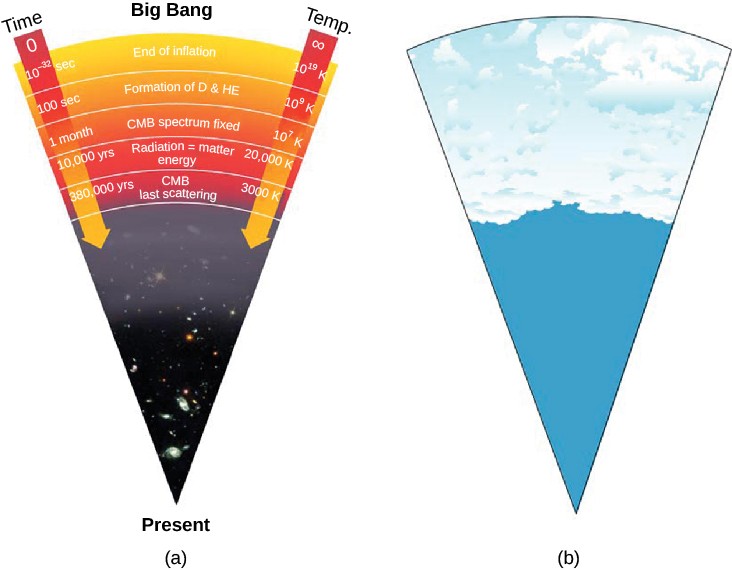
About 380,000 years after the Big Bang, the universe had cooled to roughly 3,000 K. At that temperature, protons and electrons could finally combine into neutral hydrogen atoms, a process called recombination. Before recombination, photons were constantly scattering off free electrons and couldn't travel far. Once neutral atoms formed, photons decoupled from matter and began streaming freely through space. The universe became transparent to light.
The surface of last scattering is the "shell" in space-time where these photons had their final interaction with matter before propagating to us. Every direction you look in the sky, you're seeing photons from this surface. Those photons have been redshifted by the expansion of the universe from ~3,000 K down to the 2.725 K we observe today.
Evidence for the Big Bang Theory
- The CMB's very existence confirms the Big Bang prediction of a hot, dense early universe that cooled as it expanded.
- Its spectrum is an almost perfect blackbody at 2.725 K, exactly what you'd expect from radiation that was once in thermal equilibrium at ~3,000 K and then redshifted by cosmic expansion.
- The observed redshift of CMB photons is consistent with the expanding universe described by the Hubble-Lemaître law.
- The cosmic abundances of light elements (roughly 75% hydrogen, 25% helium, trace lithium) match the predictions of Big Bang nucleosynthesis, which occurred in the first few minutes after the Big Bang. The CMB's temperature tells us the conditions under which that nucleosynthesis happened.

CMB Fluctuations and Cosmological Implications
Power Spectrum of CMB Fluctuations
The CMB isn't perfectly uniform. Tiny temperature variations (on the order of 1 part in 100,000) appear across the sky, and the angular power spectrum is the tool used to analyze them. It plots the amplitude of temperature fluctuations against angular scale, parameterized by multipole moments (). Low values correspond to large angular scales; high values correspond to small angular scales.
The power spectrum shows a series of peaks and troughs that arise from acoustic oscillations in the primordial plasma. Before recombination, the photon-baryon fluid experienced a tug-of-war: gravity pulled matter inward toward denser regions, while photon pressure pushed outward. These competing forces set up standing sound waves. At the moment of decoupling, some regions were at maximum compression and others at maximum rarefaction, imprinting a characteristic pattern of peaks onto the CMB.
What the peaks tell us:
- Position of the first peak (~, or about 1° on the sky): Sensitive to the curvature of the universe. Its observed location is consistent with a spatially flat geometry.
- Relative heights of odd vs. even peaks: Odd peaks correspond to compressions, even peaks to rarefactions. Their ratio constrains the baryon density .
- Overall envelope of peak heights: Constrains the total matter density .
At the largest angular scales (low ), the power spectrum flattens into the Sachs-Wolfe plateau. These large-scale fluctuations reflect the primordial density perturbations seeded during cosmic inflation, essentially unchanged since they were too large to have been affected by acoustic oscillations.
Constraints from CMB Measurements
The CMB power spectrum, measured with high precision by missions like WMAP and Planck, provides tight constraints on cosmological parameters:
- Flat geometry: The first peak's location at indicates the total energy density is very close to the critical density (), meaning the universe is spatially flat.
- Baryon density: The ratio of odd to even peak heights gives , meaning ordinary matter makes up only about 5% of the total energy budget.
- Matter density: The overall peak structure constrains , which includes both baryonic and dark matter. Since baryons account for ~0.05, dark matter accounts for ~0.25.
- Hubble constant: The peak positions and heights, combined with other data, constrain km/s/Mpc (with some tension between CMB-derived and local measurements).
Combining these results yields the current concordance model of the universe's composition:
- ~5% ordinary (baryonic) matter
- ~27% dark matter
- ~68% dark energy
Polarization of the CMB provides independent confirmation. E-mode polarization patterns arise from the same acoustic oscillations that produce temperature anisotropies, offering a cross-check on parameters like and supporting the overall framework.
CMB in Cosmological Model Testing
The CMB is one of the most powerful tools for testing cosmological models:
Inflation: The temperature fluctuations exhibit a nearly scale-invariant power spectrum (the spectral index , slightly less than 1). This is a key prediction of inflationary theory. A perfectly scale-invariant spectrum would have ; the slight tilt toward matches what most inflationary models predict.
Primordial gravitational waves: Inflation should also produce gravitational waves that leave a distinctive B-mode polarization signature in the CMB. Detecting primordial B-modes would be direct evidence for inflation and would constrain the energy scale at which inflation occurred. This remains one of the major observational targets in cosmology.
Dark energy: CMB data alone constrain the dark energy density to , but the constraints become much tighter when combined with other probes:
- Baryon acoustic oscillations (BAO) in galaxy surveys, which measure the same acoustic scale imprinted in the CMB but at later cosmic times
- Type Ia supernovae, which provide luminosity distance measurements that independently trace the expansion history
Fundamental physics: Precise CMB measurements test physics at energy scales far beyond what particle accelerators can reach. They probe the validity of general relativity on cosmic scales, constrain the number of neutrino species, set upper limits on neutrino masses, and test whether fundamental constants have changed over cosmic time.