
Cosmological Parameters and Tensions
Cosmological parameters define the universe's composition, geometry, and expansion history. When independent methods of measuring these parameters disagree beyond their expected uncertainties, we call that a "tension." These tensions matter because they either point to unrecognized measurement errors or signal that the standard CDM model is incomplete and new physics is needed.
Key Cosmological Parameters
Hubble constant () quantifies the current expansion rate of the universe. It directly determines estimates of the universe's age and observable size. Getting right is foundational because many other cosmological calculations depend on it.
Density parameters describe how the universe's total energy budget is divided:
- Matter density (): The fraction of total energy density in baryonic matter plus dark matter. This controls how gravity slows expansion and drives structure formation.
- Dark energy density (): The fraction in dark energy, which drives the accelerating expansion observed at late times.
- Curvature density (): Encodes the geometry of the universe. If , the universe is spatially flat (). Current observations are consistent with flatness, but small deviations remain possible.
Primordial fluctuation parameters characterize the tiny density variations seeded in the early universe that grew into all cosmic structure:
- Scalar amplitude (): Sets the overall size of initial density fluctuations. It determines the normalization of the CMB power spectrum.
- Spectral index (): Describes whether fluctuations are stronger on large or small scales. A value of would mean perfectly scale-invariant fluctuations; observations give , slightly tilted, which matches predictions from inflation.
The Hubble Tension
The most prominent tension in cosmology is the disagreement between two ways of measuring :
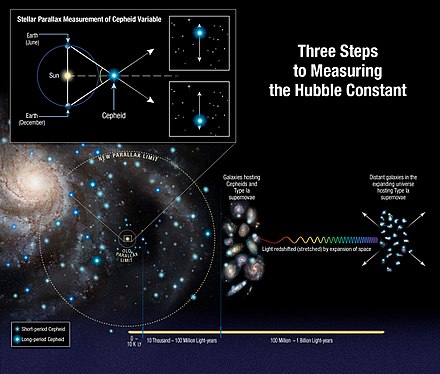
Late-universe (local) measurements use the cosmic distance ladder:
- Calibrate distances to nearby Cepheid variable stars using geometric methods (parallax).
- Use Cepheids to calibrate the brightness of Type Ia supernovae in the same galaxies.
- Extend Type Ia supernovae out to cosmological distances to measure the expansion rate.
This approach, led by the SH0ES team, consistently yields km/s/Mpc.
Early-universe measurements work differently. The Planck satellite mapped the CMB with extreme precision, capturing the universe at recombination (about 380,000 years after the Big Bang). By fitting the observed CMB power spectrum to the CDM model, Planck infers km/s/Mpc.
The gap between these values is roughly 5, which is statistically very significant. This isn't a small discrepancy you can wave away with error bars.
CMB vs. Large-Scale Structure Observations
Beyond the Hubble tension, there's a second, related disagreement involving how "clumpy" matter is in the universe today.
CMB data from Planck predicts specific values for and (the amplitude of matter fluctuations smoothed over 8 Mpc scales). Together these are often combined into the parameter .
Large-scale structure surveys measure these quantities more directly at late times:
- Galaxy surveys (such as the Sloan Digital Sky Survey and the Dark Energy Survey) map how galaxies and galaxy clusters are distributed, probing the growth of structure and the influence of dark energy.
- Weak lensing surveys measure subtle distortions in the shapes of background galaxies caused by the gravitational lensing of foreground matter. This provides a direct map of the dark matter distribution.
These late-universe probes tend to find lower values of than what Planck's CMB data predicts. In other words, the universe appears slightly less clumpy than the standard model expects. The statistical significance here (roughly 2–3) is less dramatic than the Hubble tension, but it points in a consistent direction: something about the growth of structure may not match CDM predictions.
Proposed Resolutions
There are broadly two categories of explanation:
Systematic errors in measurements:
- Unrecognized uncertainties in the distance ladder calibration (e.g., Cepheid crowding effects, supernova standardization issues) could shift local values.
- Incomplete modeling of astrophysical foregrounds or instrument effects in CMB analysis could bias Planck results.
- The JWST has recently provided independent checks on Cepheid calibrations, and so far the local value has held up, making pure systematics a harder explanation.
New physics beyond CDM:
- Early dark energy: A component of dark energy that was significant before recombination but faded afterward. This would change the sound horizon scale inferred from the CMB, raising the Planck-derived to better match local measurements.
- Non-standard neutrino physics: Extra neutrino species (sterile neutrinos) or neutrino self-interactions would alter the expansion rate in the early universe and affect structure growth.
- Modified gravity: Theories that change how gravity operates on cosmological scales could reconcile the different growth rates inferred from CMB versus large-scale structure data.
No single proposed solution has yet resolved all tensions simultaneously without creating new problems. That's what makes this an active and genuinely open area of research.

Implications and Future Directions
What Resolution Would Mean
If improved measurements eliminate the tensions, the CDM model is validated as a remarkably complete description of the universe. If the tensions persist and grow more significant with better data, the standard model needs modification. Either outcome deepens our understanding of dark matter, dark energy, and fundamental physics.
Future Observational Programs
- Vera C. Rubin Observatory (formerly LSST) will survey billions of galaxies across the sky, dramatically improving weak lensing measurements and mapping large-scale structure with unprecedented statistical power.
- Euclid (ESA space mission, launched 2023) will measure dark energy and dark matter through weak lensing and galaxy clustering across a large fraction of the sky, complementing ground-based surveys.
- DESI (Dark Energy Spectroscopic Instrument) is already collecting galaxy redshifts to map the expansion history through baryon acoustic oscillations, providing independent constraints on and dark energy.
Novel Cosmological Probes
- Gravitational wave standard sirens: Binary neutron star mergers (like GW170817) provide a distance measurement independent of the traditional distance ladder. As more events are detected by LIGO/Virgo/KAGRA, these will give an independent measurement that could break the deadlock.
- 21-cm cosmology: Radio observations of neutral hydrogen's 21-cm emission line can map the universe during the epoch of reionization and the cosmic dawn, probing structure growth at high redshifts where current data is sparse.
The convergence of these different observational approaches, combined with advances in theoretical modeling and numerical simulations, will tighten constraints on cosmological parameters from multiple independent angles. Within the next decade, we should know whether the current tensions are pointing toward genuinely new physics or whether they'll be absorbed by better-understood systematics.