
Fundamental Principles and Assumptions in Cosmology
Cosmology rests on a small number of powerful assumptions that make it possible to model the entire universe with tractable mathematics. These principles constrain what kinds of universes are physically reasonable and guide how we interpret observations from telescopes and satellites.
Cosmological Principle and Assumptions
The cosmological principle states that on sufficiently large scales, the universe is homogeneous and isotropic.
- Homogeneity means the universe looks the same from every location. The distribution of matter and energy is uniform once you zoom out far enough, past individual galaxies and even galaxy clusters, to scales of hundreds of megaparsecs.
- Isotropy means the universe looks the same in every direction. There's no preferred direction: no cosmic "up" or "down," no special axis. An observer facing any direction sees statistically the same large-scale structure.
These two properties together are a strong claim. On small scales, the universe is obviously lumpy: stars, galaxies, and voids are not evenly distributed. The cosmological principle only applies at very large scales, where those local variations average out.
Why does this matter? Without it, the math becomes unmanageable. The cosmological principle lets cosmologists use the Friedmann-Lemaître-Robertson-Walker (FLRW) metric, a simplified description of spacetime geometry that assumes uniform curvature everywhere. This metric is the backbone of nearly every standard cosmological model.
Role of the Copernican Principle
The Copernican principle states that Earth does not occupy a special or privileged position in the universe. It's named after Nicolaus Copernicus, whose heliocentric model displaced Earth from the center of the solar system, but the modern version goes much further: no location in the universe is fundamentally different from any other.
This principle serves as the philosophical foundation for the cosmological principle. Here's the connection: if we observe the universe to be isotropic from Earth, and Earth isn't special, then the universe should appear isotropic from every location. Homogeneity plus isotropy from one point implies isotropy everywhere.
The Copernican principle also carries a deeper implication: the laws of physics, including constants like the gravitational constant and the speed of light, are the same everywhere. This assumption guided the development of general relativity as a universal theory of gravity and supported the acceptance of the expanding universe model after Hubble's observations in the late 1920s.

Concept of the Expanding Universe
The universe is not static. Galaxies are moving away from each other, and the farther apart they are, the faster they recede. This relationship is captured by Hubble's law:
where is the recession velocity of a galaxy, is the Hubble constant (currently measured at roughly 67–73 km/s/Mpc, depending on the method), and is the galaxy's distance from the observer.
A few things to understand clearly about expansion:
- It's not that galaxies are flying through space away from a central point. Space itself is expanding, carrying galaxies along with it.
- Light traveling through expanding space gets stretched to longer wavelengths. This is cosmic redshift, and while it's analogous to the Doppler effect, it's actually caused by the expansion of space rather than the motion of a source through space.
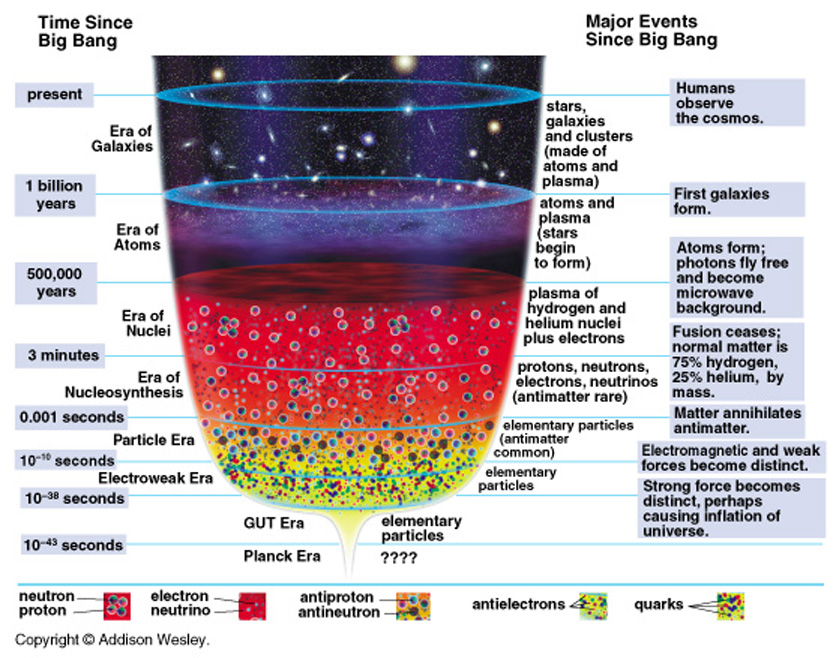
- Running the expansion backward in time implies the universe was once extremely hot and dense, converging toward a singular state. This is the basis of the Big Bang model.
The expansion has major consequences for cosmology:
- The universe has a finite age, currently estimated at approximately 13.8 billion years.
- There is an observable universe with a finite horizon, beyond which light has not had time to reach us.
- Observations of the cosmic microwave background (CMB) radiation and galaxy redshift surveys (such as the Sloan Digital Sky Survey) provide strong, independent lines of evidence for expansion.
Assumptions of the Standard Cosmological Model
The Lambda Cold Dark Matter (CDM) model is the current standard model of cosmology. It combines the principles above with general relativity and a specific recipe for the universe's contents.
Its core assumptions are:
- The universe is homogeneous and isotropic on large scales (the cosmological principle).
- General relativity accurately describes gravity on cosmological scales, meaning gravity arises from the curvature of spacetime.
- The universe contains three main components:
- Ordinary (baryonic) matter: protons, neutrons, electrons, roughly 5% of the total energy budget.
- Cold dark matter: slow-moving, non-baryonic particles that interact gravitationally but not electromagnetically, roughly 27%.
- Dark energy: represented by the cosmological constant , driving the accelerating expansion, roughly 68%.
The CDM model successfully explains a wide range of observations:
- The detailed pattern of temperature fluctuations in the CMB, as measured by the Wilkinson Microwave Anisotropy Probe (WMAP) and the Planck satellite.
- The large-scale structure of the universe, including galaxy clusters, filaments, and the cosmic web.
- The accelerating expansion discovered through observations of Type Ia supernovae.
- Baryon acoustic oscillations and gravitational lensing measurements, which independently confirm the model's predictions.
Despite this success, significant open questions remain:
- The nature of dark matter is unknown. Leading candidates include weakly interacting massive particles (WIMPs) and axions, but none have been directly detected.
- The nature of dark energy is equally mysterious. The cosmological constant is the simplest explanation, but alternatives like evolving scalar fields have not been ruled out.
- The model does not explain the initial conditions of the universe. Cosmic inflation is the leading framework for how the universe reached its early uniform state, but inflation itself is not yet part of the confirmed standard model.
- At the earliest moments (the Planck epoch, before roughly seconds), general relativity breaks down and a quantum theory of gravity would be needed. No complete theory exists yet.
Even with these gaps, CDM remains the most widely accepted cosmological model because no alternative matches its breadth of observational support.