
Function-as-a-Service platforms like AWS Lambda and Azure Functions are game-changers in cloud computing. They let developers focus on code without worrying about servers, scaling automatically and charging only for actual usage.
FaaS is perfect for event-driven tasks and microservices. It offers benefits like easy scaling and cost-efficiency, but also has challenges like cold starts and stateless design. Understanding FaaS is key for modern cloud architecture.
Key characteristics of FaaS
- Function-as-a-Service (FaaS) is a cloud computing model that allows developers to execute code without managing the underlying infrastructure
- FaaS platforms abstract away the complexities of server management, enabling developers to focus on writing and deploying individual functions
- FaaS is well-suited for event-driven architectures, where functions are triggered by specific events or requests
Serverless computing model
- FaaS follows a serverless computing model, meaning developers do not need to provision, manage, or scale the servers that run their code
- The cloud provider is responsible for managing the infrastructure, including server allocation, scaling, and maintenance
- Developers can concentrate on writing the business logic and leave the operational tasks to the FaaS platform
Event-driven execution
- FaaS functions are executed in response to specific events or triggers, such as HTTP requests, database updates, or message queue events
- Functions remain idle until an event occurs, at which point the FaaS platform automatically spins up an instance to handle the request
- Event-driven execution enables functions to be highly responsive and scalable, as they only consume resources when needed
Automatic scaling and provisioning
- FaaS platforms automatically scale the number of function instances based on the incoming workload
- As the number of events or requests increases, the platform provisions additional instances to handle the load
- Scaling is done transparently to the developer, ensuring that the application can handle varying levels of traffic without manual intervention
- When the workload decreases, the platform scales down the number of instances to minimize resource consumption
Pay-per-use pricing model
- FaaS platforms typically follow a pay-per-use pricing model, where users are charged based on the actual execution time and resources consumed by their functions
- Billing is often done at a granular level, such as per-second or per-100ms intervals, allowing for precise cost allocation
- The pay-per-use model is cost-effective for applications with variable or unpredictable workloads, as users only pay for the resources they actually use
- This pricing model eliminates the need to pay for idle resources or over-provisioned infrastructure
FaaS vs traditional architectures
- FaaS represents a significant shift from traditional monolithic architectures and offers several advantages for building modern, scalable applications
- Understanding the differences between FaaS and traditional architectures is crucial for making informed decisions when designing and deploying cloud-based solutions
Comparison of FaaS and monolithic architectures
- Monolithic architectures bundle all application components into a single, tightly-coupled unit, making it difficult to scale and maintain individual parts of the system
- FaaS, on the other hand, promotes a modular and loosely-coupled approach, where applications are broken down into smaller, independent functions
- FaaS allows for granular scaling and deployment of individual functions, enabling better resource utilization and faster development cycles
- Monolithic architectures often require dedicated infrastructure and manual scaling, whereas FaaS leverages the cloud provider's infrastructure and automatic scaling capabilities
Benefits of FaaS for microservices
- FaaS is well-suited for implementing microservices architectures, where applications are composed of small, independently deployable services
- Each microservice can be implemented as a separate function, allowing for independent development, deployment, and scaling
- FaaS enables faster development and iteration cycles, as developers can focus on writing business logic without worrying about infrastructure management
- The event-driven nature of FaaS aligns well with the communication patterns in microservices architectures, such as message-based or event-driven interactions
Limitations and challenges of FaaS
- FaaS has some limitations and challenges that need to be considered when adopting this architecture:
- Cold starts: Functions may experience increased latency when invoked after a period of inactivity, as the platform needs to spin up a new instance
- Limited execution duration: FaaS platforms typically impose a maximum execution time for functions, which may not be suitable for long-running tasks
- Stateless nature: Functions are expected to be stateless, meaning they should not rely on in-memory state across invocations, which can require changes in application design
- Vendor lock-in: FaaS platforms are often tied to specific cloud providers, making it harder to switch providers or deploy functions across multiple clouds
AWS Lambda overview
- AWS Lambda is a leading FaaS platform provided by Amazon Web Services (AWS), enabling developers to run code without provisioning or managing servers
- Lambda supports a wide range of programming languages and integrates seamlessly with other AWS services, making it a powerful tool for building serverless applications
Lambda function components
- Lambda functions consist of several key components:
- Function code: The actual code that defines the function's behavior, written in one of the supported programming languages
- Function configuration: Settings that specify the function's runtime, memory allocation, timeout, and environment variables
- Event sources: The triggers that invoke the Lambda function, such as API Gateway requests, S3 events, or CloudWatch events
- Permissions: IAM roles and policies that define the function's access to other AWS services and resources
Supported programming languages
- AWS Lambda supports multiple programming languages, allowing developers to choose the language that best fits their skills and project requirements:
- Node.js (JavaScript)
- Python
- Java
- C# (.NET Core)
- Go
- Ruby
- Custom runtimes (via AWS Lambda Layers)
Integration with other AWS services
- Lambda integrates with a wide range of AWS services, enabling developers to build powerful and scalable serverless architectures:
- API Gateway: Expose Lambda functions as RESTful APIs
- S3: Trigger functions based on object creation or deletion events
- DynamoDB: Execute functions in response to database updates or streams
- SNS: Invoke functions when messages are published to a topic
- CloudWatch Events: Schedule function execution or respond to system events
Lambda function triggers and events
- Lambda functions can be triggered by various event sources, allowing for flexible and event-driven architectures:
- Synchronous invocation: Functions are invoked directly by the caller and wait for a response (e.g., API Gateway, AWS SDK)
- Asynchronous invocation: Functions are invoked without waiting for a response, enabling parallel processing (e.g., S3 events, SNS messages)
- Stream-based invocation: Functions process records from a stream (e.g., DynamoDB Streams, Kinesis)
- Scheduled invocation: Functions are executed on a regular schedule using CloudWatch Events
Azure Functions overview
- Azure Functions is Microsoft's FaaS offering, allowing developers to build and deploy serverless applications on the Azure cloud platform
- Azure Functions shares many similarities with AWS Lambda but also offers unique features and integrations with Azure services
Function app structure
- In Azure Functions, a function app serves as a container for one or more related functions
- A function app provides a way to group functions that share the same configuration, such as runtime, hosting plan, and deployment settings
- Each function within a function app can have its own trigger and binding configuration
Supported programming languages
- Azure Functions supports a range of programming languages, giving developers flexibility in their choice of language:
- C#
- JavaScript (Node.js)
- F#
- Java
- PowerShell
- Python
- TypeScript
Integration with Azure services
- Azure Functions integrates seamlessly with various Azure services, enabling developers to build powerful serverless solutions:
- Azure Blob Storage: Trigger functions based on blob creation or modification events
- Azure Cosmos DB: Execute functions in response to document changes or queries
- Azure Event Hubs: Process real-time data streams with functions
- Azure Service Bus: Invoke functions based on messages in a queue or topic
- Azure Logic Apps: Orchestrate serverless workflows with functions as steps
Triggers and bindings in Azure Functions
- Azure Functions uses triggers and bindings to define how functions are invoked and how they interact with other services:
- Triggers: Specify the event source that causes a function to execute (e.g., HTTP request, timer, blob storage event)
- Input bindings: Declare the data sources that a function reads from (e.g., Cosmos DB document, Blob storage file)
- Output bindings: Declare the data destinations that a function writes to (e.g., Queue storage message, Event Hub event)
- Bindings simplify the code required to interact with other services, as the platform handles the connection and data transfer
Developing FaaS applications
- Developing FaaS applications requires a different approach compared to traditional monolithic or server-based applications
- Best practices and design principles should be followed to ensure scalability, performance, and maintainability of FaaS applications
Best practices for FaaS development
- When developing FaaS applications, consider the following best practices:
- Keep functions small and focused on a single responsibility
- Write stateless functions that don't rely on in-memory state across invocations
- Use environment variables for configuration and secrets management
- Implement proper error handling and logging for better observability
- Optimize function performance by minimizing cold starts and resource usage
- Use appropriate function timeouts and memory allocations based on the workload
Function design principles
- FaaS functions should adhere to certain design principles to ensure optimal performance and scalability:
- Single Responsibility Principle (SRP): Each function should have a single, well-defined purpose
- Stateless: Functions should not maintain state across invocations, relying on external storage for persistence
- Idempotent: Functions should produce the same result when given the same input, regardless of the number of invocations
- Loosely coupled: Functions should have minimal dependencies on other functions or services, promoting modularity and independent scaling
Stateless and idempotent functions
- FaaS functions should be designed to be stateless and idempotent:
- Stateless functions do not store or rely on in-memory state across invocations, ensuring horizontal scalability and avoiding data inconsistencies
- Idempotent functions produce the same result when called multiple times with the same input, allowing for safe retries and avoiding unintended side effects
- Stateless and idempotent functions are easier to scale, distribute, and reason about in a serverless environment
Error handling and retries in FaaS
- Proper error handling and retry mechanisms are crucial in FaaS applications to ensure reliability and resilience:
- Implement try-catch blocks to handle exceptions gracefully and prevent function failures
- Use appropriate error codes and messages to communicate the nature of the error to the caller
- Leverage built-in retry mechanisms provided by the FaaS platform (e.g., AWS Lambda's automatic retries for asynchronous invocations)
- Implement exponential backoff and jitter for retrying failed function invocations to avoid overloading downstream services
- Consider dead-letter queues (DLQs) to capture and handle failed function invocations for later analysis and reprocessing
FaaS deployment and management
- FaaS platforms provide various deployment options and management features to streamline the development and operation of serverless applications
- Understanding these options and best practices is essential for successful FaaS deployments

Deployment options for Lambda and Azure Functions
- AWS Lambda and Azure Functions offer multiple deployment options to suit different development workflows and requirements:
- Console-based deployment: Deploy functions directly through the web-based management console
- CLI deployment: Use command-line tools (e.g., AWS CLI, Azure CLI) to package and deploy functions
- Serverless frameworks: Leverage frameworks like Serverless Framework or AWS SAM to define and deploy functions using configuration files
- CI/CD pipelines: Integrate function deployment into continuous integration and continuous deployment (CI/CD) pipelines for automated releases
Versioning and alias management
- FaaS platforms support versioning and alias management to enable controlled rollouts and management of function versions:
- Versioning allows multiple versions of a function to exist simultaneously, enabling gradual rollouts and rollbacks
- Aliases provide a way to map a specific version of a function to a human-readable name (e.g., "prod", "staging")
- Aliases can be updated to point to different function versions, allowing for blue-green deployments and canary releases
Monitoring and logging in FaaS platforms
- Monitoring and logging are essential for maintaining the health and performance of FaaS applications:
- AWS Lambda integrates with Amazon CloudWatch for logging and monitoring, providing insights into function invocations, errors, and performance metrics
- Azure Functions integrates with Azure Application Insights for logging, tracing, and performance monitoring
- Use structured logging techniques to ensure logs are easily searchable and analyzable
- Set up alerts and notifications based on specific metrics or error patterns to proactively identify and resolve issues
Security considerations for FaaS
- Security is a shared responsibility between the FaaS platform provider and the application developer:
- Use principle of least privilege when assigning permissions to functions, granting only the necessary access to resources
- Encrypt sensitive data at rest and in transit using platform-provided encryption features or third-party libraries
- Implement proper authentication and authorization mechanisms for function invocations, such as API keys, OAuth, or JWT tokens
- Regularly update function runtimes and dependencies to address security vulnerabilities
- Monitor function invocations and access patterns for suspicious activities or potential security breaches
FaaS use cases and examples
- FaaS platforms are well-suited for a wide range of use cases, enabling developers to build scalable and cost-effective serverless applications
- Understanding common FaaS use cases and real-world examples can help in identifying opportunities to leverage serverless architectures
Web and API backends with FaaS
- FaaS functions can be used to build scalable and flexible web and API backends:
- Functions can handle HTTP requests and respond with JSON or other formats, serving as the backend for web applications or mobile apps
- API Gateway (AWS) or API Management (Azure) can be used to create, publish, and secure APIs backed by FaaS functions
- FaaS enables granular scaling and cost optimization for web and API backends, as functions are only invoked when needed
Data processing and ETL pipelines
- FaaS is well-suited for data processing and extract, transform, load (ETL) pipelines:
- Functions can be triggered by events like file uploads or database updates to perform data transformations or enrichment
- Serverless architectures allow for parallel processing of data, enabling efficient and scalable ETL workflows
- FaaS can be combined with other services like AWS Glue or Azure Data Factory for more complex data processing scenarios
Serverless web application architectures
- FaaS can be used as a building block for creating fully serverless web application architectures:
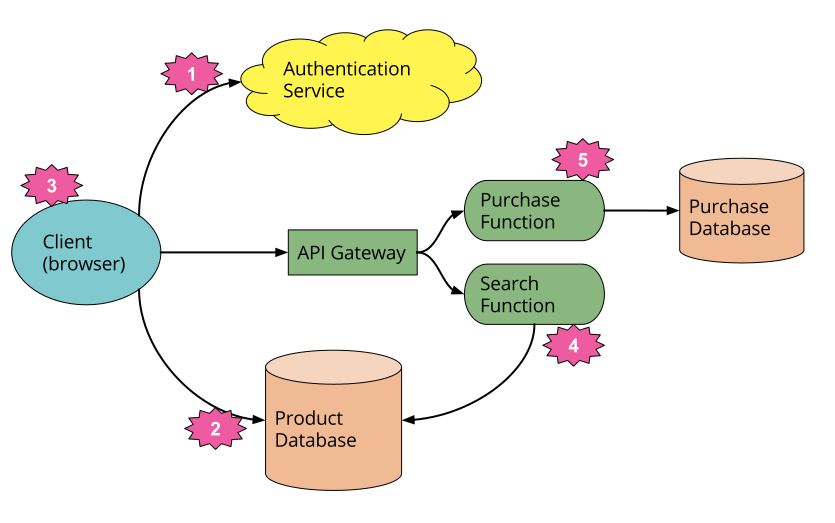
- Static website hosting (e.g., AWS S3, Azure Storage) can be used to serve the frontend assets
- FaaS functions can handle dynamic backend logic and API calls
- Serverless databases (e.g., AWS DynamoDB, Azure Cosmos DB) can store and retrieve application data
- Serverless authentication and authorization services (e.g., AWS Cognito, Azure Active Directory) can secure access to the application
Real-time stream processing with FaaS
- FaaS is well-suited for real-time stream processing scenarios, where data needs to be processed as it arrives:
- Functions can be triggered by events from message queues (e.g., AWS Kinesis, Azure Event Hubs) to process and analyze streaming data
- Serverless architectures enable elastic scaling to handle variable throughput and spikes in data volume
- FaaS can be combined with other services like AWS Lambda Layers or Azure Durable Functions for stateful stream processing and aggregation
FaaS performance and cost optimization
- Optimizing the performance and cost of FaaS applications is crucial for ensuring efficient resource utilization and minimizing expenses
- Several strategies and considerations can help in achieving optimal performance and cost-effectiveness in FaaS environments
Cold starts and performance implications
- Cold starts occur when a new instance of a function is provisioned to handle an incoming request, leading to increased latency:
- Cold starts happen when a function has not been invoked recently or when the number of concurrent requests exceeds the available instances
- The impact of cold starts varies depending on factors like function size, runtime, and language
- Strategies to mitigate cold starts include provisioned concurrency (AWS), premium plans (Azure), and keeping functions warm through periodic invocations
Optimizing function execution time
- Optimizing function execution time is important for reducing costs and improving performance:
- Minimize the function package size by including only necessary dependencies and libraries
- Use efficient algorithms and data structures to reduce computation time
- Leverage caching mechanisms (e.g., AWS ElastiCache, Azure Cache for Redis) to store and retrieve frequently accessed data
- Avoid long-running tasks and consider breaking them into smaller, asynchronous functions
- Monitor and analyze function execution times using platform-provided tools and metrics
Strategies for reducing FaaS costs
- Several strategies can help in reducing FaaS costs and optimizing resource utilization:
- Right-size function memory and timeout settings based on the actual resource requirements of the workload
- Use cost-aware function invocation patterns, such as batching requests or using asynchronous invocations when possible
- Leverage reserved capacity options (e.g., AWS Lambda Reserved Concurrency, Azure Functions Premium Plan) for predictable and stable workloads
- Implement efficient error handling and retry mechanisms to avoid unnecessary function invocations and resource consumption
- Monitor and analyze cost metrics using platform-provided tools (e.g., AWS Cost Explorer, Azure Cost Management) to identify cost optimization opportunities
Comparing costs of FaaS vs traditional architectures
- When evaluating the costs of FaaS compared to traditional architectures, consider the following factors:
- FaaS pricing is based on