13.3 Neoclassicism and the revival of Classical forms

📜Classical Poetics Unit 13 Review
13.3 Neoclassicism and the revival of Classical forms
📜 Classical Poetics
Neoclassical Poets
Neoclassicism revived Classical forms in poetry during the 17th and 18th centuries, treating ancient Greek and Roman literature not as historical curiosities but as living models for how to write well. Writers like Pope, Dryden, and Boileau championed reason, order, and moral purpose, producing works that reflected both ancient traditions and the Enlightenment ideals of their own time.
These poets gravitated toward specific forms like the heroic couplet and followed strict rules of decorum (the principle that style should match subject matter). They valued wit, satire, and clarity above emotional self-expression, seeing poetry as a craft governed by learnable principles rather than pure inspiration.

Top images from around the web for Major Figures and Their Contributions
Nicolas Boileau Des Preaux | 1 grafiskt blad, kopparstick Ko… | Flickr View original
Is this image relevant?
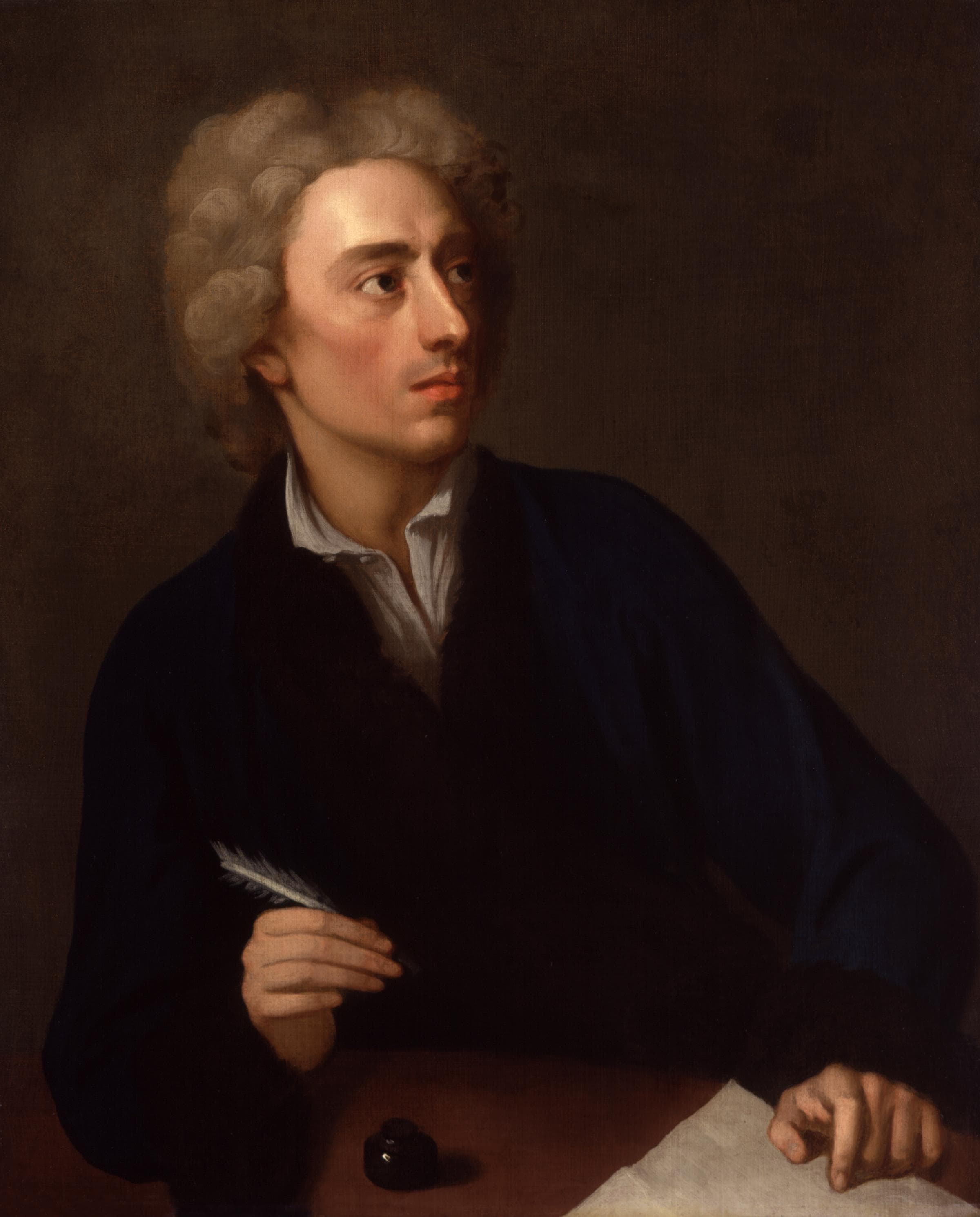
File:Alexander Pope by Michael Dahl.jpg - Wikipedia View original
Is this image relevant?
Wikipedia:WikiProject Missing encyclopedic articles/DNB Epitome 16 - WikiVisually View original
Is this image relevant?
Nicolas Boileau Des Preaux | 1 grafiskt blad, kopparstick Ko… | Flickr View original
Is this image relevant?
File:Alexander Pope by Michael Dahl.jpg - Wikipedia View original
Is this image relevant?
Major Figures and Their Contributions
John Dryden pioneered Neoclassicism in England during the late 17th century. He served as England's first official Poet Laureate in 1668 and worked across genres: plays, poems, translations, and literary criticism. His verse satire Absalom and Achitophel (1681) used a biblical allegory to comment on contemporary political crisis, and his play All for Love (1677) reworked Shakespeare's Antony and Cleopatra according to Neoclassical principles. Dryden developed the heroic couplet into a flexible instrument for both narrative and satirical purposes, setting the stage for the generation that followed.
Alexander Pope became the leading figure of English Neoclassicism in the early 18th century. His An Essay on Criticism (1711), written when he was only 23, laid out principles for good writing and fair criticism. The Rape of the Lock (1712/1714) is a mock-epic that satirizes aristocratic vanity by treating a stolen lock of hair with the gravity of a Homeric battle. Pope's translations of Homer's Iliad and Odyssey brought him financial independence and demonstrated his total command of the heroic couplet. Throughout his career, he explored human nature, morality, and social folly with unmatched precision of language.
Nicolas Boileau shaped French Neoclassicism through both criticism and poetry. His L'Art poétique (1674) outlined principles for Neoclassical literature in verse, consciously modeled on Horace's Ars Poetica. Boileau advocated for clarity, reason, and strict adherence to classical models, and his influence extended well beyond France, helping to establish Neoclassical aesthetics across Europe.
Shared Characteristics and Themes
Despite working in different languages and decades, these poets shared a core set of commitments:
- Reason and order over emotional spontaneity or personal confession
- Emulation of classical models, particularly Horace, Virgil, and Homer
- Universal themes and moral instruction, treating poetry as a vehicle for truth about human nature
- Wit and satire as tools for social commentary, not mere entertainment
- Clarity and precision in language, favoring the exact word over the suggestive one

Neoclassical Forms and Devices
Poetic Structures and Techniques
The heroic couplet became the dominant verse form in English Neoclassical poetry. It consists of rhyming pairs of iambic pentameter lines, and its tight structure forced poets to compress complex ideas into balanced, memorable statements. Pope's An Essay on Man shows this compression at work:
"Hope springs eternal in the human breast; / Man never is, but always to be blest."
Each line carries a complete thought, and the couplet as a whole creates a satisfying sense of closure. Dryden pioneered this form's use for extended argument and narrative; Pope refined it into an instrument of extraordinary polish.
Decorum governed the relationship between style and subject matter. A tragedy required elevated diction and noble characters; a satire could use a lower register. This wasn't arbitrary fussiness. The idea was that form and content should reinforce each other, so that a mismatch between them (a king speaking like a peasant, say) would undermine the work's effect. Mock-epic poems like The Rape of the Lock deliberately violated decorum for comic purposes, applying grand epic conventions to trivial subjects:
"Here thou, great Anna! whom three realms obey, / Dost sometimes counsel take—and sometimes tea."
The joke depends on the reader recognizing that "counsel" and "tea" don't belong in the same syntactic slot. That's decorum being broken on purpose.
Wit in the Neoclassical sense meant more than humor. It referred to the ability to perceive unexpected connections between ideas and express them with intellectual sharpness. Pope defined it in An Essay on Criticism as "What oft was thought, but ne'er so well expressed." Wit enhanced both the satirical and the didactic dimensions of Neoclassical writing.

Literary Conventions and Rules
- The three unities (time, place, and action), derived from interpretations of Aristotle, governed dramatic works. A play should unfold in a single location, within roughly 24 hours, with one main plot.
- Formal diction and elevated language were expected in serious poetry, while lower genres permitted plainer speech.
- Classical allusions and mythological references appeared constantly, assuming a reader educated in Greek and Roman literature.
- Symmetry and balance shaped poetic structure at every level, from the antithesis within a single couplet to the architecture of an entire poem.
- Logical progression of ideas was prized over associative or dreamlike movement.
Neoclassical Influences
Historical and Cultural Context
The Age of Enlightenment provided the intellectual atmosphere in which Neoclassicism flourished. Enlightenment thinkers emphasized reason, empiricism, and the search for universal laws governing both nature and human behavior. Neoclassical poets absorbed these values: their commitment to clarity, logic, and moral universality mirrors the broader Enlightenment project of understanding the world through rational inquiry.
The Augustan Age in England (roughly 1700–1745) took its name from the reign of the Roman Emperor Augustus, when Virgil, Horace, and Ovid produced their greatest works. English writers of this period saw a deliberate parallel: just as Augustan Rome represented a golden age of literary achievement, their own era could achieve similar greatness by emulating those classical models. The label itself reveals how deeply these poets identified with their ancient predecessors.
Classical Foundations and Literary Theory
Three ancient texts provided the theoretical backbone for Neoclassical poetics:
Horace's Ars Poetica was the single most important classical source. Horace offered practical guidelines for writing and judging poetry, stressing unity, coherence, and decorum. His famous dictum that poetry should both instruct and delight (aut prodesse aut delectare) became a touchstone for Neoclassical writers. Boileau's L'Art poétique is essentially a French verse adaptation of Horace's principles.
Aristotle's Poetics informed Neoclassical dramatic theory above all. Aristotle introduced mimesis (the idea that art imitates nature), catharsis (the emotional purgation tragedy produces in an audience), and the structural principles that later critics codified as the three unities. Neoclassical playwrights and epic poets treated Aristotle's observations as prescriptive rules, sometimes more rigidly than Aristotle himself intended.
Longinus's On the Sublime offered a counterweight to the emphasis on rules. Longinus explored what makes writing genuinely great and emotionally powerful, arguing that true sublimity comes from elevated thought and passionate feeling as well as from technical skill. This text fueled Neoclassical debates about whether poetic greatness could be achieved through craft alone or required something closer to natural genius. Those debates would eventually help open the door to Romanticism.
See Fiveable more often in Google
Mark Fiveable as a preferred source and Google is more likely to show you our guides in Top Stories, with a "preferred" badge in AI Mode and AI Overviews.