
Stoichiometry is all about the math behind chemical reactions. It helps us figure out how much stuff we need and how much we'll get when chemicals react. This topic is super important for understanding how reactions work in the real world.
In this section, we'll learn about reactant ratios, limiting reactants, and yields. We'll also dive into actual vs. theoretical yields and how to do calculations that help us predict reaction outcomes. It's like cooking, but with chemicals!
Reactant and Product Ratios
Balanced Chemical Equations and Molar Ratios
- A balanced chemical equation provides the relative numbers of moles of reactants and products in a reaction
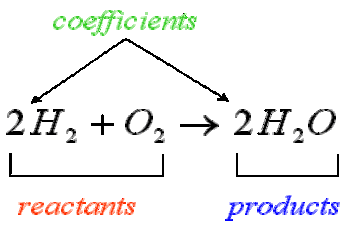
- The coefficients in a balanced chemical equation represent the molar ratios of reactants and products (2H2 + O2 -> 2H2O, the molar ratio of H2 to O2 is 2:1)
- Molar ratios are essential for solving stoichiometric problems and determining the limiting reactant and theoretical yield of a reaction
Using Molar Ratios in Stoichiometric Calculations
- Molar ratios can be used to determine the amount of reactant needed or product formed in a reaction
- The molar ratio is a conversion factor that relates the moles of one substance to the moles of another substance in a balanced chemical equation
- For example, in the reaction 2Na + Cl2 -> 2NaCl, if 4 moles of Na react, 2 moles of Cl2 will be consumed, and 4 moles of NaCl will be produced
Limiting Reactant and Yield
Determining the Limiting Reactant
- The limiting reactant is the reactant that is completely consumed first in a chemical reaction and limits the amount of product that can be formed
- The reactant in excess is the reactant that remains after the limiting reactant has been completely consumed
- To determine the limiting reactant, calculate the moles of each reactant and compare them to the molar ratios in the balanced chemical equation (if the molar ratio of A:B is 2:1, and there are 4 moles of A and 3 moles of B, B is the limiting reactant)
Calculating Theoretical Yield
- The theoretical yield is the maximum amount of product that can be formed in a chemical reaction based on the amount of limiting reactant
- To calculate the theoretical yield, use the molar ratio between the limiting reactant and the desired product, and multiply it by the moles of limiting reactant
- For example, if the limiting reactant is 2 moles of H2 in the reaction 2H2 + O2 -> 2H2O, the theoretical yield of H2O would be 2 moles
Actual vs Percent Yield
Actual Yield
- The actual yield is the amount of product actually obtained from a chemical reaction, which is often less than the theoretical yield due to various factors such as incomplete reactions, side reactions, and losses during purification
- To calculate the actual yield, measure the mass or volume of the product obtained from the reaction
- For example, if a reaction theoretically yields 10 grams of product, but only 8 grams are actually obtained, the actual yield is 8 grams
Percent Yield
- The percent yield is the ratio of the actual yield to the theoretical yield, expressed as a percentage
- To calculate the percent yield, divide the actual yield by the theoretical yield and multiply by 100% (Percent yield = (Actual yield / Theoretical yield) × 100%)
- Percent yield is an important measure of the efficiency of a chemical reaction and can be used to optimize reaction conditions (a percent yield of 80% indicates that the reaction is relatively efficient, while a percent yield of 50% suggests that improvements can be made)

Stoichiometric Calculations
Problem-Solving Steps
- Stoichiometric problems involve the quantitative relationships between reactants and products in a chemical reaction
- To solve stoichiometric problems, use the mole concept, molar mass, and the balanced chemical equation
- Convert given quantities (mass, volume, or moles) of reactants or products to moles using molar mass or molar volume
- Use molar ratios from the balanced chemical equation to determine the moles of the desired substance
- Convert the moles of the desired substance to the required quantity (mass, volume, or moles) using molar mass or molar volume
Examples of Stoichiometric Problems
- Calculating the mass of product formed from a given mass of reactant (if 10 grams of Na react with excess Cl2 to form NaCl, how many grams of NaCl will be produced?)
- Determining the volume of gas consumed or produced in a reaction at given conditions (if 5 moles of H2 react with excess N2 to form NH3 at STP, what volume of NH3 will be produced?)
Conversions in Stoichiometry
Mole-to-Mole, Mass-to-Mass, and Mass-to-Volume Conversions
- Mole-to-mole conversions involve using molar ratios from the balanced chemical equation to relate the moles of one substance to the moles of another substance
- Mass-to-mass conversions involve using molar mass and molar ratios to relate the mass of one substance to the mass of another substance in a reaction
- Mass-to-volume conversions involve using molar mass, molar volume, and molar ratios to relate the mass of one substance to the volume of another substance (usually a gas) in a reaction
Using the Ideal Gas Law in Mass-to-Volume Conversions
- To perform mass-to-volume conversions, use the ideal gas law () to determine the molar volume of a gas at given conditions of temperature and pressure
- For example, to calculate the volume of CO2 produced from the combustion of 10 grams of glucose (C6H12O6) at STP, first determine the moles of CO2 produced using molar ratios, then use the ideal gas law to find the volume of CO2 at STP
- Understanding these conversions is crucial for solving a wide range of stoichiometric problems and predicting the outcomes of chemical reactions