
The scientific method is a powerful tool for solving problems in chemistry. It involves making observations, forming hypotheses, and conducting experiments to test those ideas. This systematic approach helps chemists uncover new knowledge and develop innovative solutions.
Applying the scientific method in chemistry requires careful experimental design and data analysis. By controlling variables, collecting accurate measurements, and drawing logical conclusions, chemists can gain insights into chemical processes and phenomena. This approach is fundamental to advancing the field.
Scientific Method in Chemistry
Systematic Approach to Acquiring Knowledge
- The scientific method is a systematic approach to acquiring knowledge that uses observation, hypothesis testing, and logical reasoning
- This approach helps to ensure that scientific research is rigorous, reproducible, and based on empirical evidence
- The scientific method is essential for advancing our understanding of the natural world and developing new technologies (new materials, medicines)
Steps of the Scientific Method
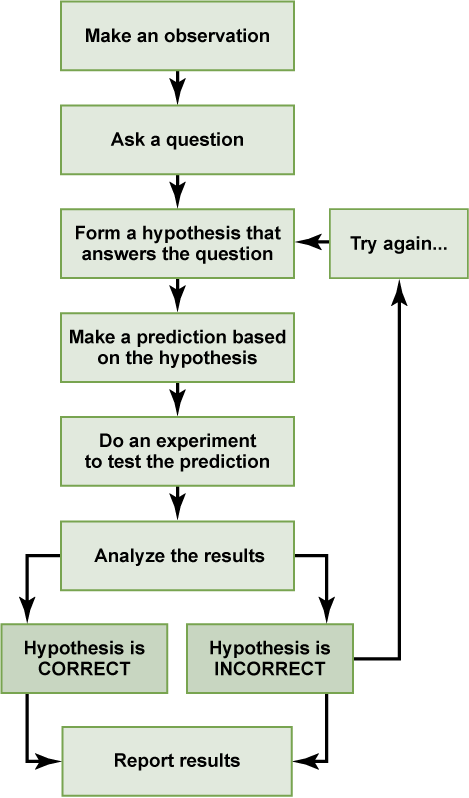
- The first step is to make an observation or identify a problem that needs to be solved
- This helps focus the research question and guides the development of a hypothesis
- The next step is to gather background information through literature searches and develop a hypothesis, which is a tentative explanation for the observation or problem
- Designing and conducting controlled experiments is crucial to test the hypothesis
- This involves manipulating one variable at a time while keeping all other variables constant
- Collecting and analyzing data from the experiments allows researchers to draw conclusions about the hypothesis
- Statistical analysis is often used to determine the significance of the results
- If the data supports the hypothesis, it can be accepted as a tentative explanation
- If the data does not support the hypothesis, it must be rejected or modified
- The final step is to communicate the results through peer-reviewed publications and presentations
- This allows other scientists to validate and build upon the research
Hypothesis Formulation
Characteristics of a Good Hypothesis
- A hypothesis is a tentative explanation for an observation or problem that can be tested through experimentation
- Hypotheses must be based on prior knowledge and observations, and should be informed by conducting a thorough literature review
- A good hypothesis is specific, measurable, and falsifiable
- It should make a clear prediction about the relationship between variables
- Hypotheses are often stated in an "if-then" format
- "If the concentration of reactant A is doubled, then the rate of the reaction will double"
Null and Alternative Hypotheses
- Null and alternative hypotheses are used in statistical analysis
- The null hypothesis predicts no effect or difference
- The alternative hypothesis predicts an effect or difference
- For example, in a study on the effect of a new catalyst on reaction rate:
- Null hypothesis: The new catalyst will have no effect on the reaction rate
- Alternative hypothesis: The new catalyst will increase the reaction rate
Experiment Design and Execution

Controlled Experiments
- Controlled experiments are designed to test a specific hypothesis by manipulating one variable at a time while keeping all other variables constant
- The independent variable is the factor that is manipulated by the researcher
- For example, the concentration of a reactant or the temperature of the reaction
- The dependent variable is the factor that is measured or observed
- For example, the rate of the reaction or the yield of the product
- Control groups are used to provide a baseline for comparison and to ensure that any changes in the dependent variable are due to the manipulation of the independent variable
Proper Experimental Design
- Proper experimental design involves careful planning and attention to detail
- This includes the use of appropriate instrumentation and techniques (spectroscopy, chromatography)
- Experiments should be reproducible, meaning that other researchers should be able to obtain similar results by following the same procedures
- Proper safety protocols must be followed when conducting experiments
- This includes the use of personal protective equipment (goggles, gloves) and proper waste disposal
Data Analysis and Conclusion
Data Analysis Techniques
- Data analysis involves organizing and interpreting the results of an experiment to determine whether they support or refute the hypothesis
- Descriptive statistics, such as mean, median, and standard deviation, can be used to summarize and visualize data
- Inferential statistics, such as t-tests and ANOVA, can be used to determine whether differences between groups are statistically significant
- Graphs and charts are often used to present data in a clear and concise manner, and to identify trends or patterns
Drawing Conclusions and Refining Hypotheses
- If the data supports the hypothesis, it can be accepted as a tentative explanation for the observation or problem
- If the data does not support the hypothesis, it must be rejected or modified
- Refining hypotheses based on experimental data is an iterative process
- This involves modifying the original hypothesis or developing new hypotheses based on the results
- Reproducibility and peer review are essential for validating experimental results and ensuring the integrity of scientific research
- For example, if a new catalyst is found to increase reaction rate in one study, other researchers should be able to reproduce these results using the same methods
- If the results are consistently reproduced, the hypothesis can be accepted as a valid explanation for the observed effect