
Methods for Determining Rate Laws
Figuring out a reaction's rate law means identifying how each reactant's concentration affects the speed of the reaction. This is central to chemical kinetics because the rate law lets you predict how fast a reaction will proceed under new conditions and gives clues about the reaction mechanism.
Three main experimental approaches are used: the method of initial rates, integrated rate law analysis, and pseudo-first-order simplification. Each works best in different situations, and understanding when to reach for each one is just as important as knowing how they work.
Method of Initial Rates
This method compares the initial rate of a reaction across several experiments where you systematically change one reactant's concentration at a time while holding the others constant.
How it works, step by step:
-
Run multiple experiments, each with a different starting concentration of one reactant. Keep all other reactant concentrations the same.
-
Measure the initial rate of each experiment (the rate right at the start, before concentrations change much).
-
Compare pairs of experiments to find the order with respect to each reactant:
- If doubling doubles the rate, the reaction is first order in
- If doubling quadruples the rate, it's second order in
- If doubling has no effect on the rate, it's zero order in
-
Combine the individual orders into the overall rate law: , where and are the orders you just determined.
-
Plug the data from any single experiment into the rate law to solve for the rate constant .
Mathematically, when comparing two experiments where only changes, the ratio of rates gives you the order directly:
Advantages: Straightforward and doesn't require knowing the reaction mechanism. Works well when you can measure initial rates accurately.
Limitations: Measuring initial rates can be tricky for very fast reactions. It also assumes the rate law form stays the same throughout the reaction.
Integrated Rate Law Analysis
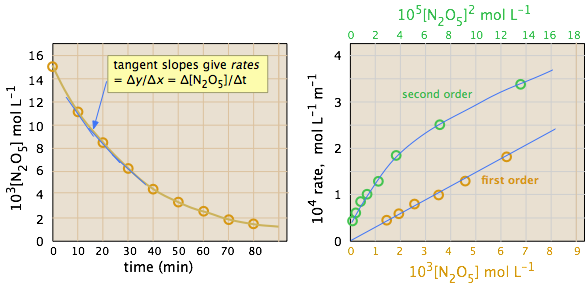
Instead of looking only at the start of a reaction, this method uses concentration data collected over the entire course of the reaction. You test which integrated rate law gives a linear plot, and that tells you the reaction order.
The three integrated rate laws to know:
| Order | Integrated Rate Law | Linear Plot | Slope |
|---|---|---|---|
| Zero | vs. | ||
| First | vs. | ||
| Second | vs. |
How it works, step by step:
- Collect concentration vs. time data for the reaction.
- Make three plots of the data: vs. , vs. , and vs. .
- Whichever plot produces a straight line tells you the reaction order.
- Determine from the slope of that straight line.
The key idea here is that each integrated rate law is already in form, so only the correct order will linearize the data.
Advantages: Uses data from the full reaction, not just the beginning. Gives both the order and the rate constant from a single dataset.
Limitations: Requires you to test each possible order. With noisy or scattered data, it can be hard to tell which plot is truly linear. This method also works best for reactions that depend on a single reactant concentration.

Pseudo-First-Order Simplification
Some reactions involve two or more reactants, making the rate law harder to analyze directly. The pseudo-first-order method gets around this by putting one reactant in large excess so its concentration barely changes during the reaction.
For example, consider a rate law . If is held in large excess, its concentration stays roughly constant, and you can fold it into the rate constant:
where . The reaction now behaves as first order in , even though it isn't truly first order overall.
How it works, step by step:
- Run the reaction with one reactant (say ) in large excess over .
- Plot vs. . If the reaction is first order in , you'll get a straight line.
- The slope of that line gives you .
- Repeat the experiment with different excess concentrations of .
- Use the relationship to determine the order with respect to and the true rate constant .
This is the same logic as the method of initial rates, but applied to values instead of initial rates.
Advantages: Turns a complex multi-reactant problem into a simpler first-order analysis. Widely used in practice, especially in biochemistry and solution-phase chemistry.
Limitations: Requires that one reactant can realistically be used in large excess, which isn't always practical. The you measure depends on the excess concentration, so you need multiple runs to get the full rate law.
Choosing the Right Method
Each method fits different experimental situations:
- Method of initial rates is your go-to when you can easily measure rates at the start of a reaction and want to determine orders for multiple reactants.
- Integrated rate law analysis works best when you have good concentration vs. time data and want to confirm the order from a single experiment.
- Pseudo-first-order simplification is most useful for multi-reactant systems where direct analysis would be too complicated.
In practice, researchers often combine these approaches. For instance, you might use pseudo-first-order conditions to isolate one reactant's behavior, then use integrated rate law plots to confirm the order and extract .