
Analog-to-Digital Conversion
Digital signal processing (DSP) is how we take the continuous electrical signals produced by the body and convert them into numbers a computer can work with. Once in digital form, these signals can be filtered, analyzed, and stored with far greater precision than analog methods allow. In biomedical contexts, DSP underpins everything from ECG interpretation to EEG spectral analysis.
The core pipeline involves three stages: sampling (grabbing values at regular time intervals), quantization (rounding those values to discrete levels), and frequency analysis (decomposing the signal into its component frequencies). Each stage introduces trade-offs between fidelity and computational cost.
Sampling and Quantization
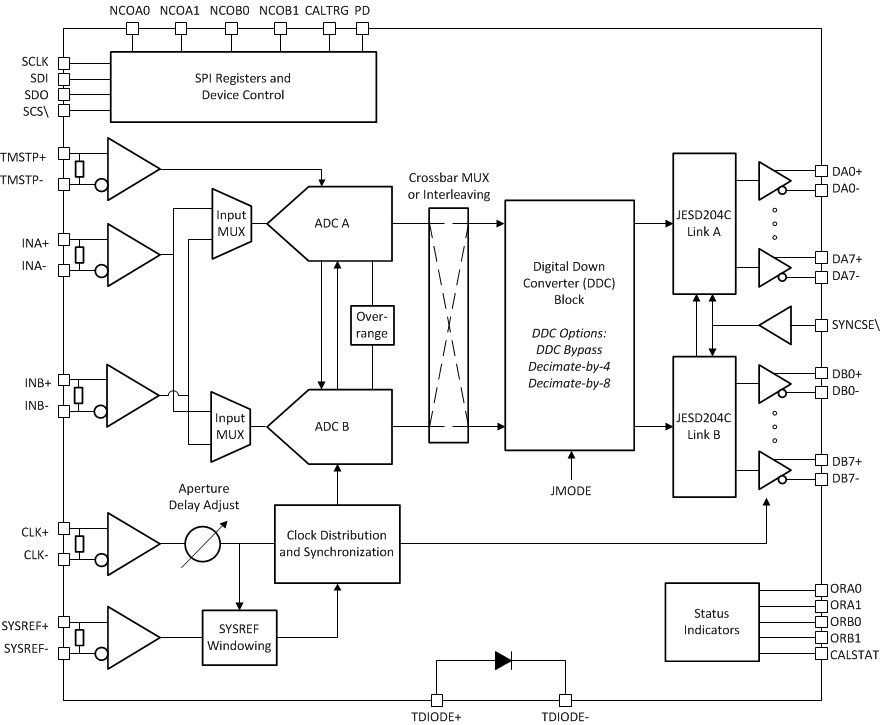
Analog-to-digital conversion (ADC) is the process of turning a continuous analog signal into a sequence of discrete digital values.
Sampling captures the signal's amplitude at evenly spaced time intervals. The rate at which you sample is the sampling frequency (), measured in Hertz. A higher preserves more detail from the original signal but demands more storage and processing power.
Quantization maps each sampled amplitude to the nearest available discrete level. The gap between the true analog value and the assigned level is called quantization error. You reduce this error by increasing the number of bits per sample:
- An 8-bit system provides levels.
- A 16-bit system (used in audio CDs) provides levels.
- Medical-grade ADCs for ECG signals commonly use 12-bit to 24-bit resolution to capture the small voltage changes of cardiac activity (on the order of millivolts).
More bits means finer resolution, but also larger data files and higher processing demands.

Nyquist Theorem and Aliasing
The Nyquist Theorem sets a hard rule: your sampling frequency must be at least twice the highest frequency present in the signal. That minimum rate is called the Nyquist rate.
If you sample below this rate, aliasing occurs. High-frequency components "fold" back into the spectrum and masquerade as lower frequencies, producing distortion that cannot be corrected after the fact.
To prevent aliasing, you place an anti-aliasing filter (a low-pass filter) before the ADC. This filter removes any frequency content above the Nyquist frequency () so that only representable frequencies reach the sampler.
A concrete example: audio CDs sample at 44.1 kHz, so the Nyquist frequency is 22.05 kHz. Since human hearing tops out around 20 kHz, this rate captures the full audible range. In biomedical applications, an ECG signal with clinically relevant content up to about 150 Hz would need a sampling rate of at least 300 Hz, though 500 Hz or higher is standard practice to provide a comfortable margin.
Frequency Domain Analysis
Time-domain signals show you when something happens. Frequency-domain analysis shows you what frequencies are present and how strong each one is. For biomedical signals, this distinction matters: an EEG's alpha rhythm (8–13 Hz) is much easier to identify and quantify in the frequency domain than by staring at a raw time trace.
Discrete Fourier Transform (DFT) and Fast Fourier Transform (FFT)
The Discrete Fourier Transform (DFT) takes a finite sequence of time-domain samples and computes the amplitude and phase of each frequency component. It converts (time domain) into (frequency domain):
Computing the DFT directly requires operations, which becomes impractical for large datasets.
The Fast Fourier Transform (FFT) is an algorithm that computes the exact same result in operations by exploiting symmetry and periodicity in the DFT calculation. For a signal with samples, the FFT is roughly 100 times faster than the brute-force DFT. This efficiency is what makes real-time spectral analysis feasible in clinical monitors.
Common biomedical uses of the FFT include:
- EEG power spectral analysis to quantify brain wave bands (delta, theta, alpha, beta)
- Heart rate variability (HRV) analysis from ECG data, separating sympathetic and parasympathetic contributions by frequency band
- Artifact identification in EMG or ECG recordings, where power-line interference at 50 or 60 Hz shows up as a sharp spectral peak
Z-Transform
The Z-transform generalizes the Fourier transform for discrete-time signals by replacing the complex exponential with a general complex variable :
Here is the discrete-time signal and is a complex number. When you evaluate the Z-transform on the unit circle (), you recover the DFT. Off the unit circle, the Z-transform captures information about signal growth and decay, which the Fourier transform alone cannot represent.
The Z-transform is primarily a design and analysis tool for digital filters. It lets you:
- Express a filter's transfer function as a ratio of polynomials in .
- Determine stability by checking whether the poles of lie inside the unit circle in the z-plane.
- Shape the frequency response to achieve specific filter types (low-pass, high-pass, band-pass, or notch).
In practice, if you're designing a notch filter to remove 60 Hz power-line noise from an ECG, you'd use the Z-transform to place zeros at the corresponding frequency on the unit circle and verify that the resulting filter is stable. The Z-transform bridges the gap between the math of filter design and the actual implementation running on a digital processor.