8.3 Orphism

🎭Art History II – Renaissance to Modern Era Unit 8 Review
8.3 Orphism
🎭 Art History II – Renaissance to Modern Era
Orphism emerged as a vibrant offshoot of Cubism in early 20th century Paris. It emphasized pure abstraction and bright colors, aiming to create a visual language that expressed abstract concepts and emotions through dynamic compositions.
Key artists like Robert and Sonia Delaunay used color as their primary expressive element, creating rhythmic, non-representational works. Orphism pushed the boundaries of visual art, influencing the development of abstract art throughout the 20th century.
Orphist Art Characteristics

Top images from around the web for Defining Features of Orphism
Abstract art - Wikipedia View original
Is this image relevant?
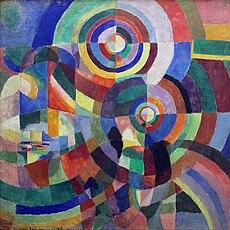
Orphism (art) - Wikipedia View original
Is this image relevant?
Sonia Delaunay, Rythme, 1938 | Flickr - Photo Sharing! View original
Is this image relevant?
Abstract art - Wikipedia View original
Is this image relevant?
Orphism (art) - Wikipedia View original
Is this image relevant?
Defining Features of Orphism
- Orphism emerged as abstract art movement in early 20th century Paris
- Emphasized pure abstraction and bright colors in compositions
- Derived name from Greek poet Orpheus symbolizing mystical properties of color
- Utilized fragmented geometric shapes and vibrant color harmonies
- Created rhythmic compositions aiming for sense of movement and musicality
- Employed simultaneous contrast technique developed by Michel Eugène Chevreul
- Juxtaposed complementary colors to produce dynamic visual effects
Philosophical and Aesthetic Aims
- Sought to create pure visual language expressing abstract concepts and emotions
- Moved away from reliance on representational imagery in artworks
- Aimed to evoke musical sensations through color and form (synesthesia)
- Conveyed sense of cosmic harmony and spiritual energy in paintings
- Often incorporated circular forms and prismatic color schemes
- Reflected orphic belief in transcendental qualities of color and shape
Color and Abstraction in Orphism

Color as Primary Expressive Element
- Used color as main vehicle for artistic expression and emotion
- Created sense of rhythm, movement, and emotional resonance through color
- Explored synaesthetic potential to evoke non-visual sensations (sound, touch)
- Extensively utilized concept of simultaneous contrasts in compositions
- Juxtaposed complementary colors to create vibrant, pulsating visual effects
- Aimed to capture ephemeral qualities of light through luminous color combinations
- Arranged vibrant color harmonies often around central circular or spiral motif
Role of Abstraction
- Focused on pure relationships between colors and shapes
- Freed artworks from constraints of depicting recognizable objects
- Employed non-representational imagery to explore color and form
- Reflected philosophical approach beyond mere stylistic choice
- Symbolized cyclical nature of life and universe through abstract forms
- Strived to convey spiritual and transcendental qualities through abstraction
- Pushed boundaries of visual art into realm of pure color and shape
Key Orphist Artists

Pioneers of the Movement
- Robert Delaunay founded and led Orphism movement
- Known for series exploring simultaneous contrasts and circular forms
- Key works include Simultaneous Windows series and The First Disk
- Sonia Delaunay made significant contributions as Robert's wife and artistic partner
- Extended Orphist principles to applied arts (textiles, fashion design)
- Notable works include Electric Prisms and Rhythm Colour no. 1076
- František Kupka developed parallel style sharing Orphist characteristics
- Focused on cosmic themes and abstract color compositions
- Significant paintings include Amorpha, Fugue in Two Colors and Disks of Newton
Related Artists and Influences
- Fernand Léger incorporated Orphist elements while primarily associated with Cubism
- Used bold colors and rhythmic compositions in his work
- Examples include The City and Contrast of Forms
- Morgan Russell and Stanton Macdonald-Wright developed related Synchromism movement
- Influenced by Orphist ideas in their color-based abstraction
- Notable works include Cosmic Synchromy and Conception Synchromy
Orphism vs Other Movements
Relationship to Cubism
- Emerged as offshoot of Cubism retaining fragmented forms and multiple perspectives
- Placed greater emphasis on color and abstraction than traditional Cubist works
- Infused Cubist structural approach with expressive use of color
- Moved further into pure abstraction compared to analytical Cubism
- Incorporated spiritual and cosmic dimensions distinguishing it from Cubist analysis
Connections to Fauvism and Other Avant-Garde Movements
- Shared Fauvism's interest in emotive power of color
- Pushed further into abstraction than Fauvist representational subjects
- Aligned with European avant-garde developments (Kandinsky, Der Blaue Reiter)
- Resonated with broader symbolist and theosophical currents of early 20th century
- Anticipated later developments in Op Art and kinetic art
- Prefigured experiments in synaesthetic art and multimedia installations
- Influenced evolution of abstract art throughout 20th century
See Fiveable more often in Google
Mark Fiveable as a preferred source and Google is more likely to show you our guides in Top Stories, with a "preferred" badge in AI Mode and AI Overviews.