6.3 The Vienna Secession

🎭Art History II – Renaissance to Modern Era Unit 6 Review
6.3 The Vienna Secession
🎭 Art History II – Renaissance to Modern Era
Formation of the Vienna Secession
The Vienna Secession, founded in 1897, marked a turning point in Austrian art. A group of artists broke away from the conservative Association of Austrian Artists to champion artistic freedom and innovation, embracing new styles and integrating art into everyday life. The movement embodied the spirit of Art Nouveau while pushing beyond it, emphasizing organic forms, craftsmanship, and the unification of different art forms.

Top images from around the web for Historical Context and Motivations
Vienna Secession, Fifth Exhibition, poster | Creator: Koloma… | Flickr View original
Is this image relevant?
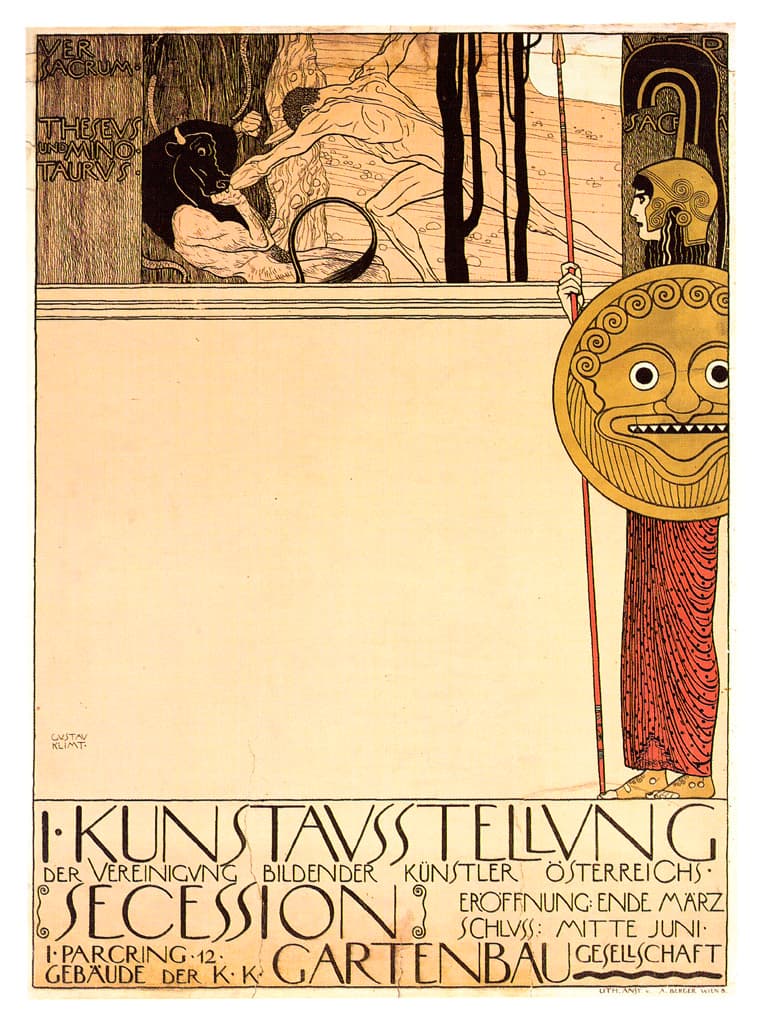
Vienna Secession, First Exhibition, poster | Creator: Gustav… | Flickr View original
Is this image relevant?
Vienna Secession - Wikipedia View original
Is this image relevant?
Vienna Secession, Fifth Exhibition, poster | Creator: Koloma… | Flickr View original
Is this image relevant?
Vienna Secession, First Exhibition, poster | Creator: Gustav… | Flickr View original
Is this image relevant?
Historical Context and Motivations
The Secession emerged during the late Habsburg Empire's "fin de siècle" period, a time of intense cultural and intellectual energy in Vienna. Political and social shifts fueled the movement: liberalism was on the rise, and a growing middle class was hungry for art that reflected modern life rather than recycling historical styles.
Their motto captures the whole philosophy: "To every age its art, to art its freedom." This was a direct rejection of historicism (the practice of imitating past artistic styles) and rigid academic art. Instead, the Secessionists wanted modern forms of expression that spoke to their own era.
A few key goals defined the movement:
- Breaking down barriers between "fine" and "applied" arts. Painting wasn't inherently superior to furniture design or metalwork.
- Integrating art into everyday life, drawing on international Art Nouveau trends already spreading across Europe.
- Pursuing the Gesamtkunstwerk ("total work of art"), a concept borrowed from Richard Wagner's operas. The idea was to unify painting, sculpture, architecture, and decorative arts into a single, cohesive aesthetic vision.
Influences and Inspirations
The Secessionists didn't emerge in a vacuum. Several movements fed into their thinking:
- The Symbolist movement in France and Belgium contributed mystical and allegorical themes that showed up throughout Secessionist painting.
- The English Arts and Crafts movement (led by figures like William Morris) reinforced the belief that high-quality craftsmanship belonged in everyday objects, not just galleries.
- Rapid industrialization and urbanization in Vienna itself created urgency. The Secessionists wanted to humanize modern life through thoughtful art and design, pushing back against mass-produced ugliness.
Artistic Innovations of the Vienna Secession
Stylistic Characteristics
The Secession never locked itself into a single style. Members worked across a wide range, from Symbolism and Naturalism to early forms of Expressionism and abstraction. What held the work together was a shared set of visual tendencies:
- Floral and organic motifs like sunflowers, vines, and sinuous curving lines, all hallmarks of the broader Art Nouveau vocabulary.
- Flattened perspective that emphasized the two-dimensional surface rather than creating an illusion of depth. This was a conscious rejection of traditional illusionistic techniques.
- Gold leaf and intricate ornamentation, which became a signature of many Secession works. Klimt's The Tree of Life (1909) is a prime example.
- Geometric forms and simplified shapes, especially in later works. Josef Hoffmann's furniture designs, for instance, anticipated the clean lines of modernist abstraction.

Innovative Approaches
Beyond painting, the Secessionists pushed boundaries in applied arts and visual communication:
- Text and image integration in posters and graphic design influenced modern visual communication. Koloman Moser's exhibition posters are standout examples of this approach.
- New materials and techniques appeared across disciplines: Josef Hoffmann's silverware designs in metalwork, Moser's bentwood chairs in furniture, and Otto Wagner's Majolica House façade in architecture (with its colorful ceramic tile exterior).
- Ver Sacrum, the movement's official journal (published 1898–1903), became a laboratory for innovative color lithography and high-quality art reproduction. It served as both a showcase and a manifesto.
- Elevating everyday objects to works of art through careful craftsmanship, even within industrial production. This principle directly influenced later movements, particularly the Bauhaus.
Key Figures of the Vienna Secession
Gustav Klimt
Klimt was a founding member and the first president of the Secession. His opulent, Symbolist paintings combined realistic figures with lavish decorative patterns and gold leaf, creating a style that's instantly recognizable.
The Kiss (1907–1908) is his most famous work. Two intertwined figures kneel on a flower-covered cliff, their bodies wrapped in elaborate geometric patterns and shimmering gold leaf. The realistic faces and hands contrast sharply with the abstract, mosaic-like robes, blending intimacy with ornamentation.
Other major works include Portrait of Adele Bloch-Bauer I (1907), sometimes called "The Woman in Gold," and The Tree of Life (1909). Throughout his career, Klimt explored themes of sexuality, life, and death, frequently provoking conservative Viennese society with imagery they considered too explicit.
Egon Schiele
Schiele began as Klimt's protégé but quickly developed a far more raw, expressionistic style. Where Klimt decorated, Schiele stripped away. His figures are angular and distorted, conveying intense psychological and emotional states.
Self-Portrait with Physalis (1912) shows his approach clearly: the body proportions are deliberately warped, and the gaze is uncomfortably direct and penetrating. His provocative depictions of the human body challenged social norms and expanded the boundaries of figurative art in the early twentieth century.
Other significant works include Death and the Maiden (1915–16) and The Family (1918), completed the same year Schiele died in the influenza pandemic at age 28.

Koloman Moser
Moser was perhaps the most versatile figure in the Secession, working across painting, graphic design, furniture, stained glass, and even postage stamps for the Austrian postal service. He truly embodied the Secessionist ideal that art should touch every part of life.
His design work for the Purkersdorf Sanatorium (1903) shows a clear shift toward geometric simplification and functional modernism. In 1903, Moser and Josef Hoffmann co-founded the Wiener Werkstätte (Vienna Workshop), a production cooperative that applied Secession principles to the design and manufacture of everyday objects, from tableware to textiles. His stained glass windows for Otto Wagner's Steinhof Church (1907) remain among his most celebrated works.
Impact of the Vienna Secession on Modernism
Influence on Art and Design
The Secession introduced modernist ideas to Austrian art and, through its exhibitions and publications, spread those ideas across Europe. Several of its contributions had lasting effects:
- Its break from academic traditions inspired other artist groups to challenge established conventions. The German Werkbund, founded in 1907, drew directly on Secessionist thinking about unifying art and industry.
- Its innovative graphic design and typography shaped visual communication and advertising well beyond Vienna. The simplified, bold poster style influenced designers like Lucian Bernhard in Germany.
- Its emphasis on integrating art and life fed directly into modernist design principles, particularly in architecture and applied arts.
Legacy and Continuing Influence
The Secession's impact rippled through multiple twentieth-century movements:
- The Wiener Werkstätte (1903–1932) extended Secession principles into commercial design and craftsmanship, influencing modernist design internationally and feeding into the Art Deco movement of the 1920s and 1930s.
- The movement's exploration of symbolism and psychological themes anticipated Expressionism in both Austria and Germany, influencing artists like Oskar Kokoschka and Max Beckmann.
- The Secession's interdisciplinary approach (unifying architecture, painting, and design) directly informed the Bauhaus school's philosophy when it launched in 1919.
- More broadly, the emphasis on individual artistic expression contributed to the pluralistic character of early modernism, encouraging the diversity of styles that defined the period. Wassily Kandinsky's development of abstract art, for instance, grew partly from the creative freedom movements like the Secession had fought to establish.
See Fiveable more often in Google
Mark Fiveable as a preferred source and Google is more likely to show you our guides in Top Stories, with a "preferred" badge in AI Mode and AI Overviews.