
The decibel scale is a cornerstone of architectural acoustics, providing a way to measure and compare sound levels. It uses logarithmic units to represent a wide range of sound intensities, from whispers to jet engines, in a compact format.
Understanding decibels is crucial for architects and acousticians. The scale aligns with human hearing perception, making it invaluable for assessing acoustic quality in buildings and designing spaces that balance sound levels for comfort and functionality.
Definition of decibel scale
The decibel (dB) is a logarithmic unit that expresses the ratio of two values of a physical quantity, such as sound pressure, sound power, or sound intensity. In architectural acoustics, decibels are the standard way to measure and quantify sound levels in buildings, rooms, and outdoor spaces.
Logarithmic units
Decibels are logarithmic, which means that an increase of 10 dB represents a tenfold increase in sound intensity (not sound pressure). This compression is what makes the scale so useful: it lets you represent an enormous range of sound levels with manageable numbers.
The logarithmic nature also mirrors how we actually hear. Human perception of loudness is roughly logarithmic, so a scale built on logarithms maps more naturally onto our experience of "how loud something sounds" than a linear scale would.
Reference level for sound pressure
The decibel scale for sound pressure level (SPL) is anchored to a reference of 20 micropascals (), which corresponds to the threshold of human hearing at 1 kHz. A measurement of 0 dB SPL means the sound pressure equals this reference value.
This standardized reference ensures that SPL measurements are comparable across different environments, instruments, and studies.
Formula for decibel calculation
The standard SPL formula can be written in two equivalent ways:
where is the measured RMS sound pressure and .
For sound power level (SWL) and sound intensity level (SIL), the formulas use a factor of 10 (not 20) because power and intensity are already proportional to pressure squared:
- SWL reference: W (1 picowatt)
- SIL reference: W/m² (1 picowatt per square meter)
These formulas are the foundation for quantifying and comparing sound levels in every area of architectural acoustics.
Advantages of decibel scale
The decibel scale offers several practical advantages that make it well-suited for architectural acoustics work.
Wide range of sound levels
The decibel scale spans from the threshold of hearing (0 dB SPL) to extremely loud sounds (120+ dB SPL). In linear pressure terms, that same range covers roughly 20 Pa to 20 Pa, a ratio of 1,000,000 to 1. Compressing that million-fold range into 0 to 120 dB makes analysis and comparison far more practical.
This matters in architecture because you'll encounter everything from quiet library reading rooms to loud mechanical plant rooms within a single building project.
Relation to human hearing perception
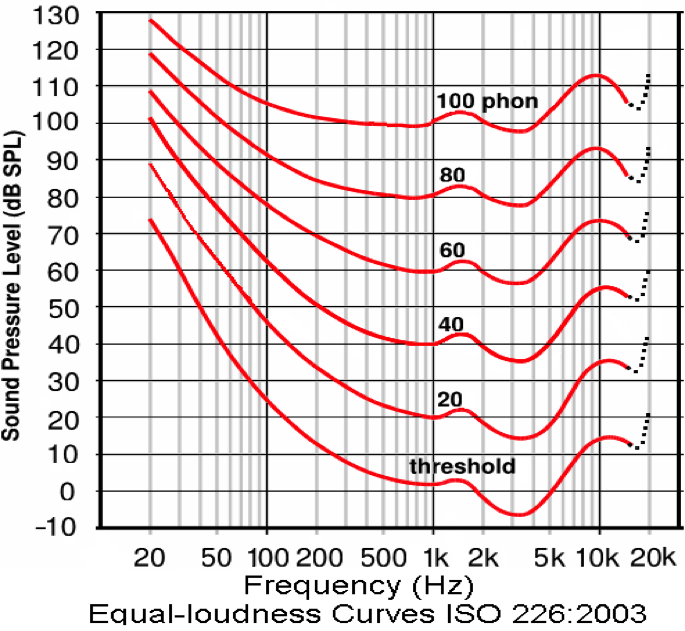
The decibel scale closely mirrors how we perceive loudness. A change of about 1 dB is generally considered the smallest difference the average person can detect under ideal conditions, while a 10 dB increase is perceived as roughly a doubling of loudness.
This alignment with perception makes decibels an intuitive tool for evaluating how occupants will actually experience the acoustic environment of a space.
Comparison to linear scale
A linear scale would require you to work with values spanning from 1 to 1,000,000 just to cover the same pressure range that decibels express as 0 to 120. Calculations involving multiplication and division of large numbers become simple addition and subtraction in the decibel domain. For professionals comparing noise levels across rooms, materials, and design options, this efficiency is significant.
Sound pressure level (SPL)
Sound pressure level (SPL) quantifies the pressure variations in a sound wave relative to a reference pressure. It's the most commonly encountered decibel measurement in architectural acoustics.
Definition and formula
SPL is defined as 20 times the base-10 logarithm of the ratio of the RMS sound pressure to the reference pressure:
where is the sound pressure level in dB, is the root-mean-square sound pressure, and is the reference pressure.
Because the formula uses the ratio of pressures (not squared pressures) with a factor of 20, a doubling of sound pressure corresponds to an increase of approximately 6 dB.
Reference pressure value
- In air: , the approximate threshold of hearing at 1 kHz
- In water: , due to the different impedance and propagation characteristics of water
This distinction matters if you ever compare underwater acoustic data with airborne measurements. The different references mean the dB values are not directly comparable.
Common SPL values
Familiarity with typical SPL values helps you set realistic design targets:
- 20 dB SPL: a quiet room or soft whisper
- 40 dB SPL: a residential living room at night
- 60 dB SPL: normal conversation at 1 meter
- 80 dB SPL: busy street traffic
- 100 dB SPL: a loud concert or motorcycle at close range
- 120 dB SPL: threshold of pain
These benchmarks are essential for designing spaces that provide appropriate acoustic comfort and protect occupants from hearing damage.
Sound power and intensity levels
Beyond SPL, sound power level (SWL) and sound intensity level (SIL) are important for characterizing sound sources and understanding how sound energy propagates through spaces.
Sound power level (SWL)
SWL measures the total acoustic power radiated by a source, independent of distance or environment. This makes it an intrinsic property of the source itself.
where is the sound power in watts and W (1 pW).
Because SWL doesn't change with distance or room conditions, it's the most reliable way to compare different sound sources (e.g., two HVAC units from different manufacturers).
Sound intensity level (SIL)
SIL measures sound power per unit area and accounts for the direction of sound propagation. This makes it useful for determining how much sound energy flows in a specific direction.
where is the sound intensity in W/m² and W/m².
Relationship between SPL, SWL, and SIL
These three quantities are interconnected, and their relationships depend on distance from the source and the acoustic environment:
- SWL stays constant regardless of distance. It's a property of the source.
- SPL decreases by 6 dB for each doubling of distance from a point source in free-field conditions (no reflections). This is the inverse square law in action.
- SIL also decreases with distance and is related to SPL through the characteristic impedance of the medium (for air at standard conditions, SPL and SIL are numerically very close).
Understanding these relationships allows you to predict how sound from a known source will behave at various points in a room or outdoor space.
Decibel addition and subtraction
Combining or comparing sound levels from multiple sources requires special handling because decibels are logarithmic. You can't simply add dB values the way you'd add linear quantities.
Logarithmic addition
To combine two sound levels and :
Step-by-step process:
- Convert each dB value back to a linear power ratio:
- Add the linear values together
- Convert the sum back to decibels:
This formula extends to any number of sources by adding more terms inside the parentheses.
Doubling of sound sources
A practical rule of thumb: doubling the number of identical sources adds 3 dB to the total level. For example, if one machine produces 80 dB SPL, two identical machines running simultaneously produce approximately 83 dB SPL, not 160 dB.
This 3 dB rule is extremely useful for quick estimates when evaluating the cumulative impact of multiple sources in a space.
Decibel subtraction for noise reduction
Decibel subtraction applies when you want to quantify the effect of a noise control measure. If a room has a background noise level of 50 dB SPL and adding sound insulation reduces it to 35 dB SPL, the noise reduction is 15 dB.
Note that this is a straightforward arithmetic subtraction of dB values (50 - 35 = 15 dB), which works because you're expressing a ratio of reduction, not combining independent sources. Don't confuse this with the logarithmic addition process above.
Frequency weighting
Human hearing isn't equally sensitive to all frequencies. Frequency weighting adjusts raw sound level measurements to account for this, producing numbers that better reflect perceived loudness.
A-weighting
A-weighting is the most widely used curve. It approximates the ear's sensitivity at low to moderate sound levels by attenuating low frequencies (below ~500 Hz) and very high frequencies (above ~6 kHz), while giving the most weight to the mid-frequency range (1-4 kHz) where hearing is most sensitive.
A-weighted levels are expressed in dBA and are the standard metric in most noise regulations, environmental assessments, and architectural acoustics specifications.
B and C-weighting
- B-weighting is similar to A-weighting but with less low-frequency attenuation. It was designed for moderate sound levels but is rarely used today.
- C-weighting applies a nearly flat response across most of the audible spectrum, with only slight roll-off at the extremes. C-weighted levels (dBC) are used for assessing high sound levels, peak levels, and low-frequency noise content.
A large difference between dBA and dBC readings at the same location indicates significant low-frequency energy, which can be a useful diagnostic clue.

Unweighted decibels (dB Z)
Unweighted measurements (dB Z, or "Z-weighting") apply no frequency adjustment at all. They capture the true physical sound pressure level across the full spectrum.
In architectural acoustics, dB Z is sometimes used to evaluate low-frequency noise problems (e.g., from HVAC systems or traffic) or to assess sound insulation performance across all frequencies without perceptual bias.
Equivalent continuous sound level (Leq)
Most real-world sound environments fluctuate constantly. Leq provides a single number that represents the average sound energy over a specified time period, making it far more useful than a single snapshot measurement.
Time-averaged sound level
Leq is the constant sound level that would deliver the same total sound energy as the actual fluctuating sound over the measurement period. It accounts for both the intensity and duration of sound events, which is why it's the preferred metric for noise exposure assessment.
Calculation of Leq
where is the instantaneous sound pressure, , and is the averaging time.
In practice, sound level meters handle this calculation automatically. Common averaging intervals include:
- : 1-second intervals, for detailed temporal analysis
- : 1-hour intervals, common in environmental noise surveys
- or day-night variants: used in long-term community noise assessment
Application in noise regulations
Leq is the basis for most noise regulations and design guidelines. Many jurisdictions specify maximum allowable Leq values by land use category (residential, commercial, industrial). In building design, Leq helps you assess whether occupants will experience acceptable noise conditions and whether proposed noise control measures will achieve compliance with relevant standards.
Noise criteria and ratings
Noise criteria and rating systems translate raw acoustic measurements into practical benchmarks for evaluating whether a space meets its intended acoustic performance goals.
Noise Criterion (NC) curves
NC curves are a family of contours that define acceptable background noise levels across octave frequency bands (typically 63 Hz to 8 kHz). To determine the NC rating of a space:
- Measure the noise spectrum in octave bands
- Plot the measured levels against the NC curves
- The NC rating is the highest NC curve that is not exceeded at any frequency band
Common NC targets include NC-25 to NC-30 for classrooms, NC-15 to NC-20 for concert halls, and NC-40 to NC-45 for open-plan offices.
Room Criteria (RC) curves
RC curves serve a similar purpose to NC curves but place greater emphasis on subjective perception. The RC rating includes two components:
- A numerical value representing the overall noise level
- A letter suffix indicating spectral character: N (neutral/balanced), R (rumbly, excess low-frequency energy), or H (hissy, excess high-frequency energy)
This additional information helps identify not just how loud the background noise is, but what it sounds like, which is often more relevant to occupant comfort.
Sound Transmission Class (STC) ratings
STC is a single-number rating for the airborne sound insulation performance of building elements like walls, floors, and doors. It's derived from laboratory measurements of transmission loss across frequency bands (125 Hz to 4 kHz).
- STC 30-35: Normal speech easily understood through the partition
- STC 40-45: Loud speech audible but not easily understood
- STC 50+: Loud speech barely audible; suitable for most noise-sensitive applications
Higher STC values indicate better sound isolation. When specifying partitions, you'll match the required STC to the noise sensitivity of adjacent spaces.
Decibel scale in room acoustics
The decibel scale underpins the measurement and evaluation of nearly every acoustic parameter used in room design.
Reverberation time and sound decay
Reverberation time () is defined as the time required for the SPL to decrease by 60 dB after a sound source stops. It's measured in seconds and is one of the most important parameters in room acoustics.
Sound decay curves plot the decrease in SPL over time after the source cuts off. The slope of this curve relates directly to : a steeper slope means a shorter reverberation time and a "drier" acoustic environment. These curves are always plotted in decibels because the 60 dB decay definition is built into the metric itself.
Speech intelligibility metrics
Clear speech communication is a primary concern in classrooms, lecture halls, conference rooms, and courtrooms. Several key metrics rely on decibel-based calculations:
- Speech Transmission Index (STI): Ranges from 0 to 1, but its underlying calculations depend on signal-to-noise ratios expressed in dB
- Clarity Index (): The ratio of early sound energy (first 50 ms) to late sound energy, expressed in dB. Higher values indicate better speech clarity.
Both metrics account for how background noise and reverberation degrade the speech signal, with the critical ratios measured in decibels.
Background noise levels
Background noise in architectural spaces is measured and expressed using decibel-based metrics like Leq, NC ratings, or RC ratings. Acceptable levels vary widely by space type:
- Recording studios and performance halls require very low background noise (NC-15 or below)
- Offices and classrooms need moderate levels (NC-25 to NC-35)
- Retail and industrial spaces can tolerate higher levels (NC-40+)
The decibel scale makes it straightforward to compare measured background noise against these established standards and to quantify how much noise reduction a design intervention needs to achieve.